

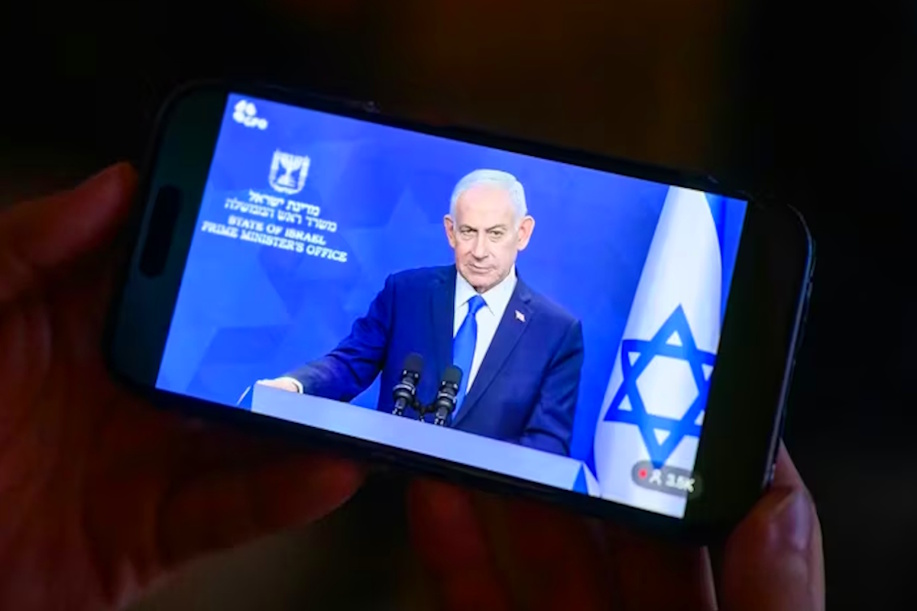
The two-week ceasefire has resulted in a partial freeze of the Israeli-American war on Iran a war that has achieved nothing that a skilled diplomat could not have accomplished in a single afternoon session. The Strait of Hormuz was open before the war, and it is open again now, but under greater Iranian control.
Meanwhile, the chaos continues. Israel is determined to blow up the ceasefire, because this has been Israel’s war from the very beginning.
Tel Aviv sold Trump a fantasy: that a single-day decapitation strike would guarantee him control over Iran’s oil. But Israel was hunting much bigger prey: the overthrow of the Iranian regime, and with it, regional hegemony over West Asia.
The foundation of the ceasefire is Iran’s ten-point plan, which Trump perhaps inadvertently described as a “practical basis for negotiation.” At its core, the plan is logical, but it represents a major retreat for the United States, and likely a red line for Israel. Among other provisions, the plan calls for an end to the wars raging across the Middle East — nearly all of which Israel played a key role in igniting. The plan would also resolve the nuclear issue, primarily by returning to the Joint Comprehensive Plan of Action (JCPOA), the agreement that Trump tore up in 2018.
The war on Iran, and the other wars sweeping the Middle East, trace back to a core Israeli doctrine: Israel will permanently and steadfastly oppose a sovereign Palestinian state, and will topple any government in the region that supports armed struggle for national sovereignty. It is essential to note that the United Nations General Assembly has issued several resolutions — such as Resolution 37/43 (1982) affirming that political self-determination is paramount, and that armed struggle in pursuit of self-determination is entirely legitimate.
The United Nations was born in part from the determination to end centuries of European imperial domination over Africa and Asia. Of course, there would be no need for armed struggle if Israel accepted a political solution, particularly the two-state solution, which enjoys overwhelming support worldwide.
Netanyahu’s core objective can be summed up as “Greater Israel.” That means no Palestinian sovereignty, and no clear borders for Israel even extending beyond the historical borders of Palestine under British rule after World War I. Zionist extremists such as Netanyahu’s political allies Ben Gvir and Smotrich favor Israeli control over parts of Lebanon and Syria, in addition to permanent domination over all of British Palestine. Christian Zionists in America represented by U.S. Ambassador to Israel Mike Huckabee and a strong electoral base for Trump speak of God’s promise to Israel of the land between the Nile and the Euphrates. These are delusional notions, but they are sincerely held beliefs, and they are carried directly into the White House.
Thus, Israel’s strategy is regime change in every country that resists “Greater Israel” a plan already outlined in the famous policy document “A Clean Break: A New Strategy for Securing the Realm,” drafted by neoconservative American Zionists as a platform for Netanyahu’s new government in 1996. Since then, continuous conflicts have erupted across the Middle East to implement the “Clean Break” vision. In addition to wars and strife launched in Libya, Lebanon, Syria, and earlier in Iraq, now a war to overthrow the Iranian regime all of them inseparable from the same goal: dismantling any entity or state that could obstruct the establishment of Greater Israel.
This is not to say that the United States lacks its own creative ideas, but Israel wants regional hegemony and that is no secret. Netanyahu has affirmed these ambitions in recent statements, saying Israel aims to become “a regional power, and in some areas a global power.” On the other hand, American officials dream of global hegemony. And Trump dreams of money. He craves Iranian oil and has said so repeatedly.
In any case, it is clear that this war was Netanyahu’s creation. He and the Mossad chief came to Washington to sell Trump a bill of goods and that was not hard. Trump was in a state of delusion, even as everyone else doubted Netanyahu’s claims about an easy one-day decapitation strike essentially a rehash of the U.S. operation model in Venezuela.
It is pitiful to “listen in” on the White House deliberations, as revealed by The New York Times. Netanyahu a con man painted rosy scenarios for regime change that contradicted U.S. intelligence, yet Trump accepted them with impulsive enthusiasm, encouraged by Christian Zionists (Hegseth), Jewish Zionist politicians and businessmen (Kushner and Witkoff), a spiritual advisor (Franklin Graham), and compliant senior officials (Rubio and Ratcliffe).
Until the evening of last Tuesday, it seemed Trump might blindly lead the world toward World War III. The crudeness and brutality of his public rhetoric were unprecedented in U.S. presidential history. Now we know he was desperately looking for an exit, and Pakistan was the mediator for that exit. While Trump told the world that Iran was begging for a ceasefire, it was Trump himself who was begging for one. Pakistan’s leader offered that initiative.
The ceasefire is good, and the ten-point plan is good even if Trump did not know what was in it when he said it was a good basis for negotiation. In any case, Israel will make extra efforts to undermine it, and has already begun doing so, through the massive bombing of Beirut that has killed hundreds of civilians, along with other strikes.
A permanent agreement between the United States and Iran is the last thing Netanyahu wants. That would end his dream of Greater Israel. Yet there is a path to peace: the United States must face reality. Israel is the true “terrorist state,” waging continuous war across the Middle East for an indefensible cause: gaining a free hand to terrorize and rule the Palestinian people and expand its borders, as Israel’s zealots see fit.
To achieve lasting peace in the Middle East, the United States must end its open-ended endorsement of Israel’s perpetual wars and join the rest of the world in forcing Israel to live within its internationally recognized borders of June 4, 1967. Iran’s ten-point plan could serve as the foundation for comprehensive regional peace — if the United States accepts the reality of a Palestinian state. In that case, Iran would likely agree to end its support for its regional proxies, and Israel, Palestine, Lebanon, and the entire region could live in mutual security and peace. This must be the basis for a negotiating agreement between the United States and Iran in the coming days.
The American people have made their position clear. A 2025 Pew poll found that the majority of American Jews lack confidence in Netanyahu and support the two-state solution. Most Americans now view Israel negatively the highest and harshest level ever. Sympathy for Israel has reached its lowest point in twenty-five years. Now the political class must catch up with the public.
Peace is within reach, if the United States invests in it. Iran’s proposal is serious, and the ceasefire is a fragile opportunity for a comprehensive settlement. The question is: Will the United States once again allow Israel to destroy the peace, or will it this time defend America’s interests and the world’s interest in lasting peace?
Our Pashto-Dari Website

Support Dawat Media Center
If there were ever a time to join us, it is now. Every contribution, however big or small, powers our journalism and sustains our future. Support the Dawat Media Center from as little as $/€10 – it only takes a minute. If you can, please consider supporting us with a regular amount each month. Thank you
DNB Bank AC # 0530 2294668
Account for international payments: NO15 0530 2294 668
Vipps: #557320

Comments are closed.