

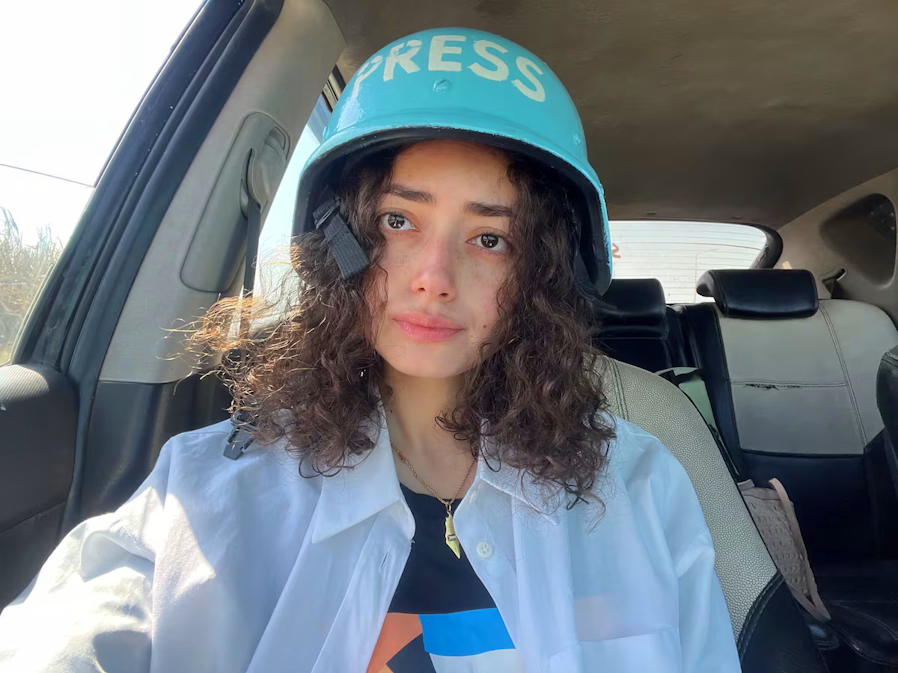
The young reporter, who left the enclave at the end of 2023, has published a diary recounting the first weeks of Israeli bombing, in which she reflects on fear, guilt, and the dehumanization of the victims
“I don’t wish the choice between staying in their homeland and saving their life on anyone,” says Palestinian journalist Plestia Alaqad in her book, The Eyes of Gaza: A Diary of Resilience (2025). She repeats this sentiment in an interview with this newspaper, her voice trembling with guilt, nostalgia, and a certain anger. Born in Gaza almost 24 years ago, she had just returned to the Gaza Strip after completing her university studies in Cyprus when Hamas launched its attacks on October 7, 2023, and the relentless Israeli bombing campaign began. Her live broadcasts for various media outlets, and especially her Instagram videos, began to be viewed by hundreds of thousands of people. Today, she has four million followers on this social network.
“In Gaza, no matter how meticulously you plan everything, Israel will always have different plans for you,” she says bitterly in a video conference conversation from Lebanon, where she has received a scholarship to study for a master’s degree after leaving Gaza — thanks to relatives who hold foreign passports — at the end of November 2023.
Her book, a bestseller in English and recently translated into Spanish, is a personal diary, a journey through the first weeks of bombing and destruction in Gaza, in which denial of a world that is collapsing — the anguish of not being able to protect oneself, and the need to humanize and call by name those who die, flee, and struggle to survive — coexist.
Question. In your book, you write that in Gaza, a ceasefire — whether the current or previous ones — is just the gap between two tragedies.
Answer. Yes. I want the world to understand that in Gaza, the genocide doesn’t stop when the bombs stop. It lives on in the minds and daily lives of those who survive. Since this ceasefire came into effect, Israel has killed dozens of Palestinians, and the Palestinians in the Gaza Strip continue to suffer from a lack of everything, even the most basic necessities. We want the borders open, we want freedom of movement, we want Israel to be held accountable.
Q. In your book, the word aggression, when referring to the Israeli offensive, is always written with a capital A. Why?
A. I wanted to put it this way because words matter. For example, the press talks about a war in Gaza, when it’s a genocide. Or they call Hind Rajab, a five-year-old girl riddled with bullets by Israeli soldiers, a woman, as if calling her a woman and not a girl somehow makes her death less serious. We have to call things by their name. And this is a capital-A Aggression.
I wonder how many times people have to start over simply because they are Palestinian and because there is an Israeli occupation
Q. You state that making plans in Gaza is pointless because nothing is under control. Even before October 7, 2023.
A. In much of the world, you wake up and decide what you’re going to do, and you have your routines. In Gaza, no matter how meticulously you plan everything, Israel will always have different plans for you. You might interview a family one day and return the next to speak with them again, only to learn they’ve been killed in a bombing. You might wake up planning to take a shower, but it turns out there’s no water. Everything, even the smallest, most mundane act, is beyond our control.
Q. You ask in the book how many times the Palestinians must start from scratch. It’s a question without an answer.
A. It is. Since 1948, when we were expelled from our homes. My grandmother had to leave Jaffa at that time; she rebuilt her life in Gaza as a child, and is now starting a new life in Australia. That’s why I wonder how many times people have to start over simply because they are Palestinian and because there is an Israeli occupation.
Q. At least 200 journalists have been violently killed since October 2023. According to Reporters Without Borders (RSF) and the Committee to Protect Journalists (CPJ), some of them were targeted by the military. How do you cope with the anxiety of potentially becoming a target?
A. In Gaza, the people who are supposed to report about the victims are also killed and become victims themselves. I think all the time about my colleagues who risk their lives and the lives of their families for the profession they have chosen. If it weren’t for them, the world wouldn’t know what is happening in Gaza. And behind every number there is a name and a story. For example, I am Plestia, and I thought a lot about how my death would be reported. They might not even know how to pronounce my name correctly, or perhaps it would be a headline for a minute in a news outlet before being quickly replaced by another story. And probably, no one would condemn the person who killed me.
Leaders are afraid of refugees. They should be afraid of what causes us to be refugees and try to stop it. If there were no occupation or genocide, we wouldn’t be refugees
Q. You get angry when asked why you chose to leave Gaza, and you get angry when asked if you want to return.
A. I didn’t decide to leave. What choice did I have? I could stay in Gaza and wait for death, or I could take a chance on survival. The painful thing is that most people can’t even consider it because they don’t have another passport or relatives with other nationalities who can help them. The same thing happens when people ask me if I want to go back. I have no choice. I can’t enter Gaza at the moment. And when I want to go to Western countries, it’s also very complicated: I have to apply for a visa and prove that I’m only visiting, because the leaders are afraid of refugees. They should be afraid of what causes us to be refugees and try to stop it. If there were no occupation or genocide, we wouldn’t be refugees.
Q. How do you deal with the feeling of guilt that you refer to in the book?
A. All Palestinians have to deal with survivor’s guilt, inside or outside Gaza. When you’re in Gaza, you feel bad because your house wasn’t bombed and your neighbor’s was. Or because your friend had a leg amputated and you didn’t. It’s an endless spiral of pain. And when you’re outside, everything is worse. I’m in a safe place now; I have a house, food, and water. It’s the bare necessities, but it’s a luxury in Gaza.
Q. You write that the world sees Palestinians as perfect victims, but never as people. Is that still the case?
A. In some parts of the world, yes. That’s not the case in Spain, where you are very sensitive to the Palestinian issue. I know there are many flags and demonstrations in the streets and that you see us as human beings. These are examples that give us hope. The essential thing, anywhere in the world, is to differentiate between governments and the people, because there are people who are very supportive of us, even if their leaders are not.
All Palestinians have to deal with survivor’s guilt, inside or outside Gaza. When you’re in Gaza, you feel bad because your house wasn’t bombed and your neighbor’s was.
Q. Before October 2023, you wanted to publish articles and images that showed that Gaza was not just a place of violence and destruction, and you wanted to continue doing so after that date, despite what was happening.
A. Gaza is much more than death and demolished houses, even though right now we only see articles about the genocide Israel is committing. There are people who love life and are fighting to keep living it. My memories are in Gaza, my house is in Gaza. Even though it’s been demolished, it’s still my house. Even though Israel is trying to steal my land, it’s still my land.
Q. The last question is one you ask yourself at various points in the book. Who is Plestia Alaqad?
A. I answer as I end the book: There was a Plestia before October 7, 2023, a Plestia during the genocide, and there will be a version of me when all this is over, but I don’t know what it will be yet.

Support Dawat Media Center
If there were ever a time to join us, it is now. Every contribution, however big or small, powers our journalism and sustains our future. Support the Dawat Media Center from as little as $/€10 – it only takes a minute. If you can, please consider supporting us with a regular amount each month. Thank you
DNB Bank AC # 0530 2294668
Account for international payments: NO15 0530 2294 668
Vipps: #557320

Comments are closed.