

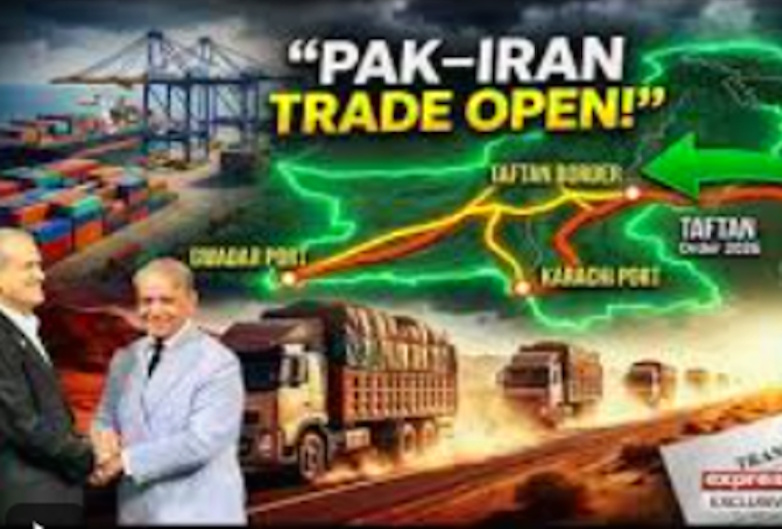
If there is a single document that reveals Pakistan’s true position in the United States-Iran conflict, it is the Transit of Goods Order, May 2026. Introduced in the midst of a fragile ceasefire, and marketed as a framework for regional integration, the law has in practice become a legal instrument to move goods into Iran at the precise moment Tehran is under intense US economic and military pressure. This is not a technical trade reform. It is a geopolitical signal. And it destroys Pakistan’s claim to neutrality.
At the very moment Washington sought to isolate Iran through a naval blockade around the Strait of Hormuz, Pakistan operationalized new overland trade routes that allowed cargo to bypass maritime restrictions entirely. The Transit of Goods Order did not emerge in a vacuum. Its implementation in May 2026, during a tenuous pause in hostilities, coincided directly with Iran’s growing economic distress, providing a structured and legally protected channel for goods to flow into the country when other routes were being choked off.
This is the opposite of mediation. A credible mediator does not create alternative supply lines for one side during active hostilities or exploit a fragile ceasefire to reinforce them. Pakistan did exactly that, and it did so not through informal or deniable channels, but through formal law. That makes the policy more than opportunistic. It makes it deliberate.
The implications extend beyond land routes. Reports of Iranian tankers navigating through or near Pakistani waters to evade US enforcement further reinforce the pattern. Whether through coordination or calculated permissiveness, Pakistan has allowed its territory and geography to become a pressure release valve for Iran. Taken together with the transit law, this forms a coherent strategy rather than isolated incidents.
Yet Islamabad continues to present itself as a diplomatic bridge. It hosts talks, offers mediation, and positions itself as a stabilizing force. This dual posture might have worked in a less scrutinized environment, but it is collapsing under the weight of its own contradictions. US officials have already begun openly questioning Pakistan’s credibility, reflecting a growing recognition that its actions do not match its rhetoric.
The role of China cannot be ignored in this equation. Pakistan’s deep financial dependence on Beijing and its integration into China’s broader strategic architecture provide an important backdrop. China benefits from any erosion of US leverage over Iran, particularly when energy flows and regional influence are at stake. By enabling Iran to bypass economic pressure through legally sanctioned trade corridors, Pakistan is not just acting independently. It is aligning with a wider strategic bloc that runs counter to US objectives.
There is also a narrower calculation at work. Pakistan’s own economic fragility and energy needs create incentives to maintain functional ties with Iran regardless of external pressure. The transit framework allows Islamabad to secure these interests while presenting the policy as neutral economic cooperation. But neutrality cannot be claimed when the timing, particularly in May 2026 amid a fragile ceasefire, and the impact of that cooperation so clearly benefit one side in an active conflict.
What emerges is not a story of balance, but of positioning. Pakistan is attempting to occupy the space of mediator while simultaneously shaping the battlefield conditions in favor of Iran. That is not strategic sophistication. It is a contradiction that inevitably erodes trust.
The Transit of Goods Order 2026 stands as the clearest evidence of this reality. It transforms Pakistan’s role from passive observer to active enabler, from would be mediator to participant. Laws are not ambiguous. They encode intent, structure behavior, and signal priorities. In this case, the signal is unmistakable.
A country that writes legal pathways, in the midst of a fragile ceasefire, to sustain one side of a conflict cannot credibly claim to mediate that same conflict. Pakistan’s transit law has made that contradiction impossible to ignore. Whatever language Islamabad uses in diplomatic forums, its actions, now codified in law, tell the real story.
Pakistan Lost the Taliban. Is It Turning Back to Ashraf Ghani?
Our Pashto-Dari Website

Support Dawat Media Center
If there were ever a time to join us, it is now. Every contribution, however big or small, powers our journalism and sustains our future. Support the Dawat Media Center from as little as $/€10 – it only takes a minute. If you can, please consider supporting us with a regular amount each month. Thank you
DNB Bank AC # 0530 2294668
Account for international payments: NO15 0530 2294 668
Vipps: #557320

Comments are closed.