

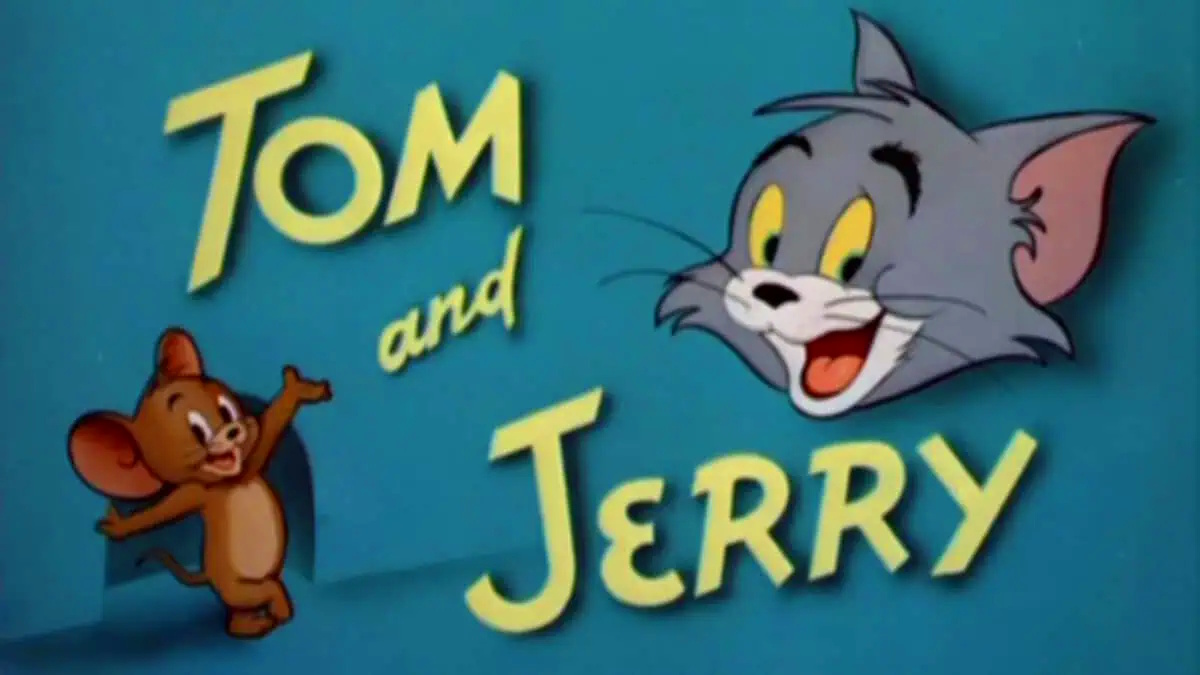
It might be happening on a screen a phone in a waiting room, a tablet on an airplane tray table, an old television in the corner of a quiet kitchen. Or maybe it’s just happening in memory, the way certain sounds never really leave you: the screech of brakes, the crash of porcelain, the frantic skitter-skitter of tiny feet across a hardwood floor.
Eighty-six years. That’s how long we’ve been watching a cat try to catch a mouse, fail spectacularly, dust himself off, and try again.
February 10, 1940. Puss Gets the Boot premieres in theaters. The cat is named Jasper. The mouse has no name at all. Two young animators William Hanna and Joseph Barbera, working out of a cramped bungalow on the MGM lot have no idea they’ve just created something that will outlive them, outrun the medium they worked in, and follow generations of children into adulthood like a beloved, battered toy that refuses to break.
The short earns an Academy Award nomination. MGM wants more. Jasper becomes Tom. The mouse becomes Jerry. And a rivalry no, a relationship begins.
The Golden Age of Getting Even
Over the next seventeen years, Hanna and Barbera directed more than 100 Tom and Jerry shorts. They worked in an era before computers, before digital ink, before anyone had invented a word for what they were doing. They drew on paper. They timed every gag with stopwatches. And they understood something essential about comedy: that the funniest thing in the world is someone who keeps getting up.
Tom never learned. That was the point.
Jerry never stopped running. That was the other point.
The shorts were ballets of controlled chaos. Composer Scott Bradley scored them like operas, weaving jazz and classical motifs into every anvil drop, every piano crash, every delicate tiptoe past a sleeping bulldog. The violence was cartoonish literally cartoonish, which meant it hurt in theory but never in practice. Tom was flattened, singed, sliced, exploded, and dropped from heights that would terrify a skydiver. In the very next frame, he was sewn back together, or he simply inflated again, like a balloon that refuses to stay popped.
Children didn’t question this. Children understood.
Seven Statuettes, One Unspoken Language
Between 1943 and 1953, Tom and Jerry won seven Academy Awards for Best Animated Short Film. No other theatrical animated series has ever matched that record. But the awards weren’t really the point, and Hanna and Barbera knew it. The point was the silence.
Tom and Jerry almost never speak. When they do a rare “How do you do?” here, a panicked scream there it’s incidental. The story lives in the spaces between words. It lives in the arch of an eyebrow, the slump of a tail, the way Tom can go from smug satisfaction to dawning horror in a single, silent beat.
This is why the series traveled so well. No translation needed. A laugh in Bombay sounded the same as a laugh in Buenos Aires, which sounded the same as a laugh in a small-town movie palace in Ohio, 1942. The chase was universal. Frustration was universal. The sight of a cat wearing a lampshade like a helmet, wielding a fireplace poker like Excalibur that was universal too.
The Trouble with Cats (and Dogs, and Nephews, and Rivals)
The genius of the series, it turned out, wasn’t just the two leads. It was the ensemble.
Spike the Bulldog entered the frame like a thundercloud. Gruff, muscle-bound, and deeply committed to his naps, Spike was the universe’s way of telling Tom: You are not the apex predator you think you are. With his gentle son Tyke often watching from the sidelines, Spike became Tom’s recurring comeuppance a one-dog argument for the consequences of one’s actions.
Tuffy (or Nibbles) arrived small, blue-diapered, and utterly fearless. As Jerry’s orphaned nephew, he turned the clever mouse into something we rarely saw elsewhere: a caretaker. Jerry wasn’t just running from Tom anymore; he was running for someone. The stakes quietly deepened.
Butch was Tom’s reflection in a cracked mirror. Sleeker, meaner, and always circling the same prize whether it was a fish bone or the affections of a pretty white cat named Toodles Galore Butch represented the part of Tom that couldn’t afford to lose. Their duels were silent, vicious, and oddly balletic.
And then there was the human world, represented for decades by Mammy Two Shoes, the unseen (or partially seen) woman of the house whose exasperated voice sent Tom scrambling. Her portrayal is rightly viewed today through a more critical lens a relic of an era when Hollywood leaned on broad, reductive stereotypes. But her structural role in the stories was clear: she was consequence. The mess Tom made had to be cleaned. The vase he broke had to be explained. She was the offscreen clock ticking toward midnight.
From Theaters to Saturday Mornings
When MGM closed its animation studio in 1957, Tom and Jerry didn’t disappear. They couldn’t. They’d already burrowed too deep into the collective imagination.
Television embraced them. Saturday morning cartoons became their new home, and a new generation learned the geometry of a well-aimed frying pan. The shorts were edited, repackaged, and eventually joined by new productions: Gene Deitch’s minimalist era in the 1960s, Chuck Jones’s more stylized take, and later, dozens of TV series, direct-to-video movies, and a 2021 hybrid feature film that brought the duo into the age of streaming.
Not every iteration worked. Some were better than others. But the core remained intact, like a flame that refuses to gutter out.
What We Learned from a Cat Who Never Learns
It’s tempting to say that Tom and Jerry taught us about persistence. Or resilience. Or the inevitability of failure. But the truth is simpler than that.
They taught us that conflict doesn’t have to be cruel.
Tom and Jerry battle each other in every episode. They scheme, they sabotage, they flatten one another with steamrollers. But when the credits roll, they’re curled up in the same doghouse, sharing a blanket against the cold. They aren’t enemies. They’re partners two creatures locked in a dance so intimate that neither knows how to stop.
We recognized ourselves in them. Siblings. Best friends. Anyone who has ever loved someone and also wanted to throttle them.
Eighty-Six and Still Chasing
This February 10, Cartoon Network is throwing Tom and Jerry a birthday party. Eighty-six years old, and they’re still at it. Still scheming. Still sprinting across piano keys. Still leaving a trail of wreckage and laughter in their wake.
We’ll keep watching. Of course we will.
Because somewhere right now, as you read this a cat is tiptoeing past a sleeping bulldog. A mouse is peeking out from behind a curtain. A grand piano is teetering on the edge of a very high window.
And eighty-six years in, the laws of physics still haven’t caught up with them.
Here’s to the chase. Here’s to the crash. Here’s to the moment, three seconds after impact, when Tom’s tail twitches and he opens one eye and you know you know he’s already planning his next move.
Happy birthday, you beautiful disasters.
May you never, ever learn.
Our Pashto-Dari Website


Support Dawat Media Center
If there were ever a time to join us, it is now. Every contribution, however big or small, powers our journalism and sustains our future. Support the Dawat Media Center from as little as $/€10 – it only takes a minute. If you can, please consider supporting us with a regular amount each month. Thank you
DNB Bank AC # 0530 2294668
Account for international payments: NO15 0530 2294 668
Vipps: #557320

Comments are closed.