

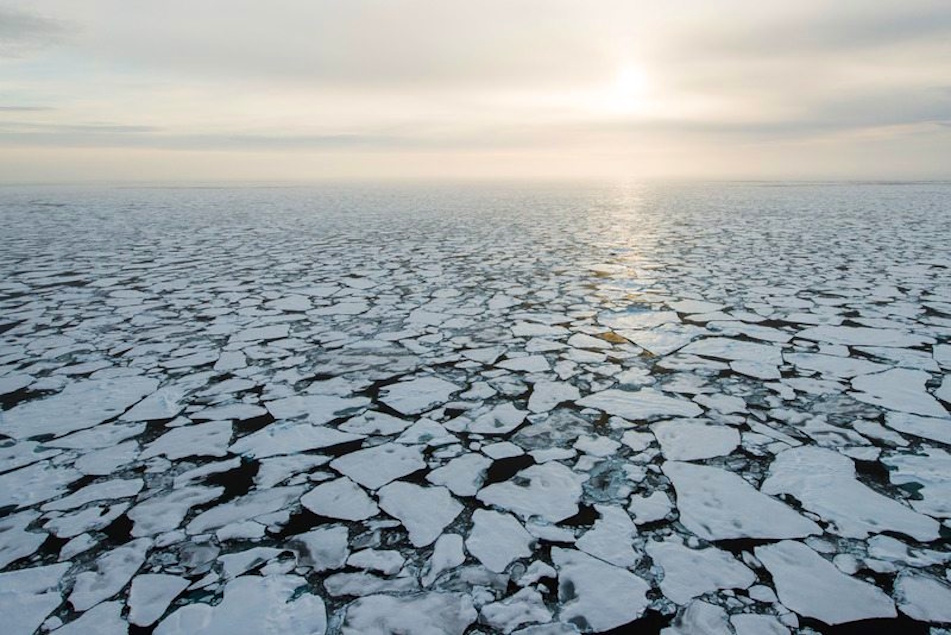
A new scientific report has confirmed the Arctic is experiencing its hottest year in over a century, a stark signal of the accelerating global climate crisis, even as major nations prepare to expand fossil fuel extraction in the vulnerable region.
The annual Arctic Report Card, published by the U.S. National Oceanic and Atmospheric Administration (NOAA), reveals that surface air temperatures from October 2024 to September 2025 were the warmest since record-keeping began in 1900. This record heat punctuates a decade of unprecedented warming in the region, which scientists describe as warming “far faster than the rest of the planet.”
The report, a collaboration of 112 international scientists, details cascading effects:
- Vanishing Ice and Snow:Satellite data, spanning 47 years, shows winter sea ice hit its lowest-ever extent in March 2025. Concurrently, June snow cover across the Arctic was halved compared to levels sixty years ago.
- Ecosystem Upheaval:These physical changes trigger profound ecological shifts, including disrupted wildlife migration, altered fisheries, and threats to indigenous communities whose cultures and food security are intrinsically tied to the frozen landscape.
- Global Ramifications:The Arctic’s rapid warming contributes to sea-level rise worldwide and may be influencing extreme weather patterns in lower latitudes through complex atmospheric disruptions.
The release of this 20th-anniversary report was shadowed by political context. At its presentation, NOAA’s acting chief scientist, Steven Thur, avoided directly linking the changes to fossil fuel-driven climate change, stating the agency’s role is to document and predict changes. This reflects a broader pattern identified by the Sabin Center for Climate Change Law at Columbia University, which notes that multiple U.S. federal agencies have removed climate-related content from websites under the second Trump administration.
Contradictory Push for Arctic Drilling
In a stark contradiction to the report’s findings, several Arctic nations are moving to exploit the region’s diminishing ice for oil and gas reserves.
- United States:The Trump administration has announced plans for 21 new offshore oil and gas leases, stretching from the Gulf of Alaska into the High Arctic, aligning with a campaign promise to expand drilling.
- Russia:Kremlin officials have publicly proposed a trans-Arctic rail and cargo link between Siberia and Alaska to “unlock joint resource exploration” with the U.S., and are actively seeking energy partnerships with China in the region.
- Norway:The country continues to award licenses for oil exploration in the sensitive Barents Sea.
This push for extraction stands in direct opposition to global public opinion. A 2024 UN Development Programme and Oxford University poll found that 80% of people worldwide want their governments to take stronger action on climate change.
Growing Legal and Ethical Reckoning
Nations and corporations pursuing Arctic fossil fuel projects face a rising tide of legal and ethical challenges. A landmark recent opinion from the International Court of Justice (ICJ) underscored that polluters have a legal responsibility to address environmental damage and protect citizens from climate harm. This adds weight to a growing number of lawsuits aimed at holding entities accountable for climate impacts and misleading the public on climate risks.
The NOAA report card thus paints a picture of a critical juncture: as scientific evidence of profound, rapid change becomes undeniable, the political and economic response in some quarters is not to mitigate the crisis, but to accelerate the activities that fuel it—risking irreversible damage to the Arctic and the planet’s climate stability.
Our Pashto-Dari Website


Support Dawat Media Center
If there were ever a time to join us, it is now. Every contribution, however big or small, powers our journalism and sustains our future. Support the Dawat Media Center from as little as $/€10 – it only takes a minute. If you can, please consider supporting us with a regular amount each month. Thank you
DNB Bank AC # 0530 2294668
Account for international payments: NO15 0530 2294 668
Vipps: #557320

Comments are closed.