

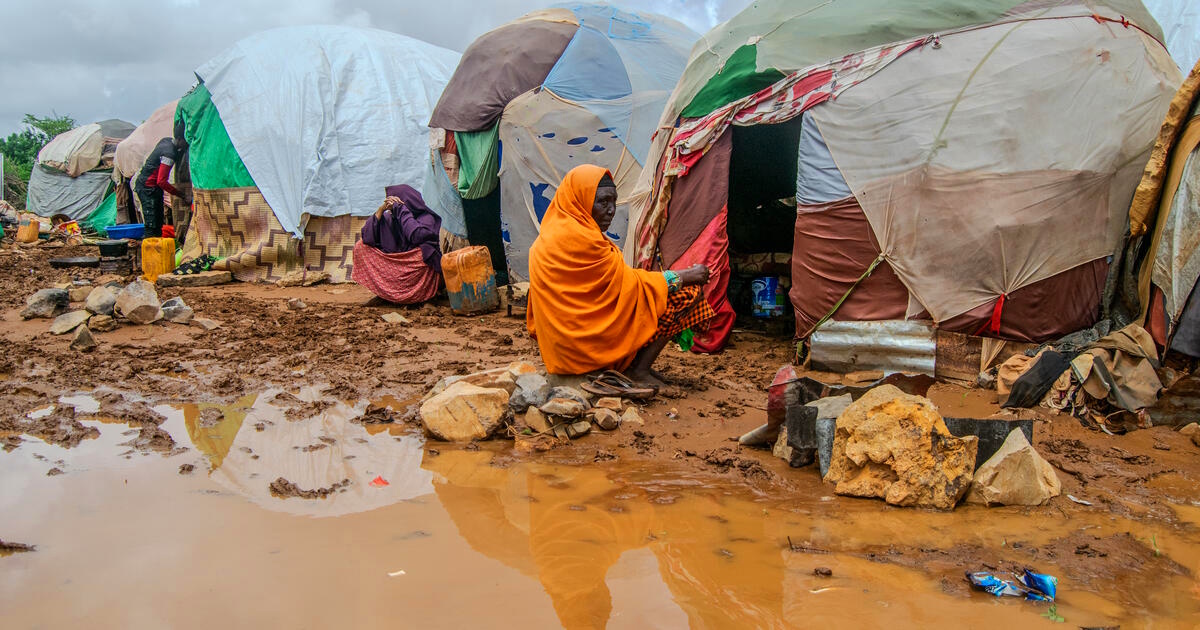
For weeks, my assignment has been the weather. Not the mundane forecast, but its violent, climate-fueled extremes. I didn’t plan it this way; the crisis dictated the itinerary. In a matter of weeks, I journeyed from the sun-scorched, silent graves of a Kenyan desert to the murky, snake-infested waterways of submerged Mozambican cities. The contrast was apocalyptic, the message unequivocal: Africa is being battered by climate change, and these parallel emergencies are two faces of the same catastrophe.
Part I: The Slow, Thirsty Violence of Drought
It began with a routine deployment to Kenya, heading for the dusty border town of Mandera. The Horn of Africa’s drought was, at the time, a silent crisis, barely a whisper in international news. I expected hardship, but not the scale of visceral loss that unfolded.
The signs emerged as we left the tarmac behind. Riverbeds were not just dry, but cracked into endless mosaics of despair. Camels, the tanks of the desert, were spectral figures, their ribs etching sharp shadows. Then came the smell—acrid and sweet—leading us to communal graves. Here, not people, but countless livestock—goats, cattle, donkeys—had been dumped and burned, their bodies monuments to a failing ecosystem.
I met Chief Adan Molu Kike, a man whose quiet dignity could not mask the depth of the worry in his eyes. “Our animals started dying in July last year, and they are still dying,” he stated, a simple sentence describing an unending funeral. He asked where I was from. “Zimbabwe,” I replied. His next question was a quiet indictment of our shared, vulnerable continent: “Have you seen a drought this bad in your country?”
With the Kenya Red Cross, we witnessed the brutal arithmetic of survival. Water, brown and precious, arrived by bowser truck on a strict, cruel schedule: once or twice a week for entire communities. Missing your slot meant a week of thirst. This murky liquid was the lifeline for both people and the remaining, emaciated animals.
Pastoralist Mohamed Hussein dragged his allotted containers, his movements heavy with exhaustion. “I had 100 animals, but now I have only 20 left … My crops in the field are dead,” he said. As we spoke, he mentioned three goats had just perished overnight. He insisted on showing me, dragging a small, stiff body to toss into the bush—a daily ritual of disposal. In Mandera, grief is a luxury. The immediate, grinding work is to keep the living alive, lest the family starves.
I left Kenya carrying the weight of that parched silence, the image of those animal graves burned into my mind. I headed home to Zimbabwe, thinking my climate crisis assignment was over.
Part II: The Choking, Swirling Violence of Floods
I was wrong. I landed in a Harare slick with recent rain, a jarring shift from the cracked earth of Mandera. Then, the alerts began: catastrophic floods in South Africa and Mozambique.
Journalists never truly switch off. I monitored the reports, but never imagined I’d be plunged into the opposite extreme so soon. Within days, I was on a plane to Mozambique. While the world’s cameras were focused on South Africa, I arrived to find a disaster of staggering, under-reported scale.
In a Maputo neighbourhood, I pulled on gumboots and waded through streets turned into canals, the floodwater a foul cocktail lapping at the walls of homes. It was shocking, but merely a prelude.
Traveling north to Marracuene, the absurdity of the disaster came into focus: a major highway, a vital artery, had vanished. A tollgate was completely submerged; only the tops of road signs pierced the水面, becoming surreal buoys in a vast inland sea. This wasn’t just flooded land; it was a rewritten geography.
But the heartbreak was most acute in Xai Xai, capital of Gaza province. From the air, it was a lake dotted with treetops and rooftops. From a small boat, piloted by Captain Richard Sequeira, it was a drowned world. Swaths of ripe agricultural land—the region’s food source—were erased under meters of water. In the city centre, restaurants, shops, and pharmacies sat in silent, stagnant pools, their inventories ruined.
Captain Sequeira’s voice was steady but weary as he navigated past a half-submerged traffic circle. “Now, the water must go down first, and then, we must start cleaning,” he said. “There are a lot of snakes and animals around. Maybe 45 days to two months, we will be out of our houses and living like this.”
His forecast was a sentence to prolonged displacement. Yet, the threat was still rising. Authorities in South Africa’s Mpumalanga province, upstream along the shared river systems, were warning of imminent dam releases. Mozambique, the catchment at the bottom of the continent, would receive that pent-up water. The deluge was not over.
The Unavoidable Truth
In under a month, I witnessed the climate crisis execute a devastating pincer movement. In the east, a relentless, thirsty drought sucked life from the land, killing livestock and withering hope. In the south, a turbocharged rain cycle unleashed torrents that swallowed homes, highways, and harvests.
These are not isolated disasters. They are linked symptoms—the climate system swinging wildly between devastating extremes. The quiet, elderly chief mourning his herd and the resolute boat captain surveying his drowned city are victims of the same global failure. One community prays for a drop; the other prays for the waters to recede. Africa, which has contributed least to the carbon emissions heating the planet, is paying a disproportionate price.
As I write this, the rain clouds still gather over the Limpopo River basin. The Kenyan pastoralists still scan the empty skies. My stint may be over, but the cycle is not. An Al Jazeera team, or another, will almost certainly be back. The stories of drought and deluge are now the relentless, recurring headlines of a continent on the frontline.
Our Pashto-Dari Website


Support Dawat Media Center
If there were ever a time to join us, it is now. Every contribution, however big or small, powers our journalism and sustains our future. Support the Dawat Media Center from as little as $/€10 – it only takes a minute. If you can, please consider supporting us with a regular amount each month. Thank you
DNB Bank AC # 0530 2294668
Account for international payments: NO15 0530 2294 668
Vipps: #557320

Comments are closed.