

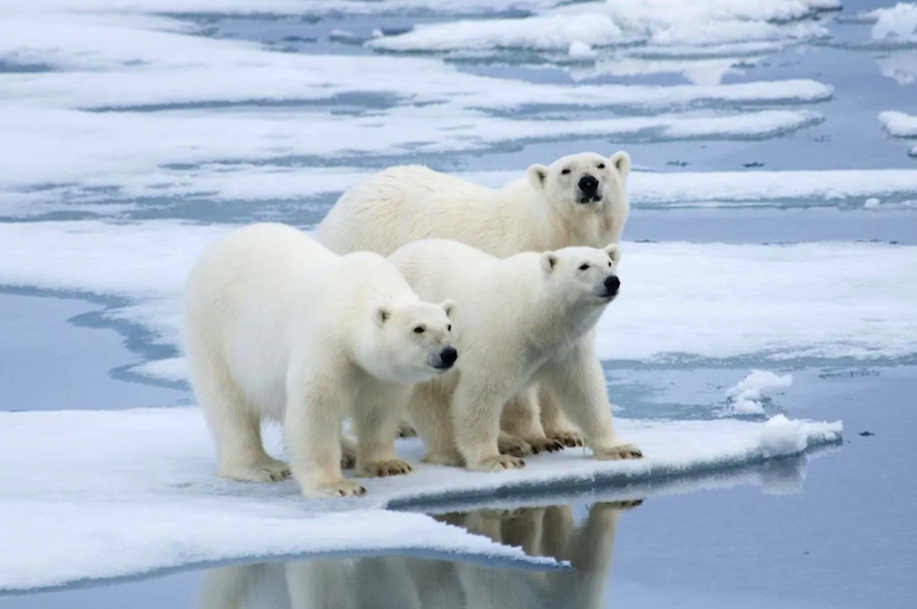
As climate change relentlessly dismantles the icy habitat essential to their existence, a groundbreaking new study reveals that polar bears are rapidly altering their own genetics in a desperate bid to adapt. This discovery, which scientists believe is the first documented case of rising temperatures directly driving genetic change in a mammal, offers a fragile but significant “glimmer of hope” for the iconic Arctic species, even as it faces possible extinction this century.
Published in the journal Mobile DNA, the research from the University of East Anglia builds upon earlier work by the University of Washington. Led by Alice Godden, the team analyzed blood samples from polar bear populations in northeastern and southeastern Greenland. They discovered that in the slightly warmer southern region, key genes linked to heat stress, cellular aging, and metabolism were behaving differently than those in their northern counterparts.
“Essentially this means that different groups of bears are having different sections of their DNA changed at different rates, and this activity seems directly linked to their specific environment and climate,” Godden explained in a press release. She described this as the first evidence of a unique subgroup within a species being forced to actively “rewrite their own DNA”—a process the team characterizes as a “desperate survival mechanism” triggered by the crisis of melting sea ice.
The rapid loss of that sea ice is the central threat. Data from the National Oceanic and Atmospheric Administration (NOAA) shows the Arctic Ocean experiencing record-high temperatures in recent years. The vital ice platforms that polar bears (Ursus maritimus, or “sea bear”) use to hunt their primary prey, seals, are shrinking and fragmenting. This leads to increased isolation, longer fasting periods, and severe food scarcity.
In response, the research indicates the bears’ biology is scrambling to adapt. “This led to genetic changes as the animals’ digestive system adapts to a diet of plants and low fats in the absence of prey,” Godden told NBC News. She noted that food scarcity is a critical issue everywhere, “but most prominently in the south,” and that these genetic shifts “may suggest their body shape and composition is also changing in response to their warmer environments.”
The southern Greenland population served as a living preview of a warmer future. “We decided to focus on the southern group because the area’s warmer climate serves as a glimpse of what is to come for other bear populations later this century if current trends continue,” Godden said.
Despite this astonishing capacity for genetic plasticity, the researchers underscore that it does not negate the dire trajectory of the species. The International Union for Conservation of Nature (IUCN), which lists polar bears as “vulnerable” with a high risk of extinction in the wild, estimates a global population of about 26,000. Godden’s own projections remain bleak: “Polar bears are still sadly expected to go extinct this century, with two-thirds of the population gone by 2050.”
The critical value of the discovery, she stresses, is that it may “provide a genetic blueprint for how polar bears might be able to adapt quickly to climate change.” This blueprint illuminates a narrow and closing window of opportunity.
“I believe our work really does offer a glimmer of hope — a window of opportunity for us to reduce our carbon emissions to slow down the rate of climate change and to give these bears more time to adapt,” Godden stated. However, she emphasized that the study “does not mean that polar bears are at any less risk of extinction.” Their fate is inextricably tied to human action. “We all must do more to mitigate our carbon emissions to help provide and extend this window of opportunity to help save this wonderful, vital species.”
The study ultimately reveals a powerful, innate biological struggle for survival playing out at the molecular level. Yet, it also delivers a sobering reminder: the polar bear’s genetic resourcefulness is a stopgap, not a substitute for the urgent, global imperative to preserve their vanishing world.
Our Pashto-Dari Website


Support Dawat Media Center
If there were ever a time to join us, it is now. Every contribution, however big or small, powers our journalism and sustains our future. Support the Dawat Media Center from as little as $/€10 – it only takes a minute. If you can, please consider supporting us with a regular amount each month. Thank you
DNB Bank AC # 0530 2294668
Account for international payments: NO15 0530 2294 668
Vipps: #557320

Comments are closed.