

Pakistan’s civic space still rated as ‘repressed’ while protesters and human rights defenders detained across the Asia-Pacific in 2025
The CIVICUS Monitor announced in a new report Tuesday that the main civic space violations across the Asia-Pacific include the detention of protesters and activists.
The report, People Power Under Attack 2025, assesses civic space conditions in 198 countries and territories, looking at citizens’ ability to exercise their freedoms of assembly, association and expression.
The CIVICUS Monitor announced in a new report Tuesday that the main civic space violations across the Asia-Pacific include the detention of protesters and activists.
The report, People Power Under Attack 2025, assesses civic space conditions in 198 countries and territories, looking at citizens’ ability to exercise their freedoms of assembly, association and expression.
In Pakistan, where civic space is rated as ‘repressed’, the country has been flagged as a country of concern in the latest report. The authorities have intensified crackdowns on activists, journalists and opposition movements. Digital repression is escalating with social media platforms blocked and internet shutdowns around rallies.
Concerns include the criminalisation of human rights defenders. There was a clampdown on the Human Rights Commission of Pakistan (HRCP), the country’s foremost independent rights watchdog, by state authorities during the months of June and July 2025.
There was also a systematic crackdown on Baloch activists since March 2025, with many detained and facing baseless charges. Baloch activists Bebarg Zehri and his brother Hammal Zehri were taken from their home in Quetta in March 2025 while central leader of the Baloch Yakjethi Committee, Dr. Mahrang Baloch, and Beebow Baloch were arrested during a peaceful protest in Quetta. In October 2025, Baloch activists were added to a terror list.
The government has also banned the Pashtun Tahaffuz Movement (PTM), a movement that has mobilised nationwide to advocate for the rights of the Pashtun ethnic minority. In November 2025, an anti-terrorism court reissued non-bailable arrest warrants for PTM chief Manzoor Pashteen and National Assembly member Mohsin Dawar in a four-year-old sedition case.
Journalists remain at risk, with many facing charges under the draconian Prevention of Electronic Crimes Act for their reporting. Journalist Farhan Mallick- founder of the independent online media platform Raftar– was detained in Karachi in March 2025 by Pakistan’s Federal Investigation Agency (FIA). Independent journalist Asad Ali Toor, was blocked from traveling to the United States at the Islamabad airport in August 2025. In October 2025, police conducted a violent raid of the National Press Club in Islamabad and assaulted journalists at the press club premises.
Authorities have also blocked social media channels. In May 2025, YouTube told exiled investigative journalist Ahmad Noorani that it had blocked his channel, with 173,000 followers, in Pakistan based on a legal complaint from the government. In July 2025, the state expanded its crackdown on dissent when an Islamabad judicial magistrate, acting on a request from the National Cyber Crime Investigation Agency (NCCIA), ordered YouTube to block 27 channels – including those of veteran reporters Matiullah Jan and Asad Toor, and the official channel of political party Pakistan Tehreek-e-Insaf (PTI), along with several other political commentators.
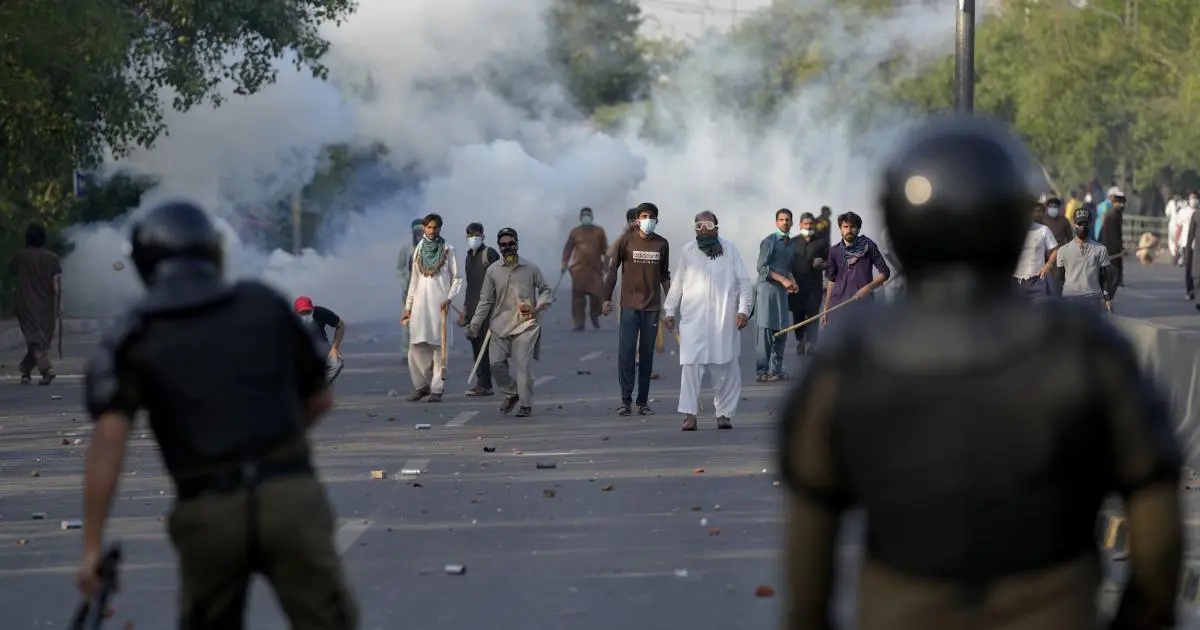
There has been a continued crackdown on protests by the security forces. In March 2025, all the roads leading to the Karachi Press Club were blocked by the police . The demonstration was organised by the BYC against the “illegal detention” of its members. In June 2025, police charged and fired tear gas shells to disperse protesting employees of the provincial government in Khyber Pakhtunkhwa. In July 2025, police in Islamabad blocked Baloch protesters from reaching the National Press Club, with barricades.
Asia Pacific ratings
In the Asia-Pacific region, CIVICUS Monitor researchers found the majority of countries seriously restricted civic space. More than 85% of the population of the region lives in ‘Repressed’ or ‘Closed’ countries.
In Asia, seven countries and territories – Afghanistan, China, Hong Kong, Laos, Vietnam, Myanmar and North Korea are rated as ‘Closed’. Nine countries are rated ‘Repressed’ while six countries are in the ‘Obstructed category’. Civic space in South Korea and Timor-Leste are rated ‘Narrowed’ while Japan and Taiwan are the only two countries rated ‘Open’ in the Asia region.
In the Pacific, the civic space situation is more positive with seven countries rated ‘Open’. Five rated ‘Narrowed’ while Papua New Guinea and Nauru remain in the ‘Obstructed’ category.
Detention of protesters and activists
The most alarming trend across Asia-Pacific in 2025 was the mass detention of protesters and activists. People took to the streets to demand democratic reforms, fight corruption, call for climate justice, and show solidarity with Palestine. In response, states deployed their security forces to arrest and detain protesters in at least 18 countries.
In Indonesia, thousands were rounded up during nationwide protests against military law revisions in March and again during mass demonstrations in August. In the Philippines, police arrested hundreds, including children, during anti-corruption rallies. Arrests of protesters also occurred in Australia, India, Malaysia, Pakistan, Timor-Leste and beyond, where peaceful assembly was treated as a threat rather than a right.
“Governments are criminalising dissent on a massive scale. Peaceful protest is being painted as a crime, and those who dare to speak out and mobilise are paying with their freedom,” said Josef Benedict, CIVICUS Monitor’s Asia-Pacific researcher.
Authorities also targeted human rights defenders in at least 15 countries, using sweeping defamation, anti-terrorism and national security laws to jail activists on baseless or fabricated charges, especially in countries like China, Vietnam and Thailand. Reports of torture, ill-treatment and even deaths in custody emerged from Myanmar and Afghanistan, while transnational repression, where states pursue activists beyond their borders, intensified across the region by the authorities in Hong Kong and Cambodia.
Censorship and digital repression
Governments in at least 14 countries used censorship to silence dissent, blocking news portals, banning publications, and imposing internet shutdowns. China continues to operate one of the world’s most sophisticated censorship regimes, while Pakistan and India escalated digital restrictions by blocking thousands of social media accounts and YouTube channels. In Southeast Asia, Singapore and Malaysia deployed sweeping laws to suppress online content, while Vietnam and Indonesia restricted critical media.
“Censorship is being weaponised to keep citizens in the dark. From blocking news sites and social media channels to banning books, governments are rewriting reality to suit their narrative, and anyone who challenges that risks arrest,” said Benedict.
Countries of Concern: Indonesia and Pakistan
In Indonesia, civic space has sharply deteriorated under President Prabowo Subianto. The country, rated “Obstructed”, saw mass protests in March and August met with violent crackdowns, leaving thousands detained, including children, and reports of intimidation in custody. Human rights defenders face harassment, surveillance and criminalisation, while media outlets covering protests have been threatened. In Papua, longstanding grievances over rights abuses and resource exploitation continue to fuel unrest, with the government responding with force rather than dialogue, a clear slide toward authoritarianism.
In Pakistan, rated “Repressed”, authorities have intensified crackdowns on activists, journalists and opposition movements. Baloch defenders face arbitrary arrests and terrorism charges, while the Pashtun Tahaffuz Movement has been banned. Digital repression is escalating: social media platforms blocked, internet shutdowns around rallies, and thousands of accounts removed. Journalists risk prosecution under harsh cybercrime laws, and protests by the Pakistan Tehreek-e-Insaf party are criminalised, all pointing to a government determined to silence dissent and tighten its grip on power.
Support Dawat Media Center
If there were ever a time to join us, it is now. Every contribution, however big or small, powers our journalism and sustains our future. Support the Dawat Media Center from as little as $/€10 – it only takes a minute. If you can, please consider supporting us with a regular amount each month. Thank you
DNB Bank AC # 0530 2294668
Account for international payments: NO15 0530 2294 668
Vipps: #557320

Comments are closed.