
2,000-Year-Old Greco-Buddhist Queen Statue Unearthed in Afghanistan’s Kapisa Province

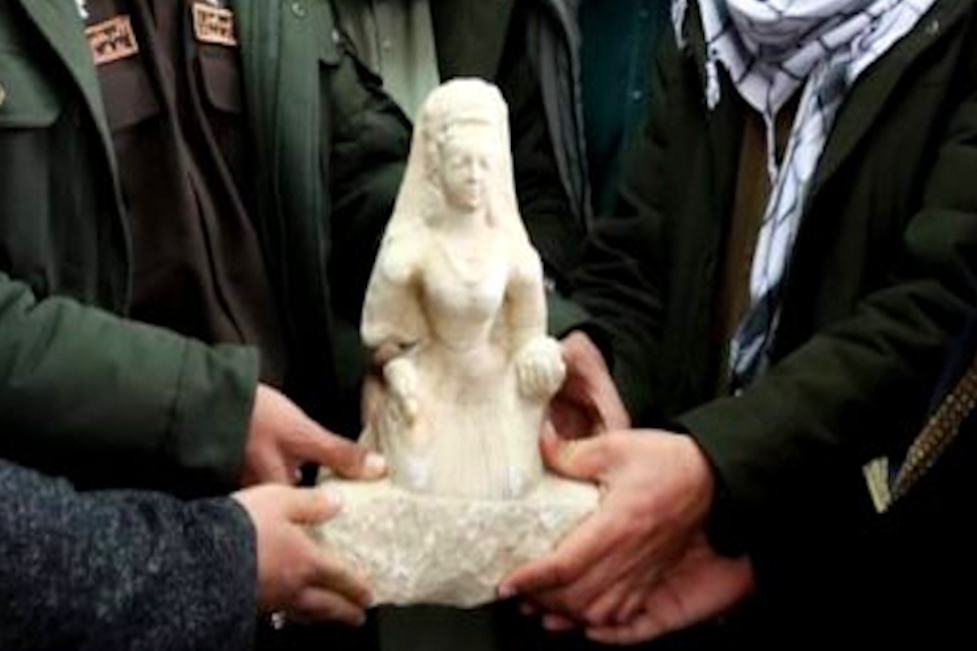
KAPISA, AFGHANISTAN — A remarkably preserved Greco-Buddhist statue, believed to be approximately 2,000 years old, has been discovered in Afghanistan’s central Kapisa province, offering a tantalizing glimpse into the region’s ancient multicultural heritage. The artifact, depicting the face of a queen from the Buddhist era, was announced by the Taliban’s provincial Department of Information and Culture in a statement on Tuesday.
According to the statement, the statue was recovered from a private residence in the “Kara Taz” area within the jurisdiction of Kapisa’s second security district. Authorities describe the object as a masterful example of Greco-Buddhist art, a style that emerged from the syncretism of Hellenistic artistic traditions introduced by Alexander the Great’s successors and the Buddhist iconography that flourished along the Silk Road.
A Testament to a Crossroads Civilization
The discovery holds significant historical weight. Kapisa, historically known as Kapisishi or Kapisha, was a pivotal center of Buddhist civilization and a crucial hub of Greco-Buddhist Gandharan art from around the 1st century BCE to the 7th century CE. As part of the ancient kingdom of Gandhara, the region served as a cultural and commercial crossroads, where Indian, Persian, Central Asian, and Greek influences converged.
The statue’s depiction of a queen provides a rare window into the era’s socio-political and artistic milieu. Experts suggest it could represent either a donor figure, a local ruling patroness of Buddhism, or even a symbolic representation of a Bodhisattva. The Hellenistic influence is typically observed in the realistic rendering of facial features, drapery, and hairstyle, combined with the spiritual themes of Buddhism.
“This is a potentially very important find,” said Dr. Arjun Sharma, a leading archaeologist of Central Asian studies (speaking from abroad). “Each new piece from the Gandharan corpus helps us piece together the complex puzzle of cultural exchange, trade routes, and religious evolution in ancient Afghanistan. A royal depiction can offer clues about patronage, gender roles, and the interplay between political power and religious institutions.”
A Discovery Amidst a Contested Cultural Legacy
The announcement places a spotlight on the Taliban’s contested role as stewards of Afghanistan’s pre-Islamic heritage. The group faces ongoing international criticism for both past and present actions regarding cultural preservation. Their most infamous act remains the systematic demolition of the twin colossal Buddhas of Bamiyan in 2001, an event that sparked global condemnation and was deemed a crime against the common heritage of humanity.
Historians and organizations like UNESCO continue to accuse the Taliban of neglecting and, in some cases, actively damaging historical sites. Since returning to power in 2021, however, the Taliban’s central leadership has issued decrees calling for the protection of antiquities, a move some analysts interpret as an attempt to gain international legitimacy and control lucrative archaeological sites.
The Kapisa discovery, recovered from a home, also hints at the persistent issue of looting and the clandestine antiquities trade, which has ravaged Afghanistan’s cultural patrimony for decades amid chronic instability.
Uncertain Future for the Artifact
While local Taliban authorities report they have “secured” the statue, its future remains uncertain. Key questions surround its preservation, study, and public access. It is unclear whether international experts will be permitted to examine the artifact using modern dating and analysis techniques, or if it will be made available for public viewing within Afghanistan.
The prospect of the statue leaving the country for exhibition or study is currently remote, given the Taliban’s isolation and international sanctions. Furthermore, the group’s ideological stance creates ambiguity over the long-term safety of pre-Islamic objects, despite their current protective statements.
A Symbol of Resilient History
Afghanistan’s landscape is strewn with the remnants of ancient Buddhist monasteries, stupas, and carvings, particularly in regions like Kapisa, Bamiyan, Hadda, and Mes Aynak. This statue serves as a powerful symbol of the nation’s layered and resilient history—a history that has repeatedly endured conquest and conflict.
For archaeologists and historians, the hope is that this serendipitous find will not merely be stored away but will catalyze a renewed, rigorous, and transparent effort to preserve and understand Afghanistan’s irreplaceable cultural legacy. As Dr. Sharma notes, “This queen from Kapisa has survived two millennia. The greatest challenge now is ensuring she is protected, studied, and allowed to tell her story to the world and to future generations of Afghans.”
Our Pashto-Dari Website


Support Dawat Media Center
If there were ever a time to join us, it is now. Every contribution, however big or small, powers our journalism and sustains our future. Support the Dawat Media Center from as little as $/€10 – it only takes a minute. If you can, please consider supporting us with a regular amount each month. Thank you
DNB Bank AC # 0530 2294668
Account for international payments: NO15 0530 2294 668
Vipps: #557320

Comments are closed.