
At UN Security Council, India Condemns Pakistani Airstrikes on Afghan Territory

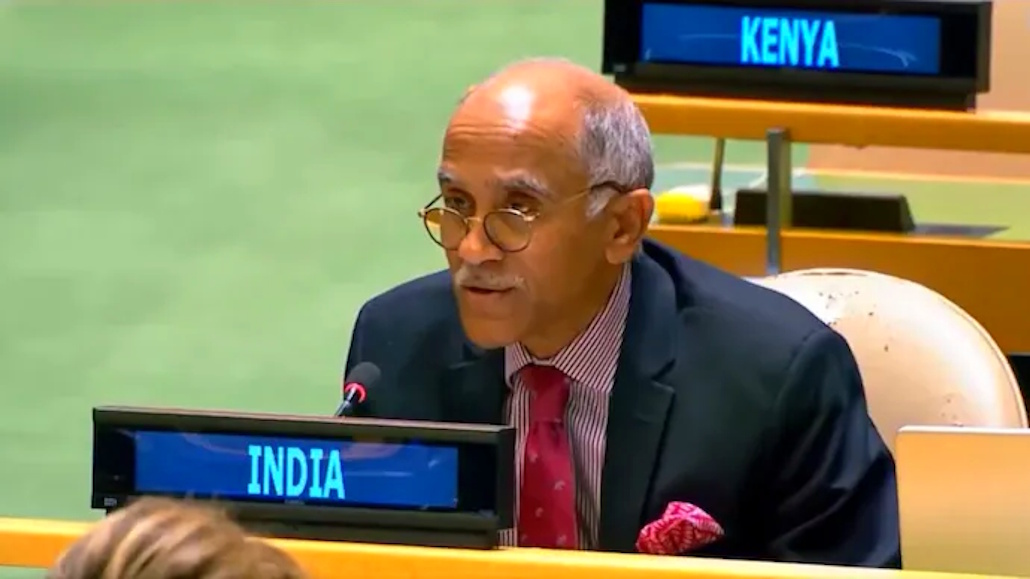
NEW YORK – India delivered a sharp condemnation of Pakistan’s recent airstrikes inside Afghanistan during a United Nations Security Council session on Wednesday, labeling the military action an unlawful violation of sovereignty that has killed civilians and threatens to destabilize the region.
India’s Permanent Representative to the UN, Ambassador Parvathaneni Harish, addressed the Council, stating that the strikes represented “a clear breach of the UN Charter and international humanitarian norms.” He emphasized that such military actions against a vulnerable and rebuilding nation like Afghanistan were unacceptable.
“We have seen with grave concern the reports of airstrikes inside Afghanistan by Pakistan, resulting in the loss of innocent lives, including women and children,” Ambassador Harish stated. “Such unilateral acts of aggression against a sovereign state are unlawful and counterproductive to the cause of regional peace and security.”
India’s Broader Concerns: Terrorism and Isolation
Ambassador Harish expanded India’s critique beyond the immediate strikes, expressing “deep concern over Pakistan’s sustained support for cross-border terrorism and its repeated, arbitrary closure of vital border crossings.” He argued that these actions serve to further isolate land-locked Afghanistan, strangling its economy and severely hampering humanitarian aid and reconstruction efforts initiated since the Taliban’s takeover in 2021.
“At a time when the Afghan people are in desperate need of international solidarity, such measures collectively punish the population and undermine stability,” Harish added. India reaffirmed its unwavering commitment to Afghanistan’s sovereignty, territorial integrity, and independence, asserting that “regional stability is inextricably linked to the inviolability of these fundamental principles.”
Pakistan’s Defense: “Necessary Counter-Terrorism Measures”
Pakistan’s UN representative offered a starkly different account, countering that Afghanistan under Taliban rule has become “a permissive safe haven” for militant groups, specifically the Pakistani Taliban (Tehreek-e-Taliban Pakistan or TTP), which Islamabad claims orchestrates deadly cross-border attacks.
“The actions taken were necessary, proportionate, and targeted defensive strikes aimed at dismantling terrorist infrastructure posing an imminent threat to Pakistan’s national security,” the Pakistani envoy stated. He asserted Pakistan’s right to self-defense under international law and called on the Taliban-led government in Kabul to deny territory and support to militant groups targeting its neighbors.
India Rejects Justification, Warns of Spiral
India firmly rejected Pakistan’s justification. “The ends do not justify the means. Attacks that result in civilian casualties cannot be legitimized under any pretext,” Ambassador Harish responded. He warned that such escalatory actions risk a dangerous cycle of violence that could destabilize not just the immediate Afghanistan-Pakistan border region, but the wider South Asian landscape.
Security Council Calls for Restraint and Dialogue
The broader UN Security Council discussion reflected concern over the escalation. While not directly naming Pakistan in a collective statement, Council members stressed that Afghanistan’s long-term stability depends on regional cooperation, respect for international borders, adherence to human rights, and accountability for any acts of cross-border aggression.
The Council urged all parties to “exercise maximum restraint, prioritize the protection of civilians, and ensure safe and unhindered humanitarian access.” It emphasized that “differences must be resolved through peaceful dialogue and diplomatic engagement,” calling on regional actors to work constructively to prevent further conflict.
Analysts Point to Broader India-Pakistan Rivalry
Security analysts view the exchange as the latest manifestation of the deep-seated India-Pakistan rivalry, with Afghanistan serving as a contested strategic ground. “This is not just about these specific airstrikes,” said Dr. Anjali Sharma, a senior fellow for South Asia studies. “It is a proxy diplomatic battle. India seeks to isolate Pakistan internationally by highlighting its aggression, while Pakistan aims to frame the Taliban’s Afghanistan as a source of regional terrorism, indirectly critiquing India’s engagement with Kabul. The Afghan people remain caught in the middle.”
The incident underscores the fragile security situation in the region and the challenges facing international efforts to foster stability in Afghanistan amid persistent bilateral tensions between its powerful neighbors.
Our Pashto-Dari Website


Support Dawat Media Center
If there were ever a time to join us, it is now. Every contribution, however big or small, powers our journalism and sustains our future. Support the Dawat Media Center from as little as $/€10 – it only takes a minute. If you can, please consider supporting us with a regular amount each month. Thank you
DNB Bank AC # 0530 2294668
Account for international payments: NO15 0530 2294 668
Vipps: #557320

Comments are closed.