

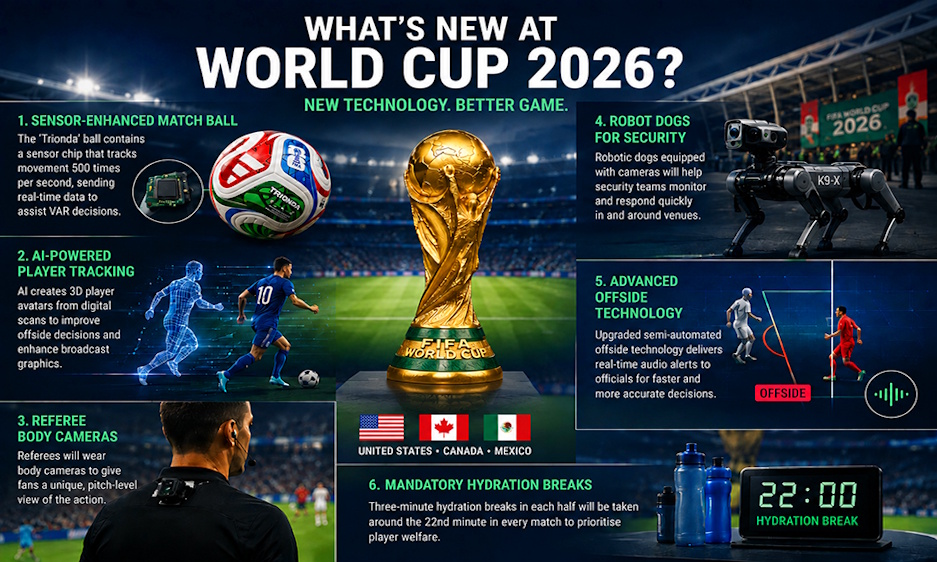
The 2026 FIFA World Cup will not only be the largest tournament in football history featuring a record 48 teams across the United States, Canada, and Mexico but also one of the most technologically advanced ever staged. From smart match balls and artificial intelligence to robotic security dogs and enhanced offside detection, FIFA is rolling out a suite of innovations designed to sharpen decision-making, bolster security, and elevate the fan experience to new heights.
Smart Match Balls: The Trionda’s Hidden Brain
The official match ball of the tournament, named Trionda, is no ordinary piece of equipment. Embedded with a miniature sensor chip, the ball tracks its own movement in real time, collecting positional data 500 times per second. This constant stream of information gives match officials precise, millisecond-level insight into the ball’s speed, trajectory, and point of impact. FIFA confirms that this data will directly support Video Assistant Referees (VAR), particularly in tight offside calls and other pivotal match decisions where fractions of a second matter.
AI-Powered Player Tracking: Virtual Avatars on the Pitch
Artificial intelligence will play a starring role throughout the tournament. Before the first whistle blows, every player will be digitally scanned to create detailed 3D avatars. During matches, AI analyzes these avatars’ movements to help officials track off-the-ball runs, tackle timing, and player positioning with unprecedented accuracy. Beyond officiating, broadcasters will use the same technology to present offside reviews in a far more realistic and engaging format allowing fans to see, from any angle, exactly why a flag went up or stayed down.
Referee Body Cameras: A Pitch-Level Perspective
For the first time in World Cup history, referees will wear body cameras during all 104 matches. The live and recorded footage will offer viewers a unique, immersive perspective on the speed, physicality, and intensity of the game as seen from an official’s vantage point. FIFA hopes this innovation will deepen public understanding of refereeing decisions while also adding a thrilling new angle for broadcast replays.
Robot Dogs for Security: Four-Legged Guardians
In Mexico, one of the tournament’s three host nations, robotic “dog” units will be deployed as part of security operations around selected venues. These four-legged machines, equipped with high-definition cameras, sensors, and two-way communication tools, can navigate stairs, rubble, and other hazardous terrain. Their primary mission is to enter potentially dangerous areas such as suspicious vehicles or restricted zones and transmit live video to security personnel long before human officers move in. Officials say the technology is designed to improve spectator safety while dramatically reducing risks for law enforcement teams.
Enhanced Offside Technology: Real-Time Audio Alerts
FIFA has also significantly upgraded its semi-automated offside system to accelerate decision-making and reduce stoppages. The new system sends instant audio alerts directly to match officials’ earpieces the moment a clear offside violation is detected. These real-time cues help referees and linesmen avoid lengthy VAR reviews, cutting down on frustrating delays and unnecessary passages of play. FIFA believes the upgrade will improve accuracy, speed up the game, and minimize confusion for players and fans alike.
Mandatory Hydration Breaks: Prioritizing Player Welfare
Player welfare is receiving unprecedented attention at World Cup 2026. Every match will include a mandatory three-minute hydration break in each half regardless of weather conditions or stadium location. Tournament organizers explain that the measure is designed to help players maintain peak physical and cognitive performance across the demanding 39-day competition, reducing the risk of heat-related illness and muscle fatigue even in air-conditioned venues.
Smarter Stadiums and Fan Connectivity
Beyond the pitch, host stadiums are being retrofitted with high-density 5G networks, universal contactless payment systems, and AI-guided crowd flow management. Fans will receive real-time updates on gate congestion, restroom availability, and concession stand wait times via the official FIFA app. Meanwhile, multilingual AI chatbots will assist visitors with navigation, translation, and emergency services making the 2026 World Cup the most connected tournament in history.
A Tournament Where Tradition Meets Tomorrow
As football’s biggest event embraces cutting-edge technology, the 2026 FIFA World Cup promises to deliver a seamless blend of tradition and innovation unlike any previous edition. From the first kick in Mexico City to the final whistle at MetLife Stadium in New Jersey, these advancements aim to protect players, empower officials, and bring fans closer to the beautiful game than ever before.
Our Pashto-Dari Website

Support Dawat Media Center
If there were ever a time to join us, it is now. Every contribution, however big or small, powers our journalism and sustains our future. Support the Dawat Media Center from as little as $/€10 – it only takes a minute. If you can, please consider supporting us with a regular amount each month. Thank you
DNB Bank AC # 0530 2294668
Account for international payments: NO15 0530 2294 668
Vipps: #557320

Comments are closed.