

When the European Union issued its latest tranche of sanctions against Israeli settler groups and their leaders, the response from the targeted organizations was not one of concern but of defiance. Regaviman organization co-founded by Israel’s far-right Finance Minister, Bezalel Smotrich welcomed the measures as a “badge of honour.” Similarly, Daniella Weiss, a veteran settler leader whose organization, Nachala, has held conferences on the Gaza border to discuss settlement expansion into the occupied Palestinian territory, dismissed the European penalties as “ridiculous” and “banal.”
In total, the EU sanctioned four entities and three individuals associated with the settler movement. Among them are high-profile figures such as Weiss, Regavim and its director Meir Deutsch, and the Amana cooperative association, which provides logistical and financial support to settlements in the occupied West Bank. Even senior government figures have been targeted in recent Western actions. Smotrich himself often described as a son of the settler movement has been sanctioned by the United Kingdom, Canada, and several other countries for his alleged role in supporting or enabling settler violence in the West Bank. These designations underscore a crucial point: the settlement project enjoys the explicit backing of the highest echelons of the Israeli state.
Sanctions as a Trophies, Not Deterrents
The nonchalant, almost celebratory response from the sanctioned figures suggests that none of the EU measures will meaningfully halt settlement expansion or hold individuals accountable for the growing wave of violence against Palestinians. Ironically, analysts say these largely toothless measures may instead become a source of domestic prestige for settler leaders. Few expect hardline figures like Weiss to spend their summers in Paris or London the kind of travel restrictions that sanctions typically impose. Instead, as a wave of terror continues across the occupied West Bank, the sanctions risk being recast as political trophies, further emboldening those they aim to punish.
Endemic Violence: Beyond Individual ‘Violations’
In the eyes of many activists and observers who spoke to Al Jazeera, the EU’s narrow focus on individual or group “violations” fails to capture either the scale of highly coordinated settler attacks or the depth of state and societal support for them. Following the Hamas-led attack of October 2023, the United Nations and human rights monitors have documented systemic, lethal settler raids in multiple areas.
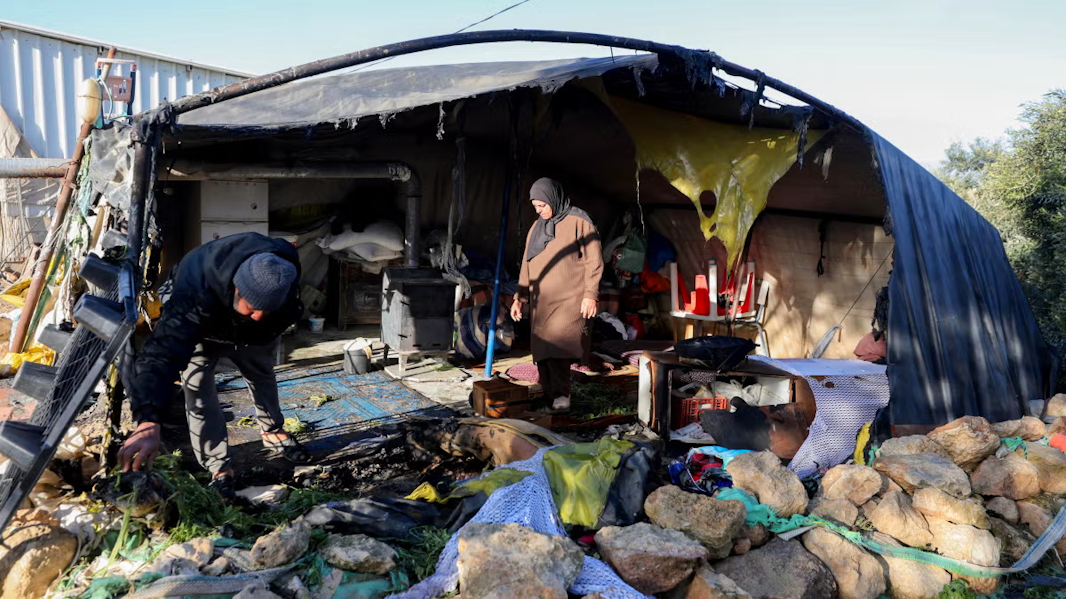
In the South Hebron Hills, residents of villages like Susiya and Umm al-Khair have been killed or seriously injured in collective incursions. In the northern West Bank, Palestinian communities around Nablus and Ramallah have seen their homes, vehicles, and olive groves torched during nighttime raids. Entire Bedouin herding communities in the Jordan Valley have been forcibly displaced after sustained campaigns of intimidation and violence. All of this points to a coordinated strategy, not random acts.
“It’s gotten much worse since October 2023,” said Tahseen Alayan, deputy director of Al-Haq, a Palestinian human rights group. “They now have the courage to attack into the heart of densely populated Palestinian villages. I see them they came into the heart of my village outside Ramallah. They feel safe to do so. If you buy a sheep, they will steal it. If you build a house, they will destroy it. If you buy a car, they will burn it.”
State Complicity: By the Numbers
Examples of Israeli government complicity in these settler raids are not hard to find. Statistics indicate a collective effort to entrench Israeli control over the West Bank, which has been occupied since 1967. According to Palestinian and UN sources, Israeli forces and settlers have killed an estimated 1,168 people in the occupied West Bank since October 2023 and injured another 12,666 Palestinians. More than 33,000 people have been displaced, while Israel has detained nearly 23,000 Palestinians in the West Bank during this period many without charge or trial.
“The violence does not happen in a vacuum,” Alayan continued. “This is an extension of the Israeli government. Settlement is at the core of their identity. They are protected by the government and by the occupying forces, and they freely admit it.”
One tragic case illustrates the impunity: settler Yinon Levi, who allegedly shot dead Palestinian activist Awdah Hathaleen in Masafer Yatta last year. Despite the killing being captured on video, Levi remains at large. “Even if they are ever prosecuted, the sentences rarely reflect the severity of the crime,” Alayan said. “These people return to their homes and are seen as heroes.”
‘Entitlement and Superiority’: The Ideology of Impunity
This sense of impunity cannot be separated from the appointment of leading settler figures or sympathizers to ministerial positions most notably National Security Minister Itamar Ben-Gvir and Finance Minister Bezalel Smotrich, the latter born in an illegal settlement in the occupied Golan Heights. In a direct sign of state-settler cooperation aimed at achieving permanent control of the West Bank in contravention of the Oslo Accords, Israel last year announced plans for the E1 settlement, which would link occupied East Jerusalem with the growing Maale Adumim settlement bloc. According to Smotrich’s own plans, the E1 settlement would effectively kill any remaining possibility of a contiguous Palestinian state in the West Bank and Gaza, fulfilling a biblical prophecy that many in the movement have long worked toward.
Daniel Bar-Tal, a professor of social-political psychology at Tel Aviv University, explained the thinking driving the settlers leading this violence. “It is a divine order to settle the West Bank,” he said. “With a divine order you do not argue, but achieve it in the way Yehoshua [Joshua] carried it out 3,000 years ago when he entered the promised land. He achieved it with the sword, so we need to do the same.”
Shai Parnes of the Israeli human rights group B’Tselem told Al Jazeera that the absence of meaningful international pressure has only strengthened the alliance between the state and the settler movement. “The Israeli regime is an apartheid regime based on Jewish supremacy and institutionalized discrimination against Palestinians,” Parnes said. “Any Israeli civilian or soldier who harms a Palestinian receives full immunity and support from the Israeli systems, and Israel itself receives this kind of cover from the international community. These facts explain the Israelis’ sense of entitlement and superiority.”
A ‘Closed Loop’ of Supremacy and Violence
Yehouda Shenhav-Shahrabani, one of Israel’s leading sociologists, described the channeling of “Jewish supremacy” from the individual to the group, to the state, and back again as a “closed loop.” This dynamic, he said, fosters a profound sense of superiority among individuals. When combined with a deeply militarized society—where most settlers also serve as soldiers violence against the native Palestinian population becomes almost inevitable.
“Some believe they’re in the West Bank because God said it was theirs. Others are there because they’re too poor to be anywhere else and have been told they’re superior anyway,” Shenhav-Shahrabani said. “Two-thirds of the time, these same people are soldiers. They carry guns all the time. Looking on while they carry out violence against Palestinians are other soldiers who believe almost exactly the same thing, and behind them stand politicians. Like I said, it’s a closed loop.”
Until that loop is broken by genuine international accountability, domestic Israeli legal reform, or a shift in the political calculus sanctions will remain little more than rhetorical gestures. And for the settlers themselves, those gestures will continue to serve as badges of honour rather than instruments of justice.
Our Pashto-Dari Website

Support Dawat Media Center
If there were ever a time to join us, it is now. Every contribution, however big or small, powers our journalism and sustains our future. Support the Dawat Media Center from as little as $/€10 – it only takes a minute. If you can, please consider supporting us with a regular amount each month. Thank you
DNB Bank AC # 0530 2294668
Account for international payments: NO15 0530 2294 668
Vipps: #557320

Comments are closed.