

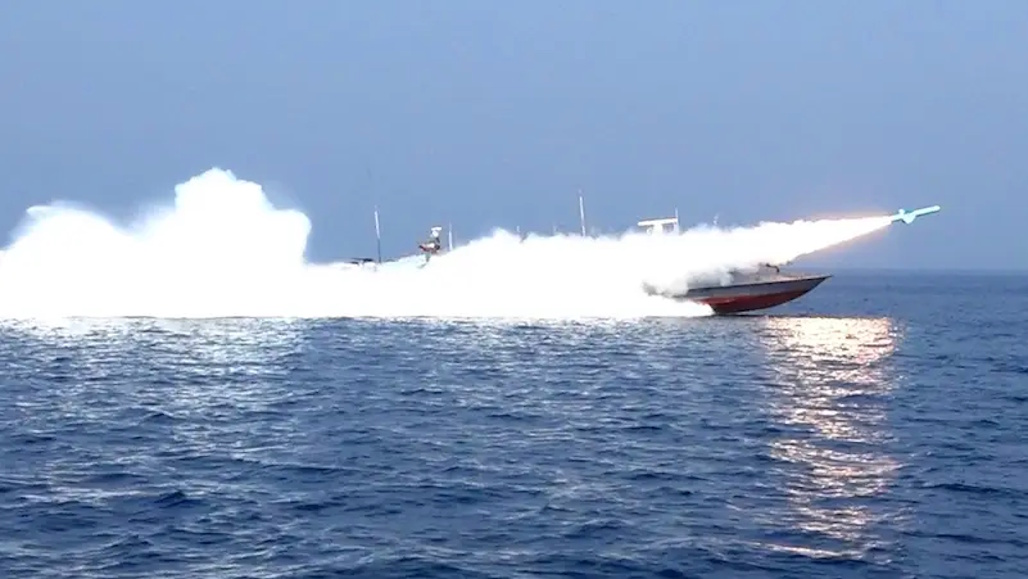
TEHRAN/WASHINGTON, D.C. – A tense maritime confrontation allegedly unfolded in the Gulf of Oman on Friday, with Iran’s military claiming it fired “warning missiles” at two U.S. Navy destroyers, forcing them to leave the area. The U.S. military’s Central Command (CENTCOM) swiftly and unequivocally denied that any such attack or engagement occurred.
Iran’s Version of Events
According to a statement carried by Iran’s state news agency IRNA, the Iranian army said the operation was “in continuation of operations to counter maritime misconduct and harassment, as well as the hijacking of commercial vessels and oil tankers by the terrorist naval forces of the United States.”
The statement named the two vessels as the destroyers DDG-103 (the USS Truxtun, an Arleigh Burke-class destroyer) and DDG-8 (the USS Winston S. Churchill). It claimed that “following the firing of warning missiles, the hostile destroyers… have left the Gulf of Oman towards the Indian Ocean.”
Iran framed the action as a response to what it described as U.S. “maritime misconduct” and alleged attempts to hijack commercial shipping.
U.S. Denial and Counter-Narrative
CENTCOM rejected Iran’s account in forceful terms.
“Iranian forces did NOT attack or fire at U.S. Navy warships,” a CENTCOM spokesperson stated. “Doing so would be a gross violation of international law and the ceasefire framework.” The command emphasized that its naval forces “continue to operate freely in regional waters” and are actively enforcing a U.S. counter-blockade on Iranian ports.
Earlier on Friday, the U.S. Indo-Pacific Command had announced a separate operation, stating that U.S. forces had intercepted the stateless vessel M/T DAVINA in the Indian Ocean overnight. “We will continue global maritime enforcement to disrupt illicit networks and interdict vessels providing material support to Iran, wherever they operate,” it posted on X.
A Broader Context of Heightened Tensions
The conflicting claims come amid an extraordinarily volatile security landscape in and around the Strait of Hormuz and the Gulf of Oman – chokepoints through which approximately one-fifth of the world’s oil transited in peacetime.
This episode is the latest to strain a fragile ceasefire announced on April 8, which has largely halted direct hostilities between Iran and the United States (as well as Israel) following the outbreak of war on February 28. Efforts to end the broader conflict through direct and mediated talks have so far failed.
U.S. Secretary of State Marco Rubio said on Wednesday that Washington was “no longer conducting sustained strikes” against Iran as part of Operation Epic Fury, the U.S. military’s name for its attacks on Iran. Rubio added that the United States had destroyed what Iran “had left of an air force” in addition to “wiping out their entire conventional navy.”
Since the onset of the war, Iran has imposed a naval blockade on the Strait of Hormuz. In response, the United States established its own blockade of Iranian ports. Friday’s incident whether real or claimed underscores how easily miscalculations at sea could shatter the tenuous ceasefire.
Analysis: A Pattern of Provocation or Propaganda?
Independent verification of the incident is not possible. However, analysts note that Iran has a history of announcing “warnings” or “captures” of U.S. naval assets that are later denied or shown to be exaggerated by U.S. forces. Conversely, the U.S. has repeatedly intercepted Iranian-linked vessels smuggling oil or weapons.
The timing is significant: with Operation Epic Fury declared over but no permanent peace agreement in place, both sides appear to be testing each other’s red lines. Iran’s claim may be an attempt to project strength domestically, while the U.S. denial aims to avoid escalation and signal that Iranian threats will not alter U.S. naval posture in the region.
No casualties or damage have been reported. Both destroyers, if they were in the area at all, are presumed to be continuing their missions.
Our Pashto-Dari Website

Support Dawat Media Center
If there were ever a time to join us, it is now. Every contribution, however big or small, powers our journalism and sustains our future. Support the Dawat Media Center from as little as $/€10 – it only takes a minute. If you can, please consider supporting us with a regular amount each month. Thank you
DNB Bank AC # 0530 2294668
Account for international payments: NO15 0530 2294 668
Vipps: #557320

Comments are closed.