

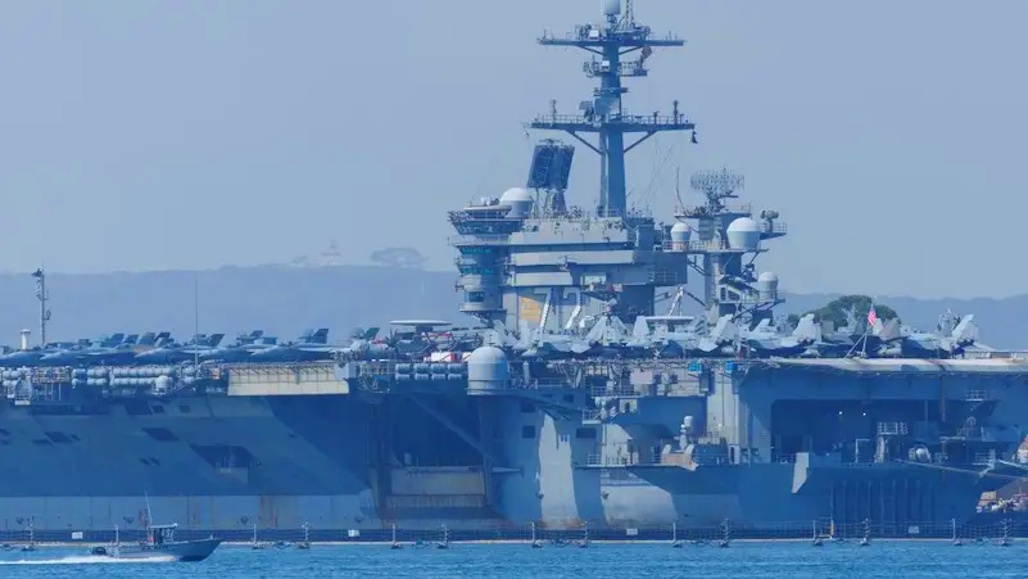
WASHINGTON – The United States is deploying the aircraft carrier USS Abraham Lincoln and a complement of supporting warships to the Middle East, senior U.S. officials confirmed Thursday. The move reinforces American military assets in the region at a time of lingering instability, even as President Donald Trump expressed a desire to avoid new conflict with Iran.
The carrier strike group, which includes several guided-missile destroyers and attached fighter aircraft, began its transit from the Asia-Pacific theater last week. This repositioning occurs against a backdrop of prolonged tension between Washington and Tehran, which escalated sharply following Iran’s severe suppression of nationwide protests that began in late December.
Alongside the naval deployment, officials stated that the Pentagon is considering sending additional air defense systems to the region. The U.S. frequently adjusts troop and asset levels in the Middle East in response to security dynamics, a practice analysts often describe as a standard, defensive precaution.
However, the current buildup echoes a significant mobilization last summer, which preceded major U.S. airstrikes on Iran’s nuclear facilities in June 2025. Following those strikes, U.S. officials highlighted their success in operational secrecy.
Trump’s Rhetoric and Iran’s Nuclear Status
President Trump, who had previously threatened intervention over the violent crackdown on Iranian protesters, has recently moderated his tone as the protests have waned. Shifting his focus to other foreign policy matters, he nonetheless issued a clear warning regarding Iran’s nuclear ambitions.
In an interview with CNBC on Wednesday from Davos, Switzerland, Trump stated, “I hope there’s not further action,” but underscored a firm red line. “They can’t do the nuclear,” he said, referencing the 2025 strikes. “If they do it, it’s going to happen again.”
The status of Iran’s nuclear program remains a critical concern for the international community. It has been at least seven months since the International Atomic Energy Agency (IAEA) last verified Iran’s stockpile of highly enriched uranium, despite agency guidelines calling for monthly inspections.
A pressing issue is Iran’s obligation to report to the IAEA on the aftermath of the 2025 strikes. The attacks targeted sites holding an estimated 440.9 kilograms of uranium enriched to up to 60% purity—a level close to the 90% considered weapons-grade. According to IAEA benchmarks, that quantity of material, if further refined, could yield approximately ten nuclear weapons. Tehran has yet to provide a full accounting of the material present at the damaged facilities.
Legacy of Unrest and Human Toll
The internal unrest that triggered the recent crisis began on December 28 with economic protests in Tehran’s Grand Bazaar before spreading across the country. The human cost has been substantial.
The U.S.-based human rights organization HRANA reported it has verified 4,519 deaths linked to the unrest, including 4,251 protesters, 197 security personnel, 35 minors, and 38 bystanders. The group stated it is reviewing evidence for an additional 9,049 reported deaths. An Iranian official, speaking to Reuters this week, placed the confirmed death toll above 5,000 as of Sunday, including 500 security force members.
While the scale of protests has diminished, the underlying grievances remain, leaving potential for further instability. The convergence of Iran’s domestic turmoil, its advancing nuclear program, and the reinforced U.S. military presence sets the stage for a volatile period ahead, where miscalculation by either side could quickly reignite open confrontation.
Our Pashto-Dari Website


Support Dawat Media Center
If there were ever a time to join us, it is now. Every contribution, however big or small, powers our journalism and sustains our future. Support the Dawat Media Center from as little as $/€10 – it only takes a minute. If you can, please consider supporting us with a regular amount each month. Thank you
DNB Bank AC # 0530 2294668
Account for international payments: NO15 0530 2294 668
Vipps: #557320

Comments are closed.