

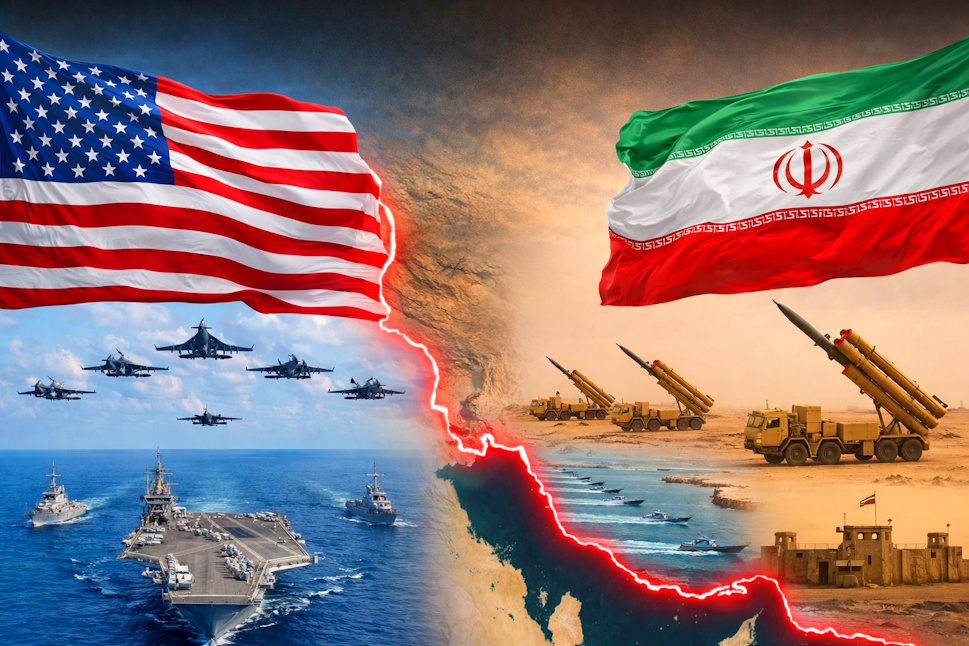
The United States and Iran have traded direct military blows, marking a dangerous escalation in their longstanding confrontation. The US carried out airstrikes against Iranian military positions along the southern coast, while Tehran responded by targeting American military assets in the region raising fears of a broader conflict just weeks after a fragile ceasefire had taken hold.
The US Account: Retaliation for Drone Attack
US President Donald Trump announced on his Truth Social platform on Friday that Iran had launched at least four armed drones toward commercial vessels transiting the Strait of Hormuz, a critical chokepoint for global oil shipments. Shortly thereafter, US Central Command (CENTCOM) confirmed that American forces had conducted precision strikes inside Iran.
In an official statement, CENTCOM said the strikes targeted Iranian missile and drone storage facilities, as well as coastal radar sites that had been used to coordinate maritime harassment. The operation, it added, was a direct response to Iran’s military action against a commercial vessel that had been navigating the strait under US-protected safe passage protocols. CENTCOM later released a grainy black-and-white video of an explosion, labeled “unclassified,” as visual confirmation of the operation. A senior US official confirmed that the mission had been concluded with all aircraft returning safely.
Iran’s Counterstrike and Legal Justification
Iran’s state-run IRNA news agency reported that naval forces of the Islamic Revolutionary Guard Corps (IRGC) retaliated by striking US military positions in the region. While Tehran did not specify the exact targets or locations, it described the action as proportionate and defensive.
The IRGC issued a statement accusing the United States of launching its airstrikes under the false pretext that a commercial vessel had used an unauthorized route through the Strait of Hormuz. Citing Article Five of the Islamabad Memorandum of Understanding the bilateral ceasefire and navigation agreement signed last week the IRGC asserted that responsibility for controlling and regulating ship traffic in the strait rests solely with Iran. The statement warned that any further US attacks would be met with a “broader and more decisive response.”
Vance: “Violence Will Be Met with Violence”
Vice President JD Vance, who has emerged as the Trump administration’s primary point person on Iran policy despite earlier skepticism about US intervention, issued a stark warning on X (formerly Twitter). He stated that the United States had fully honored the ceasefire memorandum, and that any Iranian grievances over its implementation could be resolved through diplomatic channels. “But violence will be met with violence,” Vance declared, signaling that the administration would not tolerate further provocations.
Iranian Port Struck, No Major Damage Reported
Iranian state media, citing an unnamed military source, reported that an explosion was heard near the port of Sirik in southern Iran’s Hormozgan province, with a projectile striking an area around a pier. The source noted that warning shots had been fired from Sirik toward vessels that violated strait regulations about five hours prior to the US strikes, and that two warning missiles had also been launched from the nearby Karpan area. However, on Saturday, Iran’s Mehr news agency quoted the head of ports in eastern Hormozgan as saying that the port of Sirik sustained no damage and was operating normally, with all facilities and equipment intact.
Ceasefire Violations and Competing Narratives
The US military framed its strikes as a necessary enforcement action, stating: “The unwarranted aggression against commercial shipping by Iranian forces clearly violated the ceasefire.” CENTCOM emphasized that it would continue to provide “safe passage coordination and support” to commercial vessels transiting the strait.
Iran, however, rejected that narrative. The IRGC reiterated that the ceasefire agreement explicitly grants Iran control over ship traffic in the strait. “The United States, by provoking various fronts, sought to violate this commitment,” the IRGC said in a statement carried by state media. “The necessary response was given and will continue to be given. If the aggression is repeated, our response will be broader than this.”
Ebrahim Azizi, head of the Iranian parliament’s national security committee, posted on X that Trump had failed to demonstrate commitment to negotiation or ceasefire principles. “This reckless violation of the ceasefire will, as always, lead to retreat and regret on their part,” Azizi warned.
Oil Markets React, Diplomatic Efforts Continue
Prior to the latest strikes, oil prices had fallen about 3 percent on Friday, heading for steep weekly losses, as tankers resumed exiting the strait—which before the US-Israeli campaign that began on February 28 had carried roughly one-fifth of global oil and LNG supplies. Fertilizer shipments through the strait have also picked up, easing concerns about a potential spike in global food prices.
Meanwhile, US Secretary of State Marco Rubio, concluding a tour of the Arabian Gulf to reassure regional allies about the interim pact, issued a joint statement with the Gulf Cooperation Council calling for “free, unconditional, and unrestricted navigation” in the strait without tolls or “attempts to assert control.” Iran’s foreign ministry responded by asserting that the strait should be governed jointly by Iran and Oman. Ali Akbar Velayati, a top adviser to Iran’s supreme leader, warned Washington’s Gulf allies that their survival depended on Tehran’s tolerance.
Iran Claims Retaliatory Strikes on US Targets
In a formal statement, Iran’s foreign ministry said the country had struck targets linked to US forces in retaliation for American airstrikes on its southern coast, which it described as a violation of the UN Charter and the war-ending memorandum between the two nations. Tehran did not identify the specific targets or disclose their locations, maintaining an ambiguity that has become characteristic of its asymmetric response strategy.
As both sides trade accusations and warnings, the international community watches with growing alarm. The Strait of Hormuz remains a flashpoint, and the fragile ceasefire already showing severe strain may not survive further provocations. Diplomatic channels remain open, but with both capitals hardening their rhetoric, the path to de-escalation appears increasingly narrow.
Our Pashto-Dari Website

Support Dawat Media Center
If there were ever a time to join us, it is now. Every contribution, however big or small, powers our journalism and sustains our future. Support the Dawat Media Center from as little as $/€10 – it only takes a minute. If you can, please consider supporting us with a regular amount each month. Thank you
DNB Bank AC # 0530 2294668
Account for international payments: NO15 0530 2294 668
Vipps: #557320

Comments are closed.