

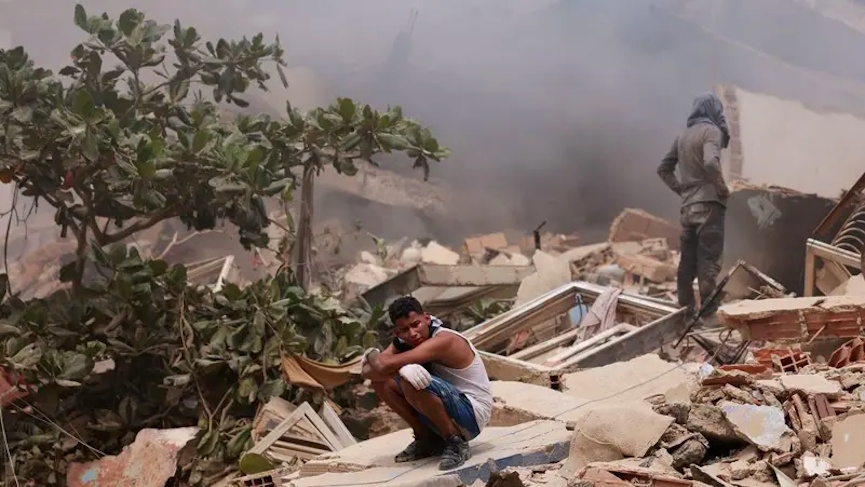
The death toll from Venezuela’s devastating twin earthquakes has climbed to nearly 3,000, according to updated official figures released on Saturday, even as international rescue teams began scaling back their search operations for survivors amid the rubble.
Fatalities rose by more than 300 from Friday to reach 2,954, following the June 24 disaster that has left tens of thousands homeless, many sleeping in makeshift camps or out in the open. The back-to-back quakes measuring 7.2 and 7.5 in magnitude and striking just 38 seconds apart ranks among the deadliest seismic events in Latin American history.
While the Venezuelan government has not issued its own estimate of the missing, the United Nations has put the number of unaccounted-for individuals as high as 50,000. The coastal La Guaira region, just north of the capital Caracas, bore the brunt of the destruction, with entire residential complexes reduced to piles of concrete and twisted steel.
Ten days after the shocks, the window for finding survivors has all but closed. The critical 72-hour mark for rescue operations has long passed, though a handful of miraculous rescues occurred earlier this week. Now, search teams are transitioning from recovery of the living to recovery of the deceased, as families continue to sift through debris in desperate attempts to retrieve the bodies of loved ones for proper burials.
In a move that signaled the formal drawdown of international assistance, interim President Delcy Rodríguez held a ceremony on Saturday to honor foreign rescue crews, including their search dogs, with medals and words of gratitude. “Venezuela is experiencing a profound grief gripping our people families still holding out hope of finding loved ones alive, people who have lost everything,” Rodríguez said.
International teams, including units from the United States and several South American nations, confirmed they were wrapping up operations. The Los Angeles County fire department rescue squad said it was ending its mission after its latest sweeps detected no signs of life, while teams from Florida and Virginia were packing equipment for departure this weekend.
On the ground, however, local volunteers and grieving relatives have expressed mounting frustration with the government’s response. Many accuse authorities of moving too slowly in the immediate aftermath, leaving families to dig through the wreckage with their bare hands for hours before outside help arrived. Rodríguez has defended the administration, stating that thousands of troops and officials were deployed to affected zones.
In La Guaira, heavy machinery began knocking down unstable structures on Saturday, while in other buildings, families labored alongside volunteers to extract remains. “We’re still working, still searching for bodies. We’re still going. It hasn’t been easy,” said Francisco Sasquia, a Venezuelan volunteer helping to clear a collapsed residence. “We found two bodies that have already been released to their families.”
Economic Aftershocks
The United Nations estimates the twin quakes have caused approximately $6.7 billion in physical damage roughly 6% of Venezuela’s GDP. For a nation already reeling from decades of economic collapse, hyperinflation, and political instability, the disaster has further crippled fragile infrastructure and overwhelmed an ailing healthcare system.
Maiquetía International Airport in La Guaira, which serves Caracas, sustained significant damage but has partially reopened to accommodate humanitarian flights. Commercial operations remain suspended. Rodríguez announced that the government is in talks with international partners to aid in the airport’s restoration, with a reconstruction plan expected by next week.
Amid the chaos, personal tragedies continue to unfold. Víctor Colivert, a grieving uncle, stood vigil beside the body of his nephew, recovered from a building’s wreckage and now sealed in a black body bag. Fearing the remains could be lost in bureaucratic disarray, Colivert and his family prevented forensic workers from taking the body away. “If I have to go to China, to wherever, I’m not leaving him alone,” he said, his voice resolute. “I’m going with him.”
As Venezuela braces for a long and painful recovery, the human cost of the earthquake continues to mount not just in numbers, but in the indelible scars left on survivors, families, and a nation already teetering on the edge.
Our Pashto-Dari Website

Support Dawat Media Center
If there were ever a time to join us, it is now. Every contribution, however big or small, powers our journalism and sustains our future. Support the Dawat Media Center from as little as $/€10 – it only takes a minute. If you can, please consider supporting us with a regular amount each month. Thank you
DNB Bank AC # 0530 2294668
Account for international payments: NO15 0530 2294 668
Vipps: #557320

Comments are closed.