

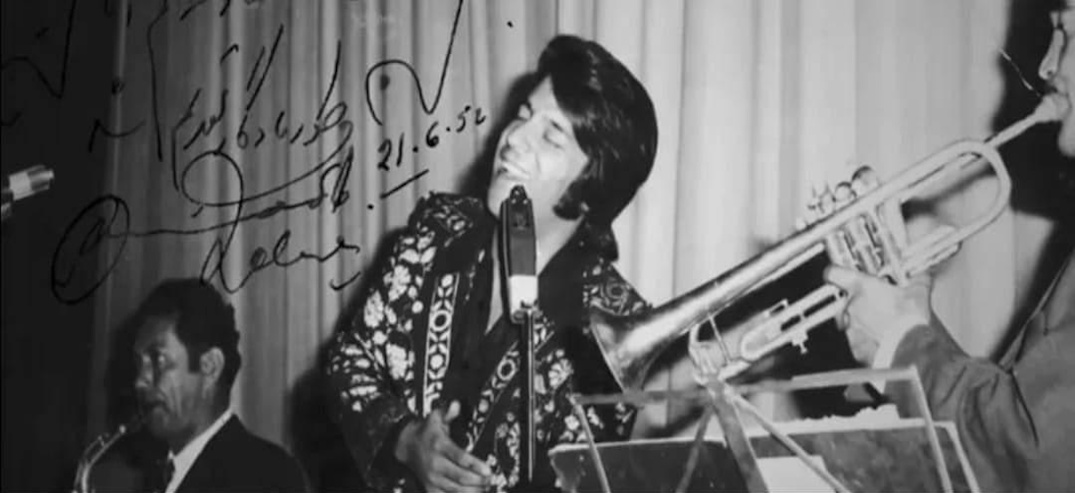
Forty-five years ago, on June 14th, 1979, a crimson luxury car veered off the winding road near the Salang Pass, colliding with a rock in the narrow canyon of Chapraq village. This was more than a tragic accident; it was a seismic event that etched itself into the soul of a nation, heralding the premature closing of the brightest chapter in Afghanistan’s modern cultural history. As villagers reached the scene, they found the lifeless body of Ahmad Zahir, the country’s undisputed musical titan, on his 33rd birthday. The mangled wreckage held a haunting paradox: while the icon was gone, three other passengers emerged miraculously unscathed, seeding decades of mystery and speculation around a death that felt profoundly orchestrated.
In his song “Az Dast-e-Dard” (From the Hands of Pain), he seemed to have composed his own elegy:
My death will one day arrive,
In the bright spring from waves of light.
The soil calls me every moment to itself,
They are coming from the path to lay me in the grave.
Alas, perhaps my lovers at midnight,
Will lay flowers on my sorrowful grave.
For over a decade, Ahmad Zahir—the “Elvis of Afghanistan”—stood as a colossus. His voice, a unique instrument that could oscillate between a silken whisper and a thunderous crescendo, carried across borders. His style—sharp suits, bold sideburns, and magnetic stage presence—made him a modern icon. But his true genius lay in his ability to weave the diverse threads of Afghanistan’s cultural tapestry into a harmonious and deeply resonant sound.
Roots of a Revolution
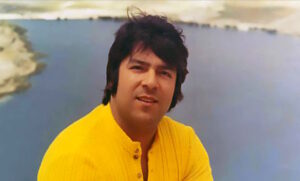
Born in Kabul on June 14, 1946, into an elite and progressive family, Ahmad Toryalai Zahir was the son of Dr. Abdul Zahir, a royal physician and later Prime Minister. This environment of intellectualism and constitutional reform provided a fertile ground for young Ahmad’s artistic sensibilities. At Habibia High School, his evocative baritone earned him the title “Bulbul-e-Habibia” (The Nightingale of Habibia). Despite his father’s initial reservations about a musical career—a profession shadowed by societal and religious stigma—a heartfelt intervention by fellow singer Zahir Howaida helped secure paternal blessing, altering the course of Afghan music.
Forging a New Sound
Studies in Mumbai exposed Zahir to the grand orchestrations of Indian cinema, which he masterfully fused with traditional Afghan rhythms and the poetry of Rumi, Hafez, and Saadi. Returning to Kabul, he shattered conventions. He moved music from static radio broadcasts and private mehmāni (gatherings) into packed restaurants, luxury hotels, and, unprecedentedly, Kabul’s sports stadiums. His 1967 debut album was a sensational public triumph, establishing him not just as a singer, but as a cultural innovator. He became one of the first Afghan artists to tour the Soviet republics and Iran, building a transnational fanbase.
The Price of Stardom and Defiance
Fame was a double-edged sword. Crowned “Singer of the Year” in 1972—a title that would remain his in perpetuity—he became a national symbol of individuality in a society layered with tribal, religious, and governmental suppressions. His life embodied the tension between Afghanistan’s overt traditionalism and its covert modern yearnings.
This defiance soon drew the ire of power. Following the communist Saur Revolution of 1978, his refusal to become a propaganda tool for the Soviet-backed regime led to a ban on his music from state media. Though the exact catalyst is debated, songs like “Bandegi” (Servitude) resonated as subtle anthems of resistance:
Life is the freedom of man and his independence,
For freedom, be courageous; servitude is not the objective.
His personal life mirrored the turbulence. A brief first marriage, a second arranged marriage ending in his wife Khalida’s mysterious murder—for which he was imprisoned and later released without conviction—and a final marriage to Fakhria, all unfolded under the harsh glare of public scrutiny. Zahir Howaida later revealed that Zahir’s final years were marked by systemic harassment by the authorities, including sabotaged recording projects.
An Unquiet Grave and an Unending Legacy
His death on that June day in 1979 remains shrouded. Was it a mere accident, an assassination by the state, or a plot by rivals? The unanswered questions only magnified his myth. Buried in Kabul’s Shuhadā-ye Şālihīn cemetery, his gravesite monument was later destroyed by the Taliban during their first regime, an attempt to erase a symbol of cultural vibrancy they deemed un-Islamic.
Today, under the Taliban’s renewed rule where music is banned and artists are persecuted, Zahir’s legacy has taken on a new, profound dimension. For a scattered global diaspora grieving a homeland in crisis, his songs are a sacred auditory homeland. They are the anthems of weddings in exile, the solace in separation, and the covert act of defiance for those under repression. His lyrics about heartbreak, exile, and the precariousness of life speak directly to the contemporary Afghan condition.
May God be your companion, the Quran, your protector,
May Sakhi be your helper…
Oh, dear love, separation is dangerous,
A fruitless sapling that bears separation…
Come, let’s sit alone, you and I,
For death unannounced brings separation.
Ahmad Zahir was more than Afghanistan’s “King of Pop”; he was the architect of its modern sonic identity. He proved that tradition could dance with innovation, and that individual expression could voice collective yearning. In a land where history is often written in tears and dust, his music remains an indelible script of joy, resistance, and remembrance. As the poet once said, and as Zahir’s life affirms:
A man does not die with death; death seeks his name,
When the name becomes eternal, how is death easy?
The nightingale of Habibia was silenced, but his song, against all odds, echoes louder than ever.
Our Pashto-Dari Website

Support Dawat Media Center
If there were ever a time to join us, it is now. Every contribution, however big or small, powers our journalism and sustains our future. Support the Dawat Media Center from as little as $/€10 – it only takes a minute. If you can, please consider supporting us with a regular amount each month. Thank you
DNB Bank AC # 0530 2294668
Account for international payments: NO15 0530 2294 668
Vipps: #557320

Comments are closed.