

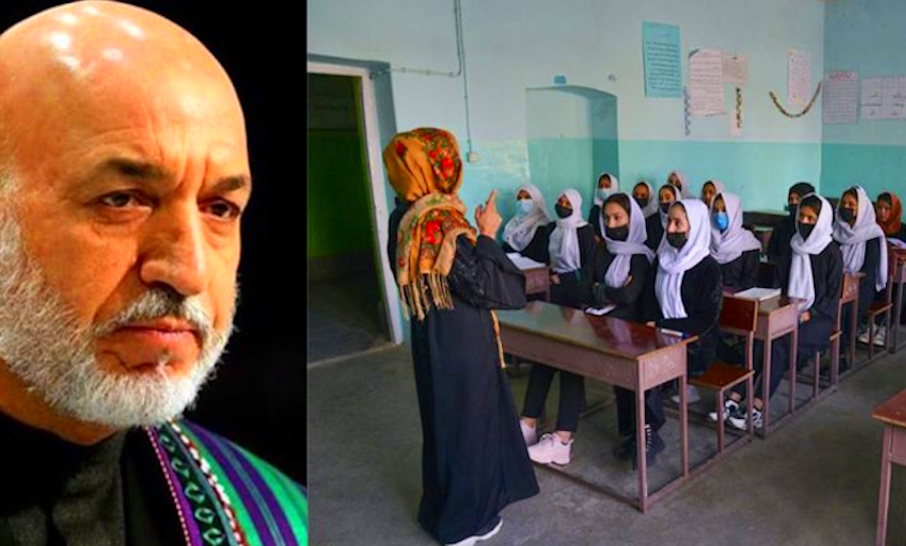
Former Afghan President Hamid Karzai has renewed his warning that Afghanistan could lose thousands of female workers as girls remain barred from education, citing United Nations projections that point to worsening workforce shortages by 2030.
In response to a recent UNICEF report detailing the devastating impact of ongoing education restrictions, Karzai cautioned that the ban on girls’ schooling threatens not only the country’s development but also its long-term independence. According to the report, if the current restrictions persist, Afghanistan could lose approximately 25,000 female teachers and health workers by the end of the decade. During the same period, more than two million girls are expected to be deprived of formal education, deepening existing social and economic crises.
Karzai stressed that denying education to girls weakens national human capital and increases Afghanistan’s reliance on foreign aid. He warned that prolonged closures of secondary schools and universities for girls would severely undermine the nation’s ability to build a self-sustaining future, leaving it vulnerable to poverty and instability.
Since the Taliban’s return to power in 2021, girls’ access to secondary and higher education has been almost entirely suspended, drawing widespread international condemnation. Despite sporadic pledges and limited reopenings, sustained policy changes have yet to materialize, leaving millions of Afghan girls without any path to learning.
The United Nations and humanitarian agencies have repeatedly highlighted the ripple effects of these restrictions on essential public services. Female teachers and health workers are especially critical in Afghanistan, where cultural norms often prevent women from seeking care or education from male professionals. Without enough women in these roles, entire communities particularly in rural and conservative areas risk being cut off from basic services.
UN projections further underscore the looming crisis: by 2030, Afghanistan could face a shortage of some 20,000 female teachers and around 5,000 female health workers. These gaps are expected to place unbearable strain on the country’s already fragile education and healthcare systems, potentially reversing decades of hard-won progress in maternal health, childhood literacy, and girls’ empowerment.
Karzai reiterated his urgent call for the immediate reopening of schools and universities to all girls, emphasizing that education is not a luxury but a necessity for national progress, social stability, and true sovereignty. He urged Afghanistan’s current authorities to prioritize inclusive policies that enable all citizens regardless of gender to contribute to the country’s future.
Our Pashto-Dari Website

Support Dawat Media Center
If there were ever a time to join us, it is now. Every contribution, however big or small, powers our journalism and sustains our future. Support the Dawat Media Center from as little as $/€10 – it only takes a minute. If you can, please consider supporting us with a regular amount each month. Thank you
DNB Bank AC # 0530 2294668
Account for international payments: NO15 0530 2294 668
Vipps: #557320

Comments are closed.