

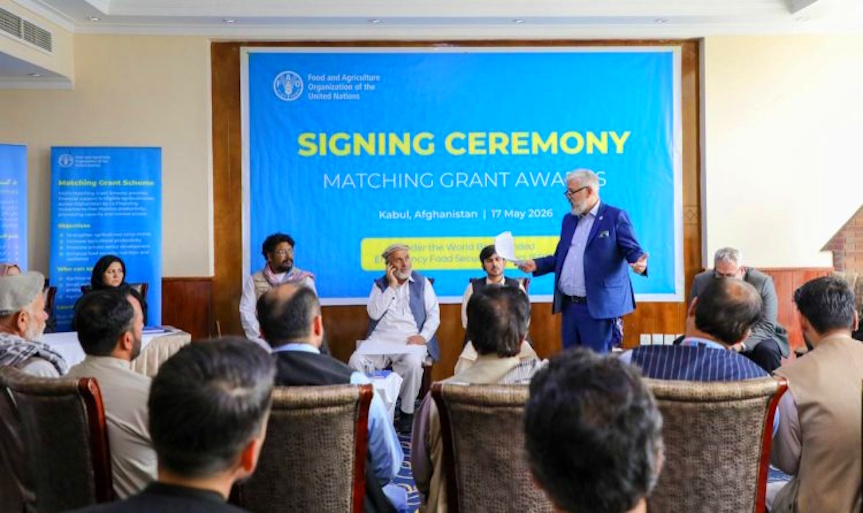
The Food and Agriculture Organization of the United Nations (FAO) and the World Bank have launched a new joint initiative aimed at strengthening Afghanistan’s agricultural sector by supporting agribusinesses, creating employment opportunities, and revitalizing rural economies across the country.
FAO announced on Wednesday that five agricultural enterprises have been selected as the first recipients of financial support under the program. The initiative is designed to help businesses expand production capacity, improve processing systems, and strengthen access to domestic and regional markets.
The selected enterprises are located in Herat, Kapisa, Kunduz, Logar, and Takhar provinces, and operate in key agricultural sectors including seed production, saffron processing, dairy products, soybean processing, and food manufacturing.
Among the initial investments are soybean oil refining projects in Kapisa, solar-powered dairy production facilities in Takhar, and modern saffron processing centers in Kunduz. FAO noted that three of the five selected businesses are women-led, highlighting the program’s focus on promoting female participation and leadership in Afghanistan’s agricultural economy.
The organization said the project is expected to generate both direct and indirect employment opportunities across multiple sectors, including agricultural production, food processing, logistics, supply chains, and agricultural marketing. Officials say the initiative is intended to strengthen local value chains and increase the long-term resilience of rural communities.
Agriculture remains one of Afghanistan’s largest sources of employment, with millions of Afghans relying on farming and livestock as their primary source of income. However, the sector has been severely affected by years of conflict, recurring drought, economic instability, and reduced investment.
According to the United Nations, more than 23 million people in Afghanistan currently require humanitarian assistance, while millions more continue to face severe food insecurity and limited access to essential services.
Humanitarian agencies warn that prolonged drought, widespread unemployment, and declining international aid have deepened hunger and economic hardship, particularly in rural areas where farming households are highly vulnerable to climate and market shocks.
The new program is being implemented under the World Bank-supported Emergency Food Security Project, which seeks to strengthen small and medium-sized agricultural enterprises and improve food production systems across Afghanistan. Officials say the effort is part of broader international support to help rebuild livelihoods, improve food security, and promote sustainable economic recovery in the country.
Our Pashto-Dari Website

Support Dawat Media Center
If there were ever a time to join us, it is now. Every contribution, however big or small, powers our journalism and sustains our future. Support the Dawat Media Center from as little as $/€10 – it only takes a minute. If you can, please consider supporting us with a regular amount each month. Thank you
DNB Bank AC # 0530 2294668
Account for international payments: NO15 0530 2294 668
Vipps: #557320

Comments are closed.