

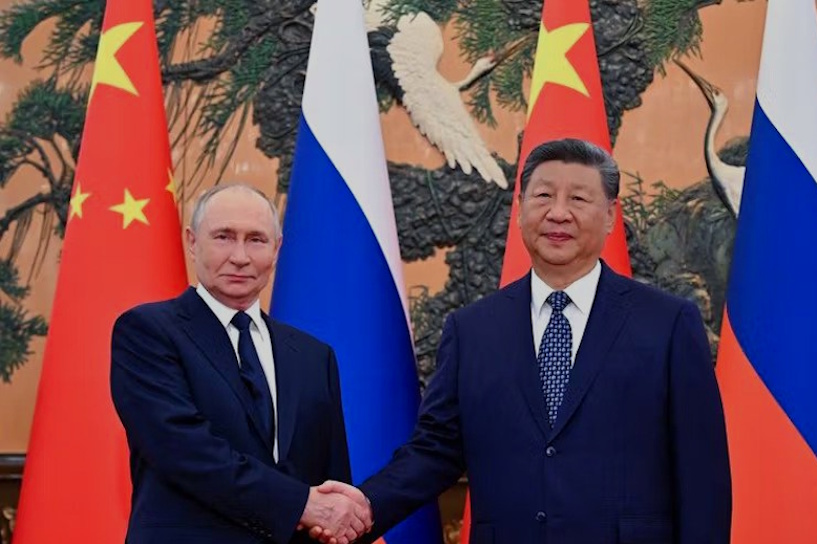
President Vladimir Putin’s visit to China comes just days after the conclusion of U.S. President Donald Trump’s official visit to Beijing.
The timing is notable. Putin’s trip was originally scheduled for February 2026, but was postponed following the U.S. Israeli attack on Iran, which also led to the rescheduling of the U.S. Israeli summit from late March to May.
Unlike Trump’s visit the first by a sitting U.S. president to China in nine years meetings between Russian and Chinese leaders take place annually, alternating between Beijing and Moscow. Putin and Xi Jinping typically meet three to five times a year, whether through bilateral visits, BRICS summits, the Shanghai Cooperation Organisation, or other international events.
As a result, Putin’s visit will be shorter than Trump’s and will focus more on resolving current issues in Russia China relations. However, recent developments in the Gulf will also influence the agenda.
Putin and Xi are expected to sign a “Declaration on the Establishment of a Multipolar World and a New Type of International Relations.” The emphasis placed by Moscow and Beijing on such a detailed statement reflects a response to Trump’s policies, including the U.S. withdrawal from multiple international organisations and his open rejection of international law.
If the United States is no longer willing to engage in global governance discussions, Russia and China appear ready to present their own vision.
China’s position on Ukraine an issue of major importance for Russia has recently become noticeably more restrained. While Beijing presented its own peace proposal in 2023 and appointed a special envoy, these efforts had effectively stalled by 2025.
During Trump’s visit, China again called for an early ceasefire, but is unlikely to take a more active role in the Ukraine conflict, given its important relationships with both Russia and the European Union.
China continues to supply Russia with industrial equipment and dual-use goods, while simultaneously supplying similar goods to Europe and Ukraine.
Russia and China coordinate their positions on Iran, including in UN Security Council votes, although Beijing’s stance on the Gulf conflict remains more cautious than Moscow’s.
The two leaders are expected to discuss the Iran issue, but are unlikely to issue any major new statements.
Another key topic will be the development of BRICS and the Shanghai Cooperation Organisation, both of which are facing challenges amid growing global instability and the Gulf conflict. Nevertheless, both organisations remain important instruments in Russian and Chinese foreign policy strategies and are expected to become more active once global conditions stabilise.
This visit is symbolically significant, marking the 25th anniversary of the Russia–China Treaty of Good-Neighbourliness and Friendly Cooperation and the 30th anniversary of their strategic partnership.
The Gulf crisis has also increased China’s interest in joint projects with Russia, not only in energy but also in logistics. Beijing appears willing to reconsider its previous policy of diversifying energy sources, which limited the share of any single supplier in its market.
In the past, this was a major obstacle to deeper cooperation. Now, China is expected to increase imports from neighbouring continental suppliers, including Russia and Central Asian countries.
There is growing likelihood of an agreement on the long-discussed “Power of Siberia 2” gas pipeline via Mongolia, which could enable Russia to supply China with 50 billion cubic metres of gas annually.
The importance of this project lies in its potential to redirect Russian gas exports previously destined for Europe towards China.
Beijing is also showing increased interest in cooperation on the development of the Northern Sea Route, particularly in light of disruptions in the Strait of Hormuz and threats to the Bab el-Mandeb Strait.
Chinese investment in Russia’s railway logistics system is also under discussion, as Russia’s rail network remains a key corridor for transporting Chinese goods to Europe.
Putin is accompanied by five deputy prime ministers, eight government ministers, the head of the central bank, and senior executives from major Russian corporations.
New agreements are expected in nuclear energy and industrial development, with around forty documents likely to be signed covering economic cooperation.
The negotiations will also address ongoing issues in bilateral economic relations. Russian industry faces significant challenges from Chinese exports, a situation not unique to this partnership.
Chinese industrial firms, operating under prolonged domestic economic slowdown and receiving substantial state support, are expanding exports into the Russian market. At times, this has seriously weakened parts of Russian industry. Last year, Russia introduced protective measures against Chinese automobiles.
These tensions are further complicated by Russia’s ongoing large-scale industrial and import-substitution programmes during the war in Ukraine, while China is accelerating the securitisation of its economic policy, including efforts to reduce imports of certain goods, particularly food products. Both sides will need closer coordination to avoid future trade frictions.
The presence of Central Bank Governor Elvira Nabiullina in the delegation suggests potential agreements on expanding financial cooperation and developing settlement systems in national currencies to shield transactions from Western pressure.
Compared to regular annual summits, the upcoming meeting between Putin and Xi is expected to focus more heavily on concrete economic projects and cooperation programmes, alongside broader statements on a shared vision of the future global order.
However, major joint decisions on responding to crises in different regions of the world remain unlikely.
Our Pashto-Dari Website

Support Dawat Media Center
If there were ever a time to join us, it is now. Every contribution, however big or small, powers our journalism and sustains our future. Support the Dawat Media Center from as little as $/€10 – it only takes a minute. If you can, please consider supporting us with a regular amount each month. Thank you
DNB Bank AC # 0530 2294668
Account for international payments: NO15 0530 2294 668
Vipps: #557320

Comments are closed.