

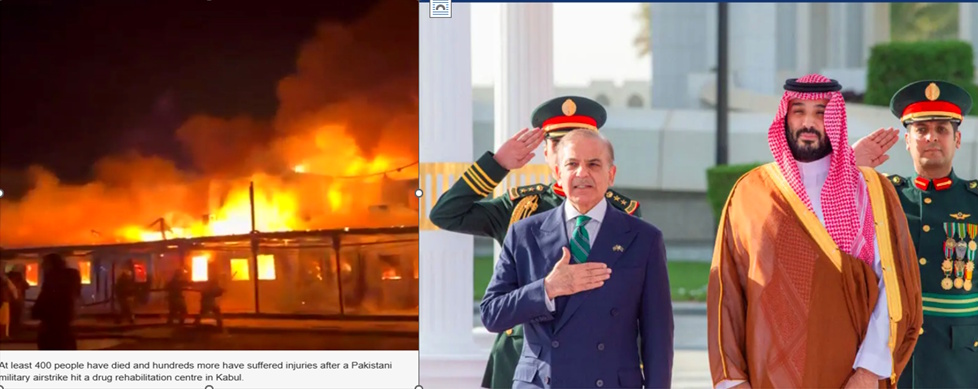
The bombing of a rehabilitation center in Kabul is not just an atrocity, it is a confession. A confession that Pakistan has lost control of its neighborhood, its strategy, and increasingly, its own.
This is not counterterrorism.
This is state violence masking strategic failure.
#KabulAttack #WarCrimes #Afghanistan
A State Striking Civilians While Losing Control Everywhere Else
While Pakistan drops bombs across the border, it is steadily losing control within its own borders:
- Balochistan is in open resistance, with a long-running insurgency that continues to challenge state authority
- Khyber Pakhtunkhwa is engulfed in militancy and unrest, where attacks and instability are no longer containable
- Armed groups once nurtured as “strategic assets” are now turning inward with force
This is the classic pattern of a state facing internal fracture:
when it cannot dominate, it lashes outward.
#Balochistan #KhyberPakhtunkhwa #Insurgency
Afghanistan: The Strategic Break That Triggered Panic
For decades, Pakistan believed Afghanistan would remain within its sphere of control. That illusion is now shattered.
The Taliban government has:
- Acted independently of Islamabad
- Refused to serve as a proxy
- Expanded relations with India, China, and Russia
This is a direct geopolitical defeat for Pakistan.
Instead of adapting, Pakistan is trying to bomb its way back into relevance, a strategy that is not only immoral, but doomed.
#Taliban #Geopolitics #SouthAsia
The Economic Collapse Driving Aggression
Pakistan is not acting from strength, it is acting from financial suffocation.
- The country is effectively “surviving loan by loan”, heavily dependent on external bailouts and oil imports
- It owes massive debts to China, Saudi Arabia, and international lenders, with external debt exceeding $130 billion
- Debt servicing has at times exceeded government revenue, reflecting a structurally broken economy
This is not a stable state. It is a debt-dependent system under pressure.
And history shows:
economically fragile states often externalize crises through conflict.
#EconomicCrisis #DebtTrap #Pakistan
The Iran War Trap: A State Trying to Escape Its Own Promises
Pakistan is now caught in what analysts describe as an “Iran trap”, a crisis of its own making.
- It signed a mutual defense pact with Saudi Arabia, promising to treat attacks on Riyadh as attacks on itself
- It publicly signaled willingness to support Saudi Arabia against Iran, raising expectations it may not be able to meet
- At the same time, it cannot afford confrontation with Iran, given geography, sectarian realities, and internal fragility
This creates a dangerous contradiction:
Pakistan must appear strong, but cannot actually act decisively.
#IranWar #SaudiArabia #MiddleEast
A Calculated Diversion: War as a Message to the Gulf
There is another, more cynical layer to Pakistan’s behavior.
Islamabad is deeply dependent on Gulf states:
- Oil supplies
- Financial bailouts
- Remittances from millions of workers
Yet the Iran war is now testing Pakistan’s ability to support Saudi Arabia militarily.
Here lies the uncomfortable possibility:
By escalating conflict with Afghanistan and showcasing instability, Pakistan may be signaling:
“We are already overstretched, we cannot fully engage in your war.”
This creates strategic ambiguity:
- It preserves ties with Saudi Arabia
- It avoids direct confrontation with Iran
- It justifies inaction under the cover of “internal crisis”
In other words, Pakistan may be weaponizing its own instability as an excuse.
#SaudiArabia #GulfPolitics #StrategicAmbiguity
Strategic Failure Disguised as Force
Pakistan’s actions are not those of a confident regional power. They are the behavior of a state trapped between:
- Internal insurgency
- Economic collapse
- Diplomatic isolation
- Strategic irrelevance in Afghanistan
So it chooses the only tool left:
violence without vision
But this approach carries a fatal flaw:
Every strike on Kabul:
- Weakens Pakistan’s legitimacy
- Strengthens Afghan independence
- Accelerates regional realignment away from Islamabad
Conclusion: A Dangerous Illusion of Power
Pakistan believes it can bomb its way out of:
- Internal collapse
- Economic dependency
- Strategic isolation
It cannot.
What we are witnessing is not strength, but decline acting loudly.
And the tragedy is that this decline is being paid for in Afghan civilian lives.
#Pakistan #AfghanistanWar #HumanRights #StopTheViolence
How the Iran War Could Weaken Pakistan and Shift Regional Influence
Our Pashto-Dari Website

Support Dawat Media Center
If there were ever a time to join us, it is now. Every contribution, however big or small, powers our journalism and sustains our future. Support the Dawat Media Center from as little as $/€10 – it only takes a minute. If you can, please consider supporting us with a regular amount each month. Thank you
DNB Bank AC # 0530 2294668
Account for international payments: NO15 0530 2294 668
Vipps: #557320

Comments are closed.