

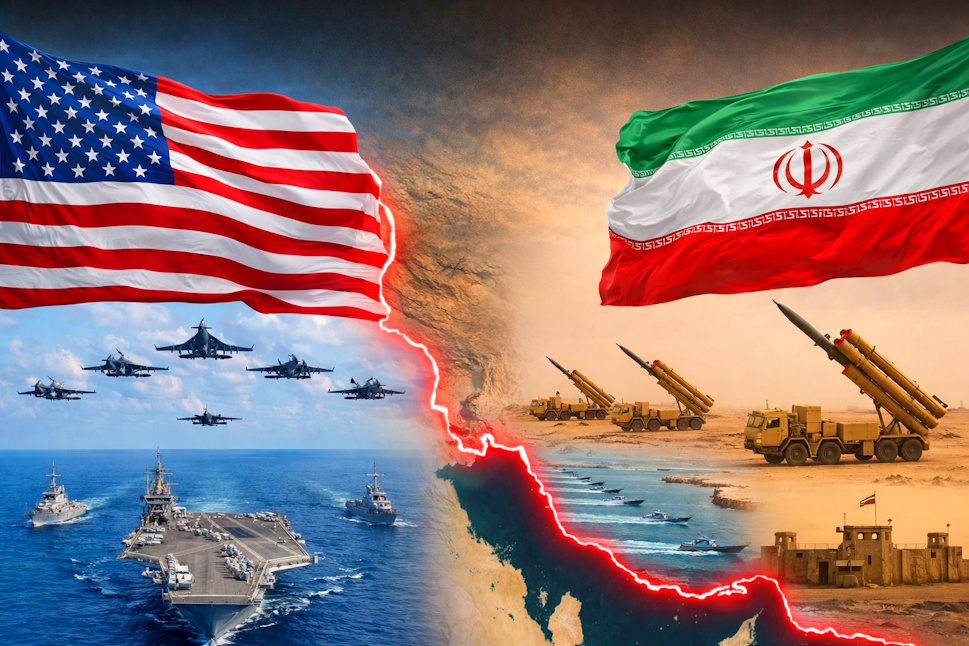
Before the situation became more complicated in recent hours, and critical moments began echoing across the region once more, U.S. President Donald Trump reaffirmed that the United States and Iran are close to finalizing an agreement on general principles to resolve outstanding issues. These include U.S. demands to impose strict limits on Iran’s nuclear program, as well as ending restrictions by both sides on traffic through the Strait of Hormuz.
To allow room for diplomacy, Trump suspended the “Project Freedom” operation on Tuesday, May 5, which had aimed to break Iran’s control over the strait.
The project was halted just hours after his senior national security officials had declared it a complete success though only a handful of tankers had moved through the strait under U.S. protection.
Among the factors contributing to Trump’s decision to suspend the operation were objections from several Arab and Gulf nations, which urged Trump to focus on Pakistani-mediated efforts rather than antagonizing Tehran.
Nevertheless, despite the halt of “Project Freedom,” Iran’s Islamic Revolutionary Guard Corps (IRGC) continued to assert its control over the strait by attacking tankers and U.S. warships passing through, prompting the United States to launch retaliatory strikes on IRGC fast-attack boats and some ports along the coast. Iranian missiles and drones also struck multiple targets in the United Arab Emirates.
Tehran and Washington continue working to finalize a one‑page “Memorandum of Understanding” (a framework agreement). U.S. officials had demanded Iran’s formal acceptance of the deal by Friday, May 8, 2026. However, Iran’s Foreign Ministry stated that the government is still studying the U.S. proposals, relayed to Tehran via Islamabad, and will provide a response soon.
Nevertheless, Tasnim News Agency, which is close to the IRGC, reports that the U.S. draft includes provisions that Tehran finds unacceptable. This clearly reflects the IRGC’s view that Iran holds the strategic upper hand in the conflict and should insist on its own terms for any settlement.
As the two sides exchange positions, global media are highlighting only the rising prices of oil and natural gas worldwide and the war’s impact on the global economy.
Trump had indicated that a diplomatic agreement is near, telling reporters last week that Iranian negotiators had become more “flexible.” A draft text published by Axios and other platforms suggested that Iran would agree to a long‑term suspension of uranium enrichment, possibly lasting up to 15 years.
After the suspension period, Iran’s enrichment activities would be limited to 3.67% purity enough for civilian nuclear reactor use but far below the 90% “weapons‑grade” level needed for a nuclear weapon.
Tehran had previously pledged it would never stop uranium enrichment under any circumstances.
Iran may also agree to allow its buried stockpile of 400 kilograms of 60% enriched uranium enough, if further enriched to weapons grade, to fuel 11 nuclear weapons to be taken out of the country, then down‑blended or otherwise rendered harmless.
Russia, which has long been involved in Iran’s civilian nuclear program, is a potential destination for that material. Trump refuses to allow Tehran to keep the stockpile, which is believed to still be beneath the rubble of the Isfahan uranium conversion facility destroyed by U.S. bombing during Operation Midnight Hammer last year.
In return, according to reports on U.S.–Iranian understandings, Iran would receive significant sanctions relief, and both sides would gradually end their restrictions on traffic through the strait, including the U.S. blockade of Iranian ports.
Trump’s sudden refocus on diplomacy has halted what international officials had assessed as an imminent return to large‑scale conflict just one month after a ceasefire.
On Monday, May 4, “Project Freedom” aimed at breaking Iran’s control over traffic through the strategic strait seemed certain to shatter the truce, even though U.S. officials portrayed it as a defensive and humanitarian mission to help stranded ships and their crews leave the Gulf.
The project was Trump’s response to political pressure from rising global energy prices to end the conflict without achieving key strategic goals.
In mid‑April, Trump sought to counter Iran’s closure of the strait without explicitly violating the ceasefire by imposing a naval blockade on Iranian ports.
Although U.S. Central Command (CENTCOM) framed “Project Freedom” as enhancing coordination and information‑sharing among international partners to support maritime security in the strait, it made clear that the U.S. military was engaged in the mission. The operation included U.S. guided‑missile destroyers, more than 100 land‑ and sea‑based aircraft, multi‑domain unmanned platforms, and 15,000 troops.
On May 4—the only full day of “Project Freedom” U.S. warships helped several U.S.-flagged commercial vessels transit, but there was no immediate movement by the estimated 1,500 ships stranded in the Gulf to try to leave the waterway.
If the operation resumes, its success will be judged by how much it eases pressure on global energy markets—a result that requires shipping managers and insurers to assess that transit risks in the strait have significantly decreased.
If “Project Freedom” does not restore an acceptable level of traffic flow through the strait, Trump is likely to escalate to a more organized naval escort mission. However, doing so also carries risks of Iranian retaliation.
IRGC commanders, who appear to control wartime decision‑making in Iran, immediately followed through on their threats to try to thwart “Project Freedom,” and followed up with further attacks on commercial vessels and U.S. Navy ships.
The IRGC, along with other hardline Iranian elements, is determined not to relinquish Iran’s stranglehold on the strait in favor of U.S. forces—an outcome that would ease global economic concerns and drain Iranian leverage.
However, the IRGC faces resource and capability constraints that have limited its ability to effectively confront U.S. military power. All IRGC missiles and drones launched at U.S. warships were intercepted by ship‑board defenses, and IRGC attacks led the U.S. to modify its rules of engagement to allow preemptive and retaliatory strikes on IRGC fast‑attack boats.
The United States not only attacked and destroyed IRGC boats involved in strikes on U.S. warships and commercial vessels but also struck and disrupted Iranian port operations along the strait coast on Thursday, May 7, including in Bandar Abbas, Qeshm Island, and Sirik.
Nevertheless, in an apparent attempt to undermine U.S. support among Arab Gulf states, Iran reserved its heaviest fire for the UAE, launching 15 ballistic and cruise missiles and drones at Emirati targets on May 4.
The UAE Ministry of Defense announced that Iran launched additional attacks on the country on Tuesday. Most projectiles were intercepted, but a tanker owned by the state‑run Abu Dhabi National Oil Company (ADNOC) was hit, and one drone set fire to a facility in the UAE’s Fujairah petroleum zone.
The attacks on the UAE appeared to spark debate in Tehran, where elected civilian leaders questioned the IRGC’s decision to attack a Gulf state with which Iranian leaders hope to rebuild relations once the conflict ends.
Progress in negotiations with the United States if confirmed may indicate that civilian leaders are pushing back against the IRGC’s inclination to fight the U.S. regardless of the costs that its resistance imposes on the Iranian people.
If the talks falter, danger will once again loom over the region.
Our Pashto-Dari Website

Support Dawat Media Center
If there were ever a time to join us, it is now. Every contribution, however big or small, powers our journalism and sustains our future. Support the Dawat Media Center from as little as $/€10 – it only takes a minute. If you can, please consider supporting us with a regular amount each month. Thank you
DNB Bank AC # 0530 2294668
Account for international payments: NO15 0530 2294 668
Vipps: #557320

Comments are closed.