

The recent statement by Taliban officials that former Afghan president Ashraf Ghani may return to Afghanistan “as an ordinary citizen” should not be viewed in isolation. It arrives at a moment of intensifying tension between Pakistan and the Taliban leadership, growing regional competition between the United Arab Emirates and Qatar, and mounting economic pressure on Pakistan itself. In that wider context, the discussion surrounding Ghani’s possible return increasingly resembles more than symbolic reconciliation. It may be the early signal of a broader geopolitical project aimed at restructuring power in Afghanistan.
The Taliban’s comments are politically significant because Ghani is not an ordinary exile. He remains one of the most controversial and ambitious figures in modern Afghan politics. When Kabul collapsed in August 2021 and he fled the country, he did not present himself as a retired leader exiting public life. Instead, he vowed to return. His repeated public statements since exile have consistently revealed a man still deeply attached to power and historical legacy.
That matters because political ambition often survives political collapse.
At the same time, the regional environment around Afghanistan has changed dramatically. Pakistan’s relationship with the Taliban has deteriorated to levels few expected after the fall of the republic. Islamabad increasingly views the Taliban not as obedient allies, but as an independent Islamist government unwilling to fully comply with Pakistani security demands, especially regarding the Tehrik-i-Taliban Pakistan, or TTP. International analysis now openly describes relations between Pakistan and the Taliban as a deepening crisis.
This is where Ghani becomes relevant again.
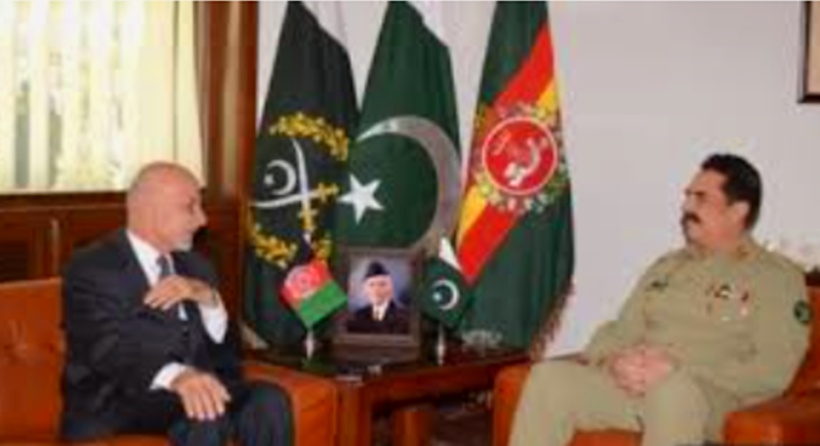
Unlike previous Afghan leaders, Ghani built an unusually close relationship with Pakistan’s military establishment during his presidency. He became perhaps the only Afghan leader in modern history to openly visit Pakistan’s General Headquarters and directly engage the Pakistani army leadership as the centerpiece of his regional policy. His meetings with former Pakistani Army Chief Qamar Javed Bajwa symbolized a level of political accommodation unprecedented for an Afghan president.
For many Afghans, this approach represented strategic surrender disguised as diplomacy. Ghani continued insisting Pakistan could deliver peace even while the Taliban insurgency intensified and Afghan territory steadily collapsed. His critics warned that he fundamentally misunderstood the strategic culture of Pakistan’s military establishment. History proved them right.
One of the least discussed but most consequential developments during Ghani’s presidency was the near completion of Pakistan’s border fencing project along the Afghan Pakistan frontier. By the final years of his administration, nearly 90 percent of the fencing project had reportedly been completed. For many Afghans who reject the legitimacy of the Durand Line, this became one of the clearest symbols of how much strategic space Pakistan gained during Ghani’s rule.
Now the geopolitical equation may be shifting again.
Ghani currently resides in the United Arab Emirates, a country whose regional rivalry with Qatar has shaped conflicts across the Middle East for years. Qatar became the Taliban’s principal diplomatic sponsor and political sanctuary through the Doha office and negotiations process. The Taliban’s rise to international legitimacy was heavily facilitated through Qatar’s mediation role.
The UAE, however, has its own regional ambitions and has often competed directly with Qatar for influence. At the same time, Pakistan’s fragile economy has become increasingly dependent on Gulf financial support. Recent reports and diplomatic discussions surrounding pressure on Pakistan to repay loans and stabilize its financial obligations have elevated the influence of Gulf states over Pakistani decision making. In such an environment, it is entirely plausible that Abu Dhabi’s preferences regarding Afghanistan are becoming more important inside Islamabad’s strategic calculations.
If Pakistan’s military establishment now views the Taliban as increasingly unreliable and too closely aligned with Qatar’s regional orbit, then supporting alternative Afghan political arrangements becomes strategically rational from Islamabad’s perspective. Ghani, despite his damaged legitimacy inside Afghanistan, offers several advantages for such a project. He remains internationally recognizable, maintains ties with former republic elites, has experience working closely with Pakistan’s military leadership, and most importantly, still appears deeply motivated to return to power.
Ironically, all of this is unfolding while Afghanistan under Taliban rule, despite severe economic hardship, sanctions, and the highly controversial restrictions on girls’ education, is experiencing its longest sustained period of nationwide security and internal stability since the communist coup of 1978. Large scale front line warfare has disappeared. Major highways function with far greater safety than during the republic era. Suicide bombings and daily urban warfare have dramatically declined.
This creates a strategic dilemma for Pakistan.
A Taliban government that is internally secure yet politically independent may ultimately be more threatening to Islamabad’s long term interests than a weak and permanently unstable Afghanistan. Pakistan historically exercised influence most effectively during periods of Afghan fragmentation and dependency. A stable Taliban government unwilling to fully submit to Pakistani priorities fundamentally alters that equation.
That is why the Taliban’s recent comments about Ghani’s return deserve close scrutiny. On the surface, the statement appears harmless. But politics in the region rarely operates at the surface level. Afghanistan has repeatedly been shaped by external power struggles, intelligence calculations, and regional rivalries disguised as political reconciliation.
The reappearance of Ashraf Ghani in political discussion at precisely the moment Pakistan’s relations with the Taliban are collapsing may not be coincidence at all. It may instead be the first visible sign that Islamabad, together with regional partners, has begun quietly preparing for a post Taliban influence structure in Afghanistan.
Our Pashto-Dari Website
Support Dawat Media Center
If there were ever a time to join us, it is now. Every contribution, however big or small, powers our journalism and sustains our future. Support the Dawat Media Center from as little as $/€10 – it only takes a minute. If you can, please consider supporting us with a regular amount each month. Thank you
DNB Bank AC # 0530 2294668
Account for international payments: NO15 0530 2294 668
Vipps: #557320

Comments are closed.