

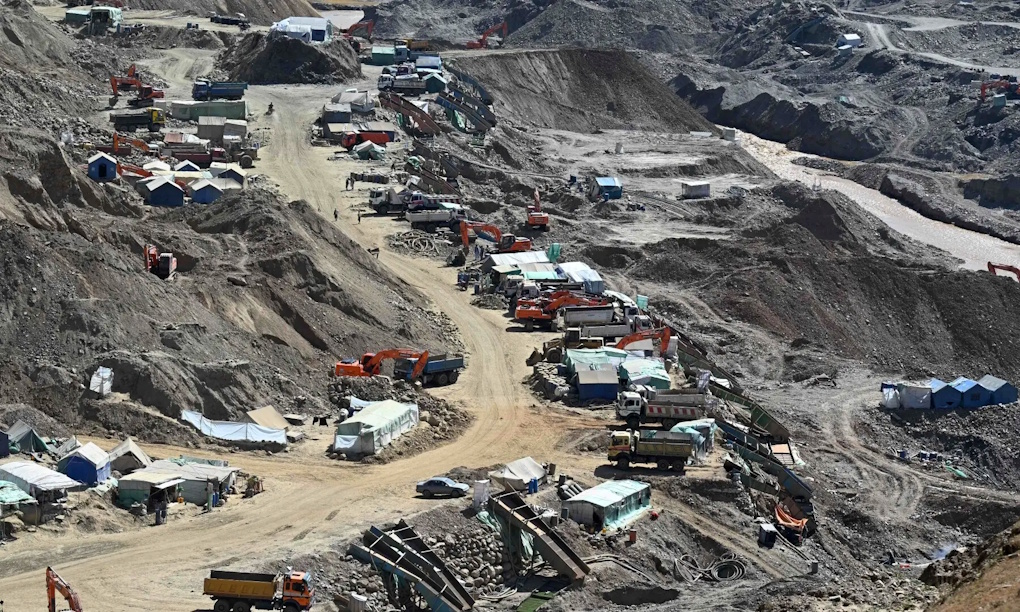
In Afghanistan’s northeastern Badakhshan province, the relentless roar of excavators now echoes through valleys where villagers once farmed, herded livestock and gathered along clear mountain streams.
Day and night, dozens of machines claw into the mountainsides around the Shiwa area, about 50 kilometers (30 miles) northeast of the provincial capital Faizabad, in search of gold.
Thousands of miners have descended on the remote region, drawn by the prospect of work in a country where jobs remain scarce and the economy has struggled since the Taliban returned to power in 2021.
For some, the gold rush has brought desperately needed income.
For others, it has brought polluted rivers, damaged farmland and landscapes transformed almost beyond recognition.
Farmer Muhammad Amin, 74, is among those who say they have paid a heavy price.
“Before, the river was deep, the water was clean,” said Amin, who lives in the Pul-e-Ziri Ban valley.
Since mining began, “the water of the river is not drinkable; you can’t even wash your body with that water,” he told AFP.
As he spoke, tears welled in his eyes.
The grass that once grew along the riverbank “has all gone,” Amin said. Farming is no longer possible because of “the wind and dust” generated by mining operations.
His livestock have also suffered. Where he once had enough grazing land to support as many as 40 goats, he can now keep only about 15.
Amin said he agreed to lease his land to a mining company for $20,000, but received only half the amount. The company, he said, also failed to keep its promise to restore his fields after mining operations ended.
For residents like Amin, the arrival of the gold industry has therefore been a bargain that came at a far greater cost than expected.
A new mining frontier
The Taliban authorities have sought to expand Afghanistan’s mining sector since returning to power, viewing the country’s largely untapped mineral wealth as a potential source of government revenue and economic growth.
Afghanistan is believed to possess substantial deposits of minerals, including gold, copper, iron ore and other valuable resources. Developing them, however, has long been hampered by decades of war, weak infrastructure, limited investment and insecurity.
The Taliban government has made mining a central part of its economic strategy, signing contracts and seeking greater control over the extraction and taxation of natural resources.
In Badakhshan alone, provincial officials say hundreds of companies have become involved.
Abdul Mateen Rahimzai, head of the provincial mines department, said officials have registered “almost 650 to 700 companies, and there are thousands of people working manually.”
The World Bank said in a May report that hundreds of mining contracts had been signed since 2021, with the sector recording “real growth averaging 25 to 30 percent” annually.
But the rapid expansion has also raised questions about environmental damage, regulation and who ultimately benefits from the country’s mineral wealth.
‘Better than anything else’
Not far from Amin’s home, mining has temporarily stopped in his village.
But in the nearby Gulak-Dara valley, the rush continues.
Dozens of excavators carve into the mountainside, stripping away soil and rock as trucks haul material away.
The work is dirty, dangerous and physically demanding, but for many of the workers arriving from across Afghanistan, it is one of the few opportunities available.
Mohammad Agha Khwaja Khail, from Kabul, has worked in mining for five years. The 21-year-old earns 10,000 Afghanis, about $150, a month loading trucks.
“It’s better than anything else… There aren’t many jobs in Kabul,” he said, speaking above the deafening rumble of the machinery.
For workers like Khwaja Khail, environmental concerns can seem distant compared with the immediate need to earn a living.
Shafiullah Ehsas, a father of five, transported his excavator hundreds of kilometers from Jalalabad to Badakhshan about three months ago.
“In Jalalabad, the gold (mining) work hasn’t started, and it was happening in Badakhshan, so we didn’t have any other option but to bring our machinery here,” said the 32-year-old.
He earns about 25,000 Afghanis per month.
The movement of machinery and workers across the country reflects the growing importance of mining as a source of income in an economy where employment opportunities remain limited.
Attempts at regulation
The Ministry of Mines and Petroleum says it is trying to bring the industry under tighter government control.
Ministry spokesman Hamayoun Afghan said mineral resources “used to be extracted erratically; it wasn’t done under supervision” under the previous government.
Now, authorities say, companies are being registered, contracts monitored and fees collected.
Gold mining has accelerated in northern Afghanistan, according to the ministry, including in neighboring Takhar province, where an Afghan company has been operating with Chinese partners.
Yet the industry’s expansion comes with a complicated legacy.
Fabrizio Foschini, a researcher at the Afghanistan Analysts Network, said that during earlier decades of war, mining “mainly benefited insurgent groups, including the Taliban, and local strongmen with links to corrupt government officials.”
Under the current system, mining companies are required to pay a fee equivalent to 20 grams of gold per hectare per month, either in gold or cash, regardless of their profits.
The government argues that such payments can turn mineral extraction into a source of public revenue.
But questions remain over whether local communities receive a fair share of that wealth.
‘Reduced to ruins’
The scale of the industry can be seen in the operations of companies working in the valleys.
Mohammadullah Mubariz, manager of a mining company employing about 100 laborers and operating 20 excavators, said his team can extract between 200 and 300 grams of gold a week.
At roughly $118 per gram, according to miners who spoke to AFP, that could represent tens of thousands of dollars in gold sales.
Yet Mubariz said his company had been operating at a loss because of the costs associated with starting operations in April.
For provincial authorities, however, the broader picture is more significant.
Rahimzai said the government collected 112 kilograms (247 pounds) of gold from Badakhshan mines last year.
The figure may represent only a fraction of the province’s actual production.
Rahimzai acknowledged that “most of the mines were not registered, and there was no system to collect the fees from them” during the previous year.
He has since ordered the closure of around 225 mining sites accused of causing damage, including sites in the Shiwa area.
Some of the consequences have been devastating.
“There was a bridge there, there were shops, and there was a school. All of them were buried under floodwater, mud, and debris. The area has been completely reduced to ruins,” Rahimzai told AFP.
The damage illustrates the risks of mining in a mountainous region where heavy excavation, altered waterways and unstable slopes can amplify the impact of floods and landslides.
Rahimzai has pledged to tackle corruption and said the authorities would ensure that the “mineral resources of Badakhshan will be utilized properly and for the benefit of the people.”
But for many residents, promises of regulation and future benefits offer little comfort when the environmental changes are already visible.
Who benefits?
Some parts of Badakhshan remain untouched.
A few kilometers from the mining sites around Shiwa, herder Fazil hopes the excavators will stay away.
He gave only his first name for security reasons.
“Because it’s a place for people, for picnics, for livestock to graze,” he said, describing the mountains where he has brought his herd every summer since childhood.
For generations, these highland areas have provided seasonal grazing grounds for local communities.
The landscape is now under growing pressure as mining companies move deeper into the mountains in search of deposits.
Fazil sees little evidence that the wealth being extracted is reaching the people who live there.
The gold industry “doesn’t benefit the local communities here,” said the 45-year-old.
“It benefits only the powerful people.”
That sentiment captures the central tension surrounding Afghanistan’s mining boom.
For the government, the industry offers a rare opportunity to generate revenue and attract investment.
For workers, it provides jobs where few alternatives exist.
For mining companies and investors, it offers access to valuable resources in a largely untapped market.
But for farmers and herders living closest to the mines, the cost can be measured not only in money, but in lost farmland, polluted water, disappearing pasture and damaged communities.
In Badakhshan’s valleys, Afghanistan’s gold rush is therefore reshaping more than the country’s economy.
It is changing the land itself and, with it, the lives of the people who depend on it.
Our Pashto-Dari Website

Support Dawat Media Center
If there were ever a time to join us, it is now. Every contribution, however big or small, powers our journalism and sustains our future. Support the Dawat Media Center from as little as $/€10 – it only takes a minute. If you can, please consider supporting us with a regular amount each month. Thank you
DNB Bank AC # 0530 2294668
Account for international payments: NO15 0530 2294 668
Vipps: #557320

Comments are closed.