

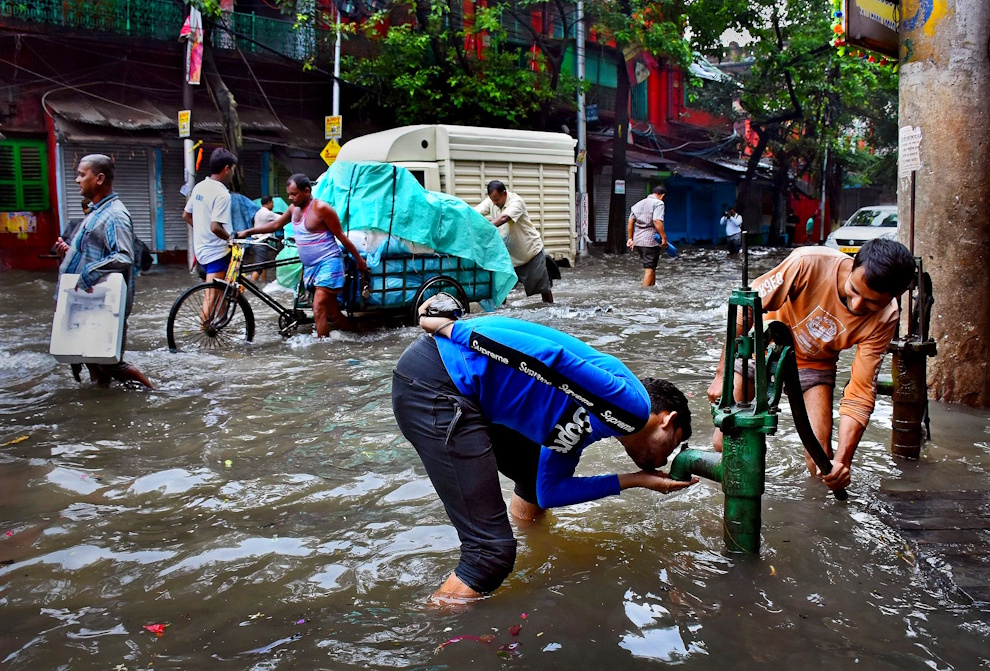
South Asia embodies a central paradox of the climate crisis: it is both a major contributor to, and one of its most vulnerable victims
South Asia stands at a critical juncture, serving as both a significant contributor to and a profound victim of the global climate crisis. This dual role reflects a tragic paradox: while the region’s development has imposed severe strain on its ecological systems, its dense populations and vulnerable geography make it acutely susceptible to climate-induced devastation. Yet, across much of the subcontinent, political leaders continue to act as though natural resources are inexhaustible, systematically ignoring clear warnings of growing water scarcity, collapsing soil fertility, and a rapidly warming climate.
The catastrophic impact of Cyclone Ditwah, which struck Sri Lanka on November 28, serves as a grim testament to this escalating emergency. Killing more than 600 people and affecting the entire island nation of 23 million, the storm’s unprecedented scale laid waste to a tropical jewel renowned for its idyllic Indian Ocean beaches, lush mountain forests, and verdant tea and spice plantations. This disaster is not an isolated event but the latest signal of a deepening environmental crisis engulfing South Asia—home to two billion people, a quarter of humanity.
The Cost of Unchecked Growth
Across the region—with the notable exception of the small Himalayan kingdom of Bhutan, which has deliberately prioritized ecological integrity over unchecked development and mass tourism—nature is being sacrificed at an alarming rate. Urban sprawl, rampant deforestation, and uncontrolled pollution are degrading ecosystems on a massive scale. The consequences are measurable in the very air, soil, and water that sustain life.
-
Air: Bangladesh, Pakistan, and India consistently rank at the very bottom of global air quality indexes. Major metropolitan centers like Delhi, Lahore, Dhaka, and even Kathmandu endure year-round, suffocating concentrations of fine particulate matter (PM2.5). Winter pollution peaks regularly reach levels deemed unlivable, turning cities into gas chambers. The public health fallout is catastrophic; The Lancet estimated that 1.7 million deaths in India in 2022 were attributable to air pollution alone, while the World Health Organization warns of an impending epidemic of respiratory and cardiovascular diseases and cancers.
-
Water: The region’s sacred rivers, most notably the Ganges and Yamuna, have been transformed from lifelines into conduits of contamination. A toxic cocktail of industrial effluent, agricultural pesticide runoff, and untreated urban sewage flows freely into these waters, lacing them with arsenic, cadmium, and lead. The human cost is starkly visible in health outcomes: across the Ganges plain, the incidence of gallbladder cancer—a relatively rare disease—has soared, with India now bearing nearly 10% of the global burden of this illness.
-
Land: The soil, the foundation of South Asia’s agrarian economies, has been exhausted by decades of intensive, chemical-dependent farming. Soil degradation and depletion threaten long-term food security for hundreds of millions.
The Deepening Water Crisis
Compounding these manifold crises is an escalating water emergency. Glaciers in the Himalayas—the region’s vital “water towers”—are retreating at an alarming pace, jeopardizing the perennial river flows that support agriculture and cities downstream. Simultaneously, groundwater tables are being pumped to perilous lows to support irrigation and urban demand, while climate change amplifies both extreme floods and prolonged droughts. This paradox—of devastating inundation alongside chronic scarcity—epitomizes the region’s climate vulnerability.
A Crisis of Governance and Priority
In the face of this existential multi-front crisis, the imperative is clear: all efforts and resources should be directed toward innovative, sustainable solutions while there is still time to avert the worst. Yet, the pace of environmental destruction has not slowed. Instead, it is often accelerated by policy choices that prioritize short-term economic metrics over long-term survival.
Nature continues to be sacrificed at the altar of unbridled growth, a model that disproportionately benefits a powerful few. A small circle of industrial oligarchs profits from extractive and polluting industries, often operating with the complicity of political leaders obsessed with narrow growth trajectories and immediate electoral gains. This governance failure perpetuates a vicious cycle: environmental degradation erodes public health and economic stability, which in turn deepens poverty and inequality, making populations even more vulnerable to the next climate shock.
The path forward demands a radical reimagining of development—one that centers climate resilience, ecological restoration, and environmental justice. Without a decisive break from the current trajectory, South Asia’s dual role as both perpetrator and victim of the climate crisis will only become more pronounced, with consequences that will resonate far beyond its own borders. The devastation of Cyclone Ditwah is not just Sri Lanka’s tragedy; it is a harbinger for a region, and a world, on the brink.
Our Pashto-Dari Website


Support Dawat Media Center
If there were ever a time to join us, it is now. Every contribution, however big or small, powers our journalism and sustains our future. Support the Dawat Media Center from as little as $/€10 – it only takes a minute. If you can, please consider supporting us with a regular amount each month. Thank you
DNB Bank AC # 0530 2294668
Account for international payments: NO15 0530 2294 668
Vipps: #557320

Comments are closed.