

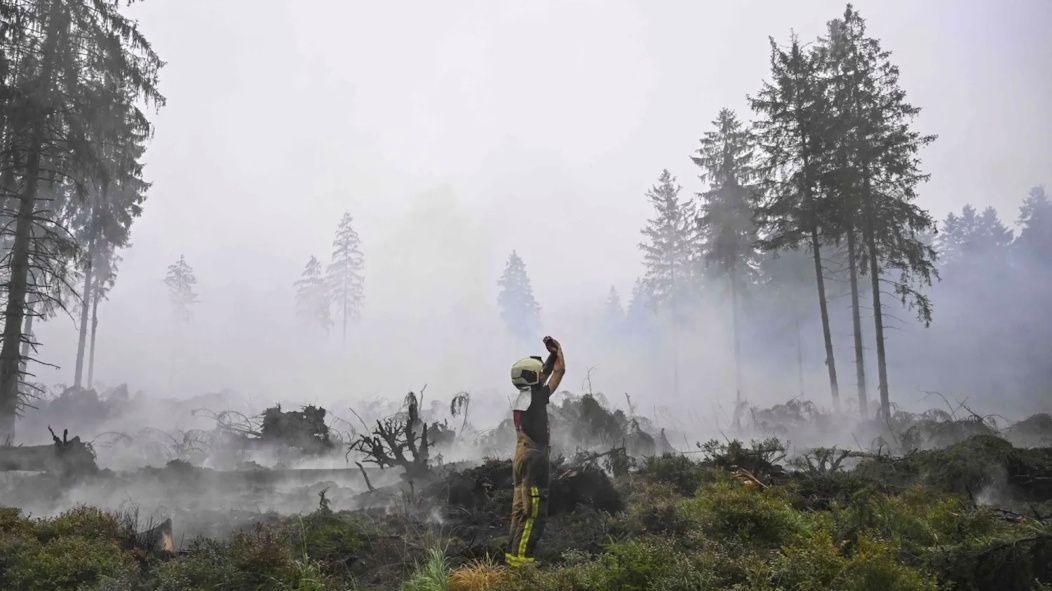
Firefighters have successfully encircled Belgium’s largest wildfire in over a century, but authorities warn that the situation on the ground is far from resolved. After a night of intense effort, crews managed to close the final gap around the blaze, yet new flare-ups continue to test their resolve.
Crisis cell spokesman Tony Hosmans confirmed Wednesday that the fire, which has been ravaging the High Fens nature reserve, is now contained and no longer advancing eastward toward Germany. The immediate priority, he said, is to bring the fire under full control “if possible with aerial support” though weather conditions have made that challenging.
“The situation remains complicated due to a number of flare-ups that have occurred in various parts of the site,” Hosmans added. These outbreaks have forced firefighters to remain on high alert, even as they shift from containment to suppression.
The fire, which broke out Friday under yet-to-be-determined circumstances, expanded over the weekend to scorch roughly 3,000 hectares (7,500 acres)—an area about half the size of Manhattan. The High Fens, a unique mosaic of peatlands, pine forests, and wooden boardwalks, has proven especially difficult to navigate, with its soggy, uneven terrain hampering ground crews and complicating logistics.
The last section to be fully encircled was a particularly inaccessible front near the German border. Ground teams labored through the night under extremely challenging conditions, advancing from the east and north to seal the gap. Their success prevented the fire from crossing into Germany, though the neighbouring town of Monschau had already been evacuated as a precaution. Two Belgian villages were also cleared, though residents of Sourbrodt have since been allowed to return home.
International support has been vital, with water-bombing aircraft arriving from Norway, Germany, Sweden, and the Netherlands. However, low cloud cover grounded all aerial operations on Tuesday, and intermittent rain while helpful in raising humidity and slowing the fire’s spread has continued to hamper visibility and flight safety since Monday. The weather, a double-edged sword, has offered some relief on the ground but limited the most effective tool for extinguishing the blaze.
One of the most insidious aspects of the fire is its behaviour underground. Peat, which makes up much of the reserve’s soil, burns slowly and deeply, making it notoriously difficult to extinguish. “The fire is burning in the peat, so it is actually underground, sometimes quite deep,” said area fire chief David Covens during a reconnaissance mission into the scorched zone. “Whenever we disturb the ground when we cut down a tree and expose the soil the fire can reignite. We’re doing everything we can with the resources available, but we know this is going to take a long time.”
Even after the fire is declared under control, officials caution that it could take weeks or even months of soaking and monitoring to fully neutralise the subterranean embers.
The High Fens blaze is the latest in a series of devastating wildfires that have swept across Europe this summer, fuelled by drought, record-breaking heatwaves, and tinder-dry vegetation. France, Greece, Portugal, and Spain have all faced major infernos, underscoring a continent-wide crisis exacerbated by climate change. Remarkably, the last time the High Fens experienced a fire of this magnitude was in 1911, during a similarly sweltering period a stark reminder of how extreme weather patterns are becoming more frequent and intense.
As firefighters continue their painstaking work, the focus remains on containment, mop-up, and prevention of reignition. For now, the flames are held at bay, but the battle is far from over.
Our Pashto-Dari Website

Support Dawat Media Center
If there were ever a time to join us, it is now. Every contribution, however big or small, powers our journalism and sustains our future. Support the Dawat Media Center from as little as $/€10 – it only takes a minute. If you can, please consider supporting us with a regular amount each month. Thank you
DNB Bank AC # 0530 2294668
Account for international payments: NO15 0530 2294 668
Vipps: #557320

Comments are closed.