

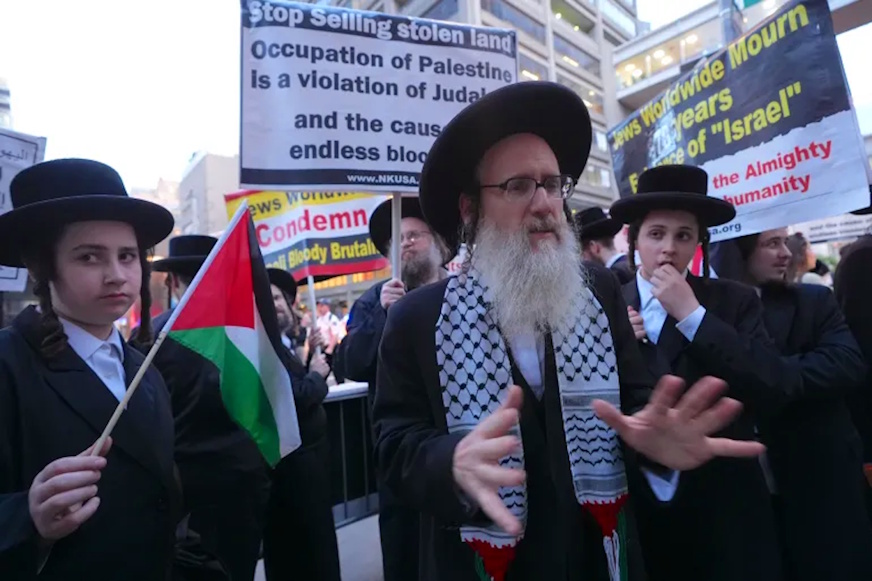
Amid far-right Israeli politicians marching in New York’s annual Israel Day Parade, a growing number of Jewish voices across the diaspora are publicly rejecting the state’s claim to speak in their name. From the streets of Manhattan to community centres in London, these activists insist that the ongoing military offensive in Gaza and the broader occupation of Palestinian territories are incompatible with their values and their faith.
Longstanding tensions between the progressive Jewish diaspora, particularly in the United States, and the Israeli government came into sharp focus this month when Israel’s far-right Finance Minister Bezalel Smotrich who has said he expects to be wanted by the International Criminal Court (ICC) attended the annual Israel Day Parade in New York City alongside other nationalist legislators. As Smotrich joined the pro-Israel procession marching down Fifth Avenue, he was met by a chorus of “shame” and “war criminal” from protesters, many of them Jewish.
The event, commonly known as Israel Day on Fifth, has long been opposed by segments of the Jewish diaspora seeking to distance themselves from Israeli government policies. But this year’s June parade proved particularly controversial, given the ongoing war in Gaza, which has killed more than 37,000 Palestinians according to local health authorities, and the presence of politicians widely accused of enabling what many international legal experts and human rights groups have described as acts of genocide.
Smotrich remained largely unfazed by the chants from progressive Jewish protesters. In remarks to the crowd, he sought to reaffirm the traditional Zionist equation of Jewish safety with Israeli state power a mantra frequently echoed by both Israeli and American political leaders.
“This is a massive celebration – a profound connection uniting the entire global Jewish community, bringing together Jews in Israel and Jews in the United States,” Smotrich said. “This shared destiny has grown significantly stronger over the past three years. The State of Israel is the home of the entire Jewish people. The security of Jews worldwide relies on the strength and security of the State of Israel. There is no better place to live than in Israel.”
Yet for many diaspora Jews, that message no longer resonates. New York Mayor Zoran Mamdani, who had pledged during his election campaign to skip the parade, followed through on his promise a move welcomed by American Jewish organisations critical of the powerful far-right undercurrent in contemporary Israeli politics.
“The Israel Day Parade, which features Israeli politicians who have not only cheered on the genocide of Palestinians but are part of the government committing that genocide, is not a celebration of Jewish identity or pride,” said a joint statement from Israelis for Peace and Jews for Racial & Economic Justice (JFREJ). “@NYCMayor knows this. We’re grateful he is not attending.”
Across the Atlantic, Jewish activists in Europe express similar frustration. They say politicians like Smotrich cynically invoke diaspora Jewish communities—and Judaism itself—to justify the destruction in Gaza, the ongoing occupation of the West Bank, and the expansion of illegal settlements. Groups such as Jewish Voice for Peace in the United States and Na’amod in the United Kingdom argue that the oppression of Palestinians is fundamentally incompatible with the democratic values Israel claims to uphold. They also reject the notion that Israel’s existence as a Jewish state should be treated as an unassailable fact, insisting instead that it must be open to critique and political transformation.
Against the consensus
Emily Hilton, co-founder of Na’amod, says her critical view of Israel crystallised after its 2014 assault on Gaza specifically, the Israeli military’s killing of four Palestinian children playing football on a beach. “I began to question the acceptance of Zionist thought from university onwards,” Hilton told Al Jazeera. “I’d met liberal Zionists who might question the politics of Israel, but it wasn’t until I went to University College London that I first began to meet Jews and Palestinians critical of Israel and what it meant.”
Hilton later joined Jewish activist groups in the UK that held traditional Jewish mourning prayers kaddish for Palestinians killed by Israeli forces during the Great March of Return protests along the Gaza border in 2018. She also attended a vigil after the Hamas-led attack on October 7, 2023, which killed approximately 1,200 Israelis and foreigners, while refusing to excuse the subsequent Israeli military campaign.
Israel’s war on Gaza, launched in response to the October 7 attacks, has killed over 37,000 Palestinians (and wounded more than 85,000), displaced nearly the entire population of the strip, and triggered a severe famine. These events have dramatically altered perceptions among some diaspora Jews about their historical and emotional ties to the state.
“More people are coming to realise that we’re right Israel has lost the moral argument,” Hilton said. “Whatever claim it once had has gone. Now, its only remaining claim is that it acts on behalf of the mainstream Jewish community, and even that is looking less certain.”
Hilton is scathing about the Israeli political opposition as well. She argues that the main political challengers to Prime Minister Benjamin Netanyahu’s government—including right-wing former premier Naftali Bennett and opposition leader Yair Lapid only debate the degree of coercion and violence to be employed, not the underlying structure of Jewish supremacy over Palestinians.
“Claims that they’re acting in my name are, frankly, outrageous,” Hilton added. “It doesn’t matter whether it is the more polite apartheid advocated by Lapid and Bennett or the violence and destruction advocated by the current government. The problem is the system itself. We need to imagine a life beyond Zionism one based on justice and equality. The Israeli state is putting Jewish people in danger by claiming that we are somehow its foot soldiers. We’re not.”
Changing opinions
Polls from across the US and Europe reveal deepening divisions within Jewish diaspora communities regarding Israel. While some Jews, particularly older and more institutionally affiliated ones, report feeling a stronger emotional connection to Israel in the face of global criticism, a significant and growing minority are turning away from a country they believe is committing genocide in their name.
“For far too long, American Jewish institutions have supported the actions of the Israeli government and parroted its justification that what it did was done for the sake of Jewish people everywhere,” Sonya Meyerson-Knox, Communications Director of Jewish Voice for Peace, told Al Jazeera. “In doing so, they not only engineered support for Israeli occupation, apartheid and genocide of Palestinians, but they also silenced and excluded Jews who opposed these actions or tried to hold the Israeli state accountable for its war crimes.”
Meyerson-Knox acknowledges that a majority of major American Jewish organisations continue to support Israel. But she points to what she calls a “sea-change” among rank-and-file community members, especially younger Jews. Surveys conducted in late 2023 and 2024 suggest that Jews under 40 in the US and UK are far more likely to criticise Israel’s actions, support a ceasefire, and identify as anti-Zionist or non-Zionist than their elders.
For decades, support for Israel’s existence as a Jewish state was a near-unshakeable consensus among the vast majority of the global Jewish diaspora, analysts told Al Jazeera. But Israel’s multifront military campaigns over the past three years in Gaza, the occupied West Bank, Lebanon, Syria, Yemen, and Iran have killed tens of thousands of civilians and forced many to revisit that assumption.
“For years, the issue of Israel has been a point of consensus among Jews in the UK and the US. That’s becoming less so,” said Keith Kahn-Harris, a sociologist and fellow at the Institute for Jewish Policy Research. “The war has exposed how many of the decades-old points of consensus about what Israel was were really not fit for purpose.”
Kahn-Harris notes that while the centre-ground consensus on Israel is in decline, and anti-Zionist sentiments are growing among the young, mainstream Jewish communities have not yet reached a stage where they openly question the future of Israel as a state. “They’re there, but they’ve got a long way to go,” he said.
Still, for activists like Hilton and Meyerson-Knox, the shift is unmistakable. The slogan “Not in my name” chanted outside parades, printed on placards, and shared across social media has become a rallying cry for a Jewish diaspora determined to reclaim its identity from what they see as a violent, exclusionary nationalism. Whether that cry will reshape the broader Jewish communal landscape remains an open question. But it is no longer being ignored.
Our Pashto-Dari Website

Support Dawat Media Center
If there were ever a time to join us, it is now. Every contribution, however big or small, powers our journalism and sustains our future. Support the Dawat Media Center from as little as $/€10 – it only takes a minute. If you can, please consider supporting us with a regular amount each month. Thank you
DNB Bank AC # 0530 2294668
Account for international payments: NO15 0530 2294 668
Vipps: #557320

Comments are closed.