

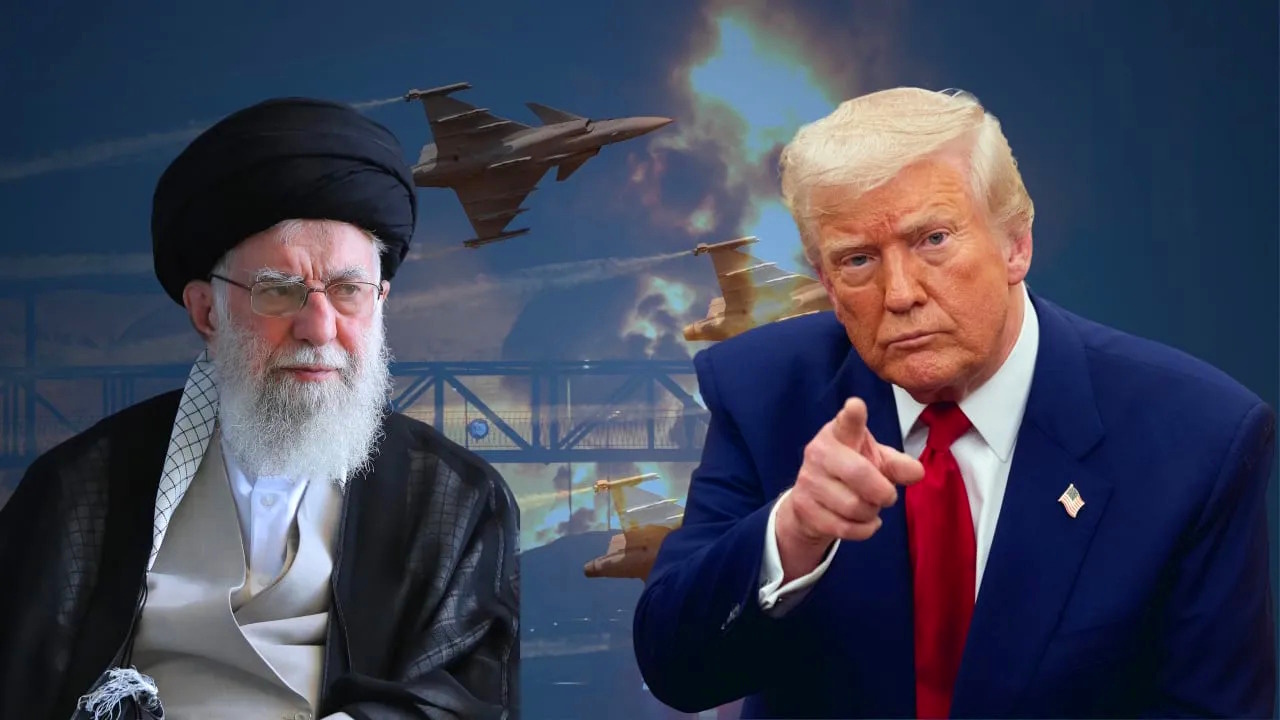
Former US president Donald Trump has warned that “bad things” could happen if Iran fails to reach a deal with Washington, even as Tehran signals readiness to restart nuclear negotiations under specific conditions.
Iranian President Masoud Pezeshkian has formally ordered the launch of nuclear talks with the United States, Iranian state media reported, confirming a potential diplomatic opening amid heightened regional tensions and ongoing domestic unrest inside Iran.
Speaking to reporters at the White House on Monday, Trump said the United States was currently engaged in discussions with Iran and expressed cautious optimism about reaching an agreement.
“Right now we’re talking to them, we’re talking to Iran, and if we can work something out, that’d be great,” Trump said. “And if we can’t, probably bad things would happen.”
While declining to specify what those consequences might be, Trump reiterated that the United States had dispatched “tremendous force” to the Middle East, including an aircraft carrier strike group, which he said was arriving in the region.
Trump has repeatedly warned that “time is running out” for Iran to reach a deal on its nuclear programme, which Western governments believe is aimed at developing an atomic bomb — an allegation Tehran has consistently denied.
Tehran Signals Conditional Willingness for Talks
On Tuesday, President Pezeshkian confirmed that he had instructed Iran’s foreign minister to pursue negotiations, provided that the talks take place in an appropriate diplomatic environment.
“I have instructed my Minister of Foreign Affairs, provided that a suitable environment exists — one free from threats and unreasonable expectations — to pursue fair and equitable negotiations,” Pezeshkian said in a post on X.
He added that any discussions would take place “within the framework of our national interests.”
Iranian Foreign Minister Abbas Araghchi echoed this position in an interview with CNN on Sunday, saying Tehran was aligned with Trump’s stated opposition to nuclear weapons.
“President Trump said no nuclear weapons, and we fully agree. We fully agree with that. That could be a very good deal,” Araghchi said, adding that Iran would expect sanctions relief in return.
Iran’s foreign ministry spokesman Esmaeil Baqaei said Tehran was finalising a framework for negotiations that would be ready in the coming days, with messages currently being exchanged through regional intermediaries.
Istanbul Talks Expected
According to an Arab official speaking to AFP on condition of anonymity, a meeting is likely to take place in Turkiye on Friday, following diplomatic interventions by Egypt, Qatar, Turkiye, and Oman.
US news outlet Axios cited two unnamed sources as saying that Araghchi was expected to meet US envoy Steve Witkoff in Istanbul to discuss a possible nuclear agreement.
Turkiye has taken a leading role in efforts to de-escalate tensions, with Araghchi recently visiting Istanbul and holding talks with regional counterparts in Egypt, Saudi Arabia, and Jordan.
Jordan’s foreign minister Ayman Safadi assured Araghchi on Monday that Jordan would “not be a battleground in any regional conflict or a launching pad for any military action against Iran.”
Threats of Regional Escalation
Iranian authorities, including Supreme Leader Ayatollah Ali Khamenei, have warned that any US military strike would trigger a “regional war.”
Public opinion inside Iran reflects a mix of defiance and frustration. In Tehran, pensioner Ali Hamidi, a 68-year-old war veteran, told AFP he was not afraid of conflict but criticised both Washington and Iran’s leadership.
“America should mind its own business. Why does it want to police the world?” he said.
“But Iranian officials are also at fault for not providing for the people. The economic troubles are back-breaking. The officials should do something tangible, not just talk.”
Protests, Crackdown, and International Fallout
The diplomatic manoeuvring comes against the backdrop of widespread protests that erupted in late December over economic hardship and surged in early January.
Iranian authorities have described the demonstrations as “riots” instigated by foreign enemies, particularly the United States and Israel, with Khamenei likening them to an attempted “coup.”
Tehran has acknowledged thousands of deaths during the unrest. On Sunday, the presidency released the names of 2,986 people out of the 3,117 it said were killed, claiming most were security personnel or bystanders and blaming the violence on “terrorist acts.”
However, the US-based Human Rights Activists News Agency said it had confirmed 6,854 deaths, mostly protesters allegedly killed by security forces, while warning that the real toll could be significantly higher.
Rights groups estimate that at least 40,000 people have been detained.
Fear and Flight
For many Iranians, daily life has become unbearable. Selina, a 25-year-old woman who declined to give her full name, told AFP she fled to Iraqi Kurdistan to escape what she described as constant fear.
“It’s not safe for us in Iran,” she said.
“We don’t even dare to go out after 6:00 pm because soldiers are everywhere.”
Diplomatic Retaliation and Sanctions
The crackdown has prompted sharp international reactions. The European Union designated Iran’s Islamic Revolutionary Guard Corps (IRGC) as a terrorist organisation, leading Iranian lawmakers to retaliate by applying the same label to European armies.
The EU and Britain have imposed fresh sanctions on Iranian officials, including the interior minister, with London targeting 10 individuals over what it described as the “brutality against protesters.”
In response, Baqaei said Iran had summoned the ambassadors of all EU member states in Tehran and warned that further measures were forthcoming.
Iranian state television also reported that four foreign nationals had been arrested in Tehran for alleged participation in the protests, without disclosing their identities or nationalities.
Our Pashto-Dari Website

Support Dawat Media Center
If there were ever a time to join us, it is now. Every contribution, however big or small, powers our journalism and sustains our future. Support the Dawat Media Center from as little as $/€10 – it only takes a minute. If you can, please consider supporting us with a regular amount each month. Thank you
DNB Bank AC # 0530 2294668
Account for international payments: NO15 0530 2294 668
Vipps: #557320

Comments are closed.