

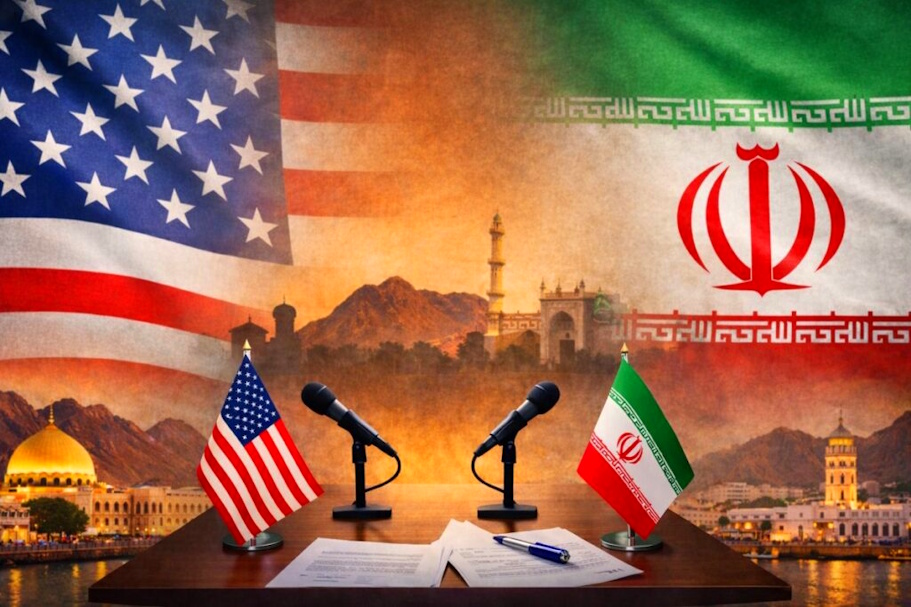
ISLAMABAD – High-stakes negotiations between Iran and the United States are set to begin in Pakistan’s capital on Saturday, as both sides arrived under a fragile ceasefire but burdened by decades of mutual mistrust. Pakistani Prime Minister Shehbaz Sharif has described the talks as a “make or break” opportunity to halt weeks of devastating conflict in the Middle East.
A high-level Iranian delegation, led by Parliament Speaker Mohammad Bagher Ghalibaf and including Foreign Minister Abbas Araghchi, landed in Islamabad on Saturday. Shortly after, the U.S. delegation, headed by Vice President JD Vance and including President Donald Trump’s special envoy Steve Witkoff and son-in-law Jared Kushner, touched down following a refueling stop in Paris.
Both delegations were received at Nur Khan airbase by Pakistan’s army chief, General Asim Munir, who has cultivated working relationships with leaders on both sides of the conflict.
Deep-Seated Distrust on Display
Despite the two-week ceasefire which followed nearly six weeks of open conflict involving Iran and the U.S.-Israeli axis major disagreements persist. Public statements from both camps before the talks began underscored the steep path ahead.
“We have good intentions, but we do not trust,” Ghalibaf said upon arrival, in comments aired by Iranian state TV. “Our experience in negotiating with the Americans has always been met with failure and broken promises.”
Tehran has insisted that Washington must first honor its commitments, including the release of frozen Iranian assets and the implementation of a truce in Lebanon, where Israeli strikes have continued. As of Friday, Israeli air raids against Hezbollah the Iranian-backed militant group have not ceased, with Israel stating that the U.S.-Iran ceasefire does not apply to Lebanon.
Vice President Vance struck a similarly cautious tone before departing Washington. “If the Iranians are willing to negotiate in good faith, we’re certainly willing to extend the open hand,” he told reporters. “But if they’re going to try to play us, then they’re going to find the negotiating team is not that receptive.”
President Donald Trump has made clear that his top priority at the Islamabad talks is ensuring Iran never obtains a nuclear weapon. “No nuclear weapon. That’s 99 percent of it,” he said Friday.
Competing Demands and Regional Flashpoints
The ceasefire itself was built on fragile conditions that have yet to be fully met. Trump demanded the reopening of the Strait of Hormuz a chokepoint for one-fifth of the world’s crude oil as a condition for the truce. However, the strait has not returned to normal traffic. Trump vowed on Friday to have it open soon “with or without” Iran’s cooperation.
Iran, meanwhile, has linked progress in Islamabad to a halt in Israeli military operations in Lebanon. But Israel has rejected any direct talks with Hezbollah, which it labels a terrorist organization. In a statement, Israel’s ambassador to the U.S., Yechiel Leiter, said his country would hold separate discussions with Lebanon’s government in Washington next week, but reiterated: “Israel refused to discuss a ceasefire with Hezbollah.”
The recent hostilities were triggered after Iran launched attacks on February 28, followed by massive Israeli strikes and a ground invasion of Lebanon. Lebanese authorities report over 1,950 people killed in the weeks of fighting, including more than 350 on the first full day of the U.S.-Iran ceasefire alone.
‘Hard Work Ahead’
Prime Minister Sharif, whose country is acting as mediator, acknowledged the difficulty of the task. “A temporary ceasefire has been announced, but now an even more difficult stage lies ahead: the stage of achieving a lasting ceasefire, of resolving complicated issues through negotiations,” he said. “This is that stage which, in English, is called the equivalent of ‘make or break.’”
In Islamabad, security has been heavily tightened. All routes leading to the Serena Hotel the expected venue for the talks have been blocked, while large banners and digital signs along the expressway herald the “Islamabad Talks.”
Global Economic and Public Reactions
The mere prospect of a diplomatic opening has already moved markets. Over the past week, all three major U.S. stock indices advanced by more than three percent, while oil prices tumbled approximately 13 percent as the fragile truce reduced fears of a wider energy disruption.
Yet public skepticism remains high. In Tehran, a 30-year-old resident told AFP that most of Trump’s statements amount to “pure noise and nonsense.” Many Iranians recall the 2015 nuclear deal, from which the U.S. unilaterally withdrew in 2018, as a lesson in broken promises.
As the delegations prepare to sit down in the same room for the first time in years, the question is not whether they can agree but whether they can even begin to trust each other long enough to try.
Our Pashto-Dari Website
Support Dawat Media Center
If there were ever a time to join us, it is now. Every contribution, however big or small, powers our journalism and sustains our future. Support the Dawat Media Center from as little as $/€10 – it only takes a minute. If you can, please consider supporting us with a regular amount each month. Thank you
DNB Bank AC # 0530 2294668
Account for international payments: NO15 0530 2294 668
Vipps: #557320

Comments are closed.