

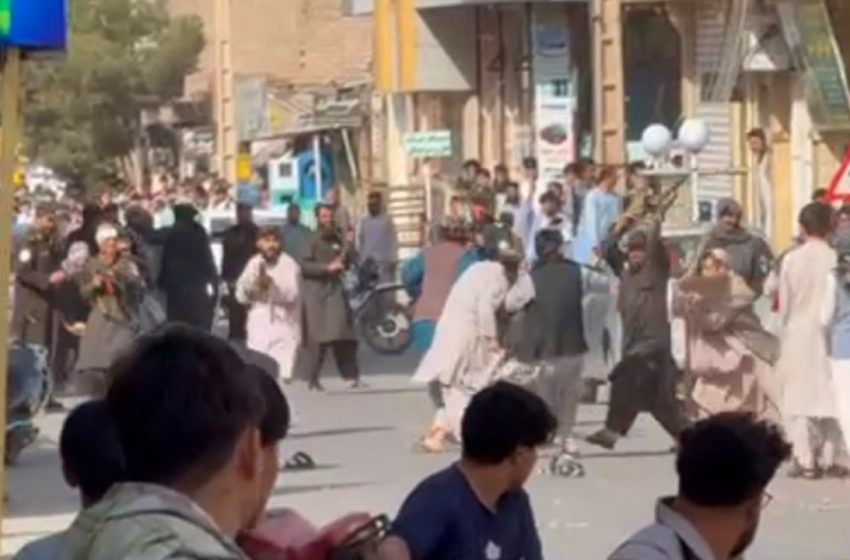
HERAT, Afghanistan – At least two people, including a woman and a child, were killed and dozens more wounded after Taliban forces opened fire on protesters in the western city of Herat, according to local sources. The incident marks one of the most violent crackdowns on public dissent since the Taliban seized power in 2021.
Sources told Dawatmedia24 that the bodies of the two victims had been transferred to Herat Regional Hospital. However, many other wounded protesters have not been taken to government medical facilities, as families fear possible reprisals or arrests by Taliban authorities.
The violence erupted on Tuesday after dozens of residents took to the streets to protest the detention of women and girls accused of violating the Taliban’s strict dress code. The demonstration began in Jebrail township, a predominantly Hazara area northwest of Herat city, where men and women gathered in solidarity with those detained in recent days by members of the Taliban’s Ministry for the Promotion of Virtue and Prevention of Vice (PVPV).
Witnesses reported that Taliban forces opened fire near an intersection known as Bahar-e Zendagi as protesters marched through the area. Several demonstrators were wounded, and according to local residents, the security forces continued firing in an effort to disperse the crowd. Gunfire could be heard for several minutes, and panic swept through the gathering as people fled for cover.
The Taliban have not publicly commented on the shootings, though a local official, speaking on condition of anonymity, denied that live ammunition was used, claiming instead that warning shots were fired into the air. This assertion was contradicted by multiple eyewitness accounts and medical sources.
The protest followed days of mounting anger over the reported detention of women and girls in Herat for allegedly failing to comply with the Taliban’s interpretation of Islamic dress requirements. Residents and local sources said the crackdown was preceded by a decision reportedly made during a provincial meeting led by Herat’s Taliban governor, who allegedly ordered stricter enforcement of dress rules, including action against women whose faces were not fully covered in public.
Sources said Taliban morality police detained as many as 35 women on Saturday at three locations across the city. The women were later released after male family members were summoned and formally warned, according to local residents. Flyers circulated across Herat on Monday calling on residents to gather Tuesday morning in Jebrail’s District 13 to protest the arrests. The demonstration appeared to be one of the largest public protests in recent months against the Taliban’s restrictions on women.
A Herat resident, speaking on condition of fear for his safety, told reporters that Taliban forces also detained 17 women following Tuesday’s protest, allegedly for participating in or supporting the demonstration. These latest detentions could not be independently verified.
The events in Herat have drawn growing international concern. Richard Bennett, the United Nations Special Rapporteur on human rights in Afghanistan, said he was “deeply alarmed” by reports that scores of women had been detained in Herat for a third consecutive day over alleged dress-code violations. He called for their immediate and unconditional release.
The issue was also raised before the UN Security Council, where Georgette Gagnon, the acting head of the United Nations Assistance Mission in Afghanistan (UNAMA), cited reports that about 30 women had been detained in Herat by Taliban morality police for allegedly failing to comply with dress requirements. Gagnon warned that such enforcement actions risk further isolating Afghanistan and deepening its humanitarian crisis.
Since returning to power in August 2021, the Taliban have imposed sweeping restrictions on women and girls, including bans on secondary and university education, limitations on most forms of employment, and increasingly strict rules governing women’s appearance and movement in public. The international community has largely condemned these measures, but efforts to reverse them have so far failed.
Residents in Herat said there were growing calls for additional demonstrations in the coming days, including after Friday prayers, as anger over the arrests and the use of lethal force against peaceful protesters continued to spread. One activist, who requested anonymity, said, “People are fed up. They are willing to risk their lives because they have nothing left to lose.”
Humanitarian and Security Implications
Local hospitals, already struggling with shortages of medicine and staff, are reportedly overwhelmed. Humanitarian workers warn that the crackdown may deter families from seeking medical care for the wounded, potentially leading to avoidable deaths or permanent injuries.
Meanwhile, the Taliban’s interior ministry has not issued any statement acknowledging the shootings or the deaths. In previous instances of protest-related violence, the Taliban have often denied using excessive force or launched investigations that yielded no public findings.
This incident underscores the fragile and increasingly repressive environment in Taliban-controlled Afghanistan, where peaceful dissent is frequently met with brute force, and where women remain at the center of a growing human rights crisis.
Our Pashto-Dari Website
Support Dawat Media Center
If there were ever a time to join us, it is now. Every contribution, however big or small, powers our journalism and sustains our future. Support the Dawat Media Center from as little as $/€10 – it only takes a minute. If you can, please consider supporting us with a regular amount each month. Thank you
DNB Bank AC # 0530 2294668
Account for international payments: NO15 0530 2294 668
Vipps: #557320

Comments are closed.