

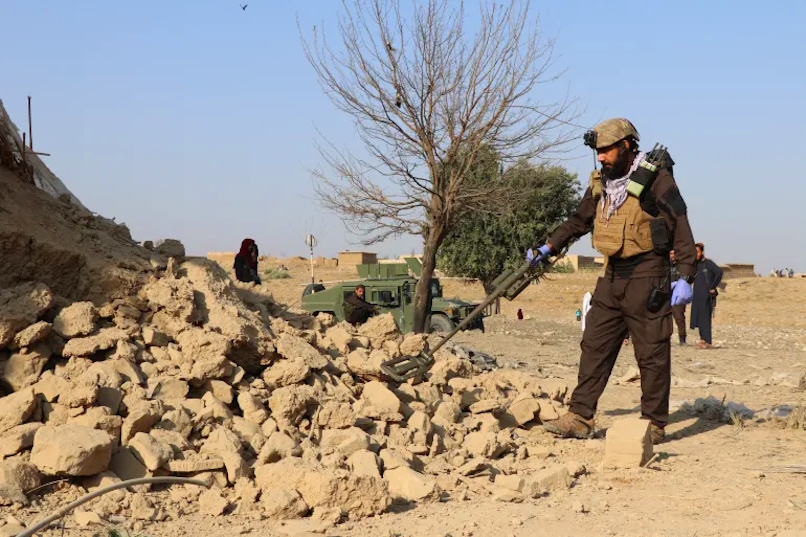
Pakistan says it carried out air strikes on 10 locations in Afghanistan allegedly used to store and launch drones involved in cross-border attacks.
Pakistan has carried out a new wave of air strikes inside Afghanistan, killing at least four people, according to the Afghan Taliban government, which has vowed to deliver an “appropriate response”.
The strikes mark a further escalation in already strained relations between the two neighbouring countries, following months of accusations over cross-border attacks and the presence of armed groups operating from Afghan territory.
Pakistan said on Thursday that its military conducted air strikes against 10 locations in Afghanistan that it identified as sites used to store and launch drones. Islamabad said some of the drones had been used in attacks against Pakistan.
Afghanistan’s Taliban government spokesperson, Zabihullah Mujahid, said the strikes targeted areas in Kandahar, Paktia and Khost provinces. He condemned the attacks and said Afghanistan reserved the right to respond.
A resident of Kandahar city told the AFP news agency that they heard a jet flying overhead before a large explosion shook the area. The resident said a fire subsequently broke out in the centre of the southern Afghan city.
Pakistan defended the operation as a limited military response to what it described as an attack originating from Afghan territory.
Information Minister Attaullah Tarar said the strikes were “deliberate, precise, calibrated, and proportionate” and were “strictly limited to identified military objectives directly linked to the attempted attacks against Pakistan”.
He accused armed groups of carrying out a “deliberate and unlawful incursion into Pakistan by drones” on Wednesday, describing it as a violation of Pakistan’s sovereignty and territorial integrity.
“This constitutes a blatant violation of Pakistan’s sovereignty and territorial integrity and is a grave and unacceptable act of aggression,” Tarar said.
The Taliban government, however, denied that Afghan authorities had launched drones against Pakistan.
The competing claims underline the increasingly hostile relationship between the two sides, with Islamabad repeatedly accusing Afghanistan of allowing armed groups to use its territory to plan and launch attacks into Pakistan.
The Taliban government rejects the accusation that it provides sanctuary to anti-Pakistani armed groups, arguing that militancy inside Pakistan is an internal issue for Islamabad to resolve.
Fighting follows months of relative calm
The latest air strikes come after a period of relative calm following some of the most serious fighting between Pakistan and Afghanistan in years.
An attack on a police facility in northwestern Pakistan last week, which killed at least 21 people, helped reignite tensions between the two countries after nearly three months of reduced hostilities. A Pakistan Taliban faction claimed responsibility for the blast and the subsequent gun battle.
Pakistan has long blamed the Tehrik-i-Taliban Pakistan (TTP), also known as the Pakistan Taliban, for attacks inside the country and has accused members of the group of operating from bases in Afghanistan.
Afghan officials have repeatedly denied that Kabul allows militants to use Afghan territory to launch attacks against Pakistan.
The dispute has become one of the central sources of tension between the two governments since the Taliban returned to power in Afghanistan in 2021. Although Pakistan was once regarded as an important regional partner of the Taliban, relations have deteriorated significantly as Islamabad has increased pressure on Kabul to prevent attacks by the TTP.
The latest escalation follows another round of Pakistani air raids earlier this week.
On Monday, Afghan officials said Pakistani aircraft struck three locations in northeastern Afghanistan. The attacks in Nurgal district of Kunar province reportedly killed three civilians, according to Afghan authorities.
Pakistan gave a different account of the operation, saying its forces had killed 28 “terrorists”. The two sides have therefore continued to provide sharply different accounts of the casualties and targets involved in the air strikes.
Regional mediation under pressure
The renewed violence also threatens diplomatic efforts by regional powers seeking to prevent the dispute from developing into a wider conflict.
China, Türkiye, Qatar and Saudi Arabia have been involved in diplomatic efforts aimed at encouraging dialogue and reducing tensions between Islamabad and Kabul.
The latest strikes could make those efforts more difficult, particularly if Afghanistan follows through on its threat of retaliation.
Neither side has indicated that it wants a prolonged conventional conflict. However, repeated cross-border strikes, accusations of harbouring militants and retaliatory attacks have created a cycle in which individual attacks risk triggering a wider military confrontation.
The situation is particularly sensitive because Pakistan and Afghanistan share a long and porous border. Armed groups have historically operated in border regions, while disputes over security, sovereignty and the movement of people and goods have repeatedly strained relations.
For now, the two governments remain divided over the fundamental question at the centre of the dispute: Pakistan says armed groups based in Afghanistan are responsible for attacks on its territory, while Afghanistan rejects the allegations and objects to Pakistani military operations on Afghan soil.
The latest air strikes, followed by Kabul’s promise of an “appropriate response”, raise the prospect of further confrontation unless diplomatic efforts succeed in containing the escalation.
Our Pashto-Dari Website
Support Dawat Media Center
If there were ever a time to join us, it is now. Every contribution, however big or small, powers our journalism and sustains our future. Support the Dawat Media Center from as little as $/€10 – it only takes a minute. If you can, please consider supporting us with a regular amount each month. Thank you
DNB Bank AC # 0530 2294668
Account for international payments: NO15 0530 2294 668
Vipps: #557320

Comments are closed.