
At UN Security Council, UNAMA Provides Briefing on Afghanistan’s Economy, Free Speech, Education, and Women’s Rights

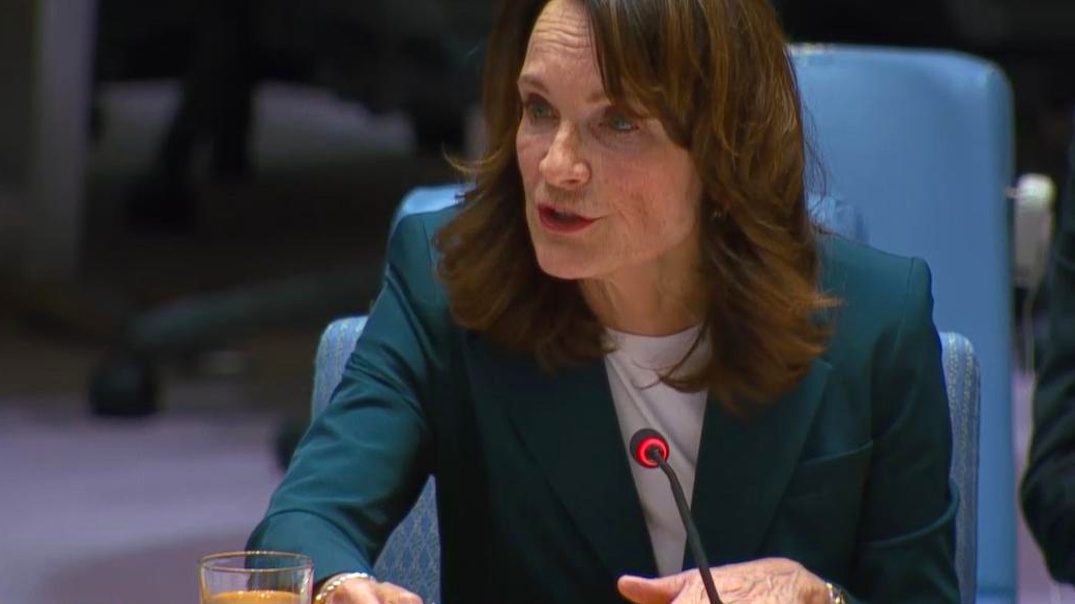
United Nations, New York – Georgette Gagnon, the Acting Head of the United Nations Assistance Mission in Afghanistan (UNAMA), briefed the UN Security Council on Monday, presenting a comprehensive report detailing Afghanistan’s deteriorating economic conditions, restrictions on free speech, the exclusion of women and girls from education, and the broader erosion of human rights under Taliban rule.
UNAMA released the full text of Gagnon’s address on the afternoon of Monday, June 8. The Security Council session on Afghanistan convened earlier that day, Kabul time, at UN headquarters in New York.
A Crisis Across All Sectors
In her address, Gagnon reported on recent travels to several remote regions of Afghanistan, where she heard consistent and urgent messages from local communities regarding mounting economic, humanitarian, and human rights pressures. Her briefing to the Council covered four key areas: political and economic developments, the situation of women and girls, human rights violations (including restrictions on freedom of expression), and regional dynamics.
Economic Situation: Fragile Stability, Severe Risks
While noting “signs of stability in macroeconomic indicators” such as exchange rates and inflation, Gagnon cautioned that these fragile gains mask significant underlying risks. She identified the mass return of Afghan migrants from neighboring countries—particularly Iran and Pakistan—as the most pressing threat. Since 2023, nearly 5.9 million people have returned to Afghanistan, an increase of more than 10 percent in the country’s total population.
According to the report, an additional 2.8 million Afghans are projected to return in 2026. Gagnon warned that these individuals are returning to communities and an economy incapable of absorbing them. As the World Bank has documented, the average Afghan is becoming poorer in real terms each day. She emphasized that Afghanistan remains one of the world’s largest humanitarian crises, with an estimated 21.9 million people requiring urgent humanitarian assistance in 2026.
Women and Girls: ‘Systematic and Institutionalized Harm’
Gagnon addressed the status of women and girls with unsparing clarity, stating that they face a form of “systematic and institutionalized harm” that will have long-term consequences for Afghan society as a whole. Under Taliban decrees, approximately 3.8 million girls aged 7 to 18 are denied access to education, including more than 2.6 million adolescent girls who have been barred from secondary schools. She noted that each year, an additional 250,000 girls are permanently excluded from the secondary education pathway, with no alternative options for formal learning.
Beyond education, Gagnon highlighted the broader erosion of rights, including severe restrictions on employment, public movement, and access to healthcare. She described Decree No. 18 on the separation of spouses as incompatible with both the Convention on the Elimination of All Forms of Discrimination Against Women (CEDAW) and the rights of the child.
Call to Action and UN Principles
The Acting Head of UNAMA reiterated the UN’s call on the de facto authorities to lift all restrictions against women and girls, including those that bar female UN staff members from working—a prohibition she characterized as a direct violation of the United Nations Charter. “We once again call on the ruling authorities to lift all restrictions,” she stated. Gagnon also described the general suppression of freedom of expression and the narrowing of civic space as deeply troubling trends that further isolate Afghanistan from the international community.
The Security Council meeting concluded with several member states voicing support for UNAMA’s continued presence and calling for unified international pressure to reverse the Taliban’s discriminatory policies. The full transcript of Gagnon’s briefing is available through UN documentation channels.
Support Dawat Media Center
If there were ever a time to join us, it is now. Every contribution, however big or small, powers our journalism and sustains our future. Support the Dawat Media Center from as little as $/€10 – it only takes a minute. If you can, please consider supporting us with a regular amount each month. Thank you
DNB Bank AC # 0530 2294668
Account for international payments: NO15 0530 2294 668
Vipps: #557320

Comments are closed.