


Pakistan’s Crypto Diplomacy and the Anatomy of a Failing State
The recent revelations linking Donald Trump’s multibillion-dollar cryptocurrency windfall to Pakistani networks are no longer speculative. They are anchored in converging international reporting that exposes what can only be described as a deliberate fusion of financial opportunism and diplomatic access.
Several outlets point to the scale of the operation. One report describes a “$1.4 billion crypto jackpot” tied to Trump-linked ventures with a “Pakistan connection,” underscoring that these gains were not incidental but structurally linked to international financial flows involving Pakistani actors. Another account characterizes the episode as a “crypto diplomatic bet,” suggesting Islamabad leveraged digital finance to secure proximity and influence.
The mechanics of this engagement are even more revealing. Reporting indicates that Pakistan did not remain a passive observer. It actively pursued agreements with Trump-affiliated crypto entities, including plans for a “dollar-linked stablecoin” to be explored within Pakistan’s financial system. This was not marginal participation. It was state-level entry into a loosely regulated financial architecture.
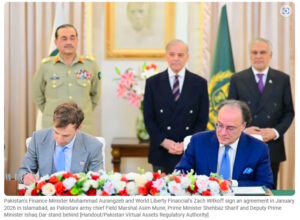
The political dimension is unmistakable. As one report bluntly framed it, the arrangement amounted to “$500m for access,” capturing the transactional nature of the relationship. That access was institutional. According to Al Jazeera, Prime Minister Shehbaz Sharif and army chief Field Marshal Asim Munir were present as executives from the Trump-linked firm were formally received in Islamabad, where Zach Witkoff signed an agreement with Finance Minister Muhammad Aurangzeb. This was diplomacy reduced to its most transactional form.
Further reporting reinforces the same pattern. Pakistan’s outreach aligned with what one outlet described as a “transactional worldview,” where financial engagement becomes a pathway to political influence. Another account highlights the role of intermediaries, noting how a “crypto bro… helped Pakistan win over Trump’s world,” effectively creating a parallel channel outside formal diplomacy.
Placed in isolation, these revelations would already be troubling. Placed in context, they become systemic.
Pakistan’s economic position is defined by structural dependency. It carries significant debt obligations to China tied to infrastructure financing. It repeatedly turns to the World Bank and IMF for stabilization. It relies on Gulf states for deposits, oil facilities, and emergency support. This is not resilience. It is layered financial exposure.
At the same time, Pakistan faces intensifying internal instability—but not for the reasons it publicly emphasizes. In Balochistan, in Khyber Pakhtunkhwa, and in Kashmir, unrest is not simply a matter of militancy or external agitation. It is rooted in chronic economic exclusion, misappropriation of resources, and the systematic failure to translate national projects into local development.
The populations of these regions do not see the benefits of the state’s economic activity. Resource-rich Balochistan remains underdeveloped, its wealth extracted while local communities experience minimal reinvestment. In Khyber Pakhtunkhwa, cycles of conflict have been compounded by the absence of sustained economic opportunity. In Kashmir, prolonged instability has further limited development while deepening political grievance.
More critically, these populations do not merely experience neglect. They experience victimization. Security-heavy responses, combined with weak governance and lack of economic inclusion, have reinforced perceptions that the state extracts from these regions without representing them. One report’s reference to “severe economic troubles” and “mounting internal unrest” only captures the surface. The underlying driver is structural: resources flow upward, while instability remains localized.
This creates a self-reinforcing cycle. Misappropriation and lack of development fuel resentment. Resentment fuels insurgency. Insurgency justifies further securitization, which in turn suppresses economic growth and deepens alienation.
It is within this environment of financial strain and internal fracture that Pakistan’s turn toward crypto-linked financial maneuvering must be understood.
Cryptocurrency, with its opacity and weak regulatory oversight, becomes a tool of last resort. But this is not innovation. It is substitution under pressure.
And here the contradiction becomes stark.
A government dependent on international financial institutions cannot credibly engage in financial ecosystems that undermine transparency. A state seeking long-term investment cannot sustain internal regions where development is absent and populations feel exploited. Yet Pakistan is attempting both simultaneously.
The crypto episode exposes this dual failure. What is presented as strategic engagement is, in reality, opportunism driven by constraint. What is framed as diplomacy is the monetization of access.
The international implications are immediate. In a global environment increasingly defined by compliance and traceability, Pakistan’s involvement in politically entangled crypto ventures reinforces perceptions of systemic risk. Creditors see governance gaps. Investors see instability. Partners see unreliability.
The most damaging element, however, is not the scandal itself. It is what the scandal reveals.
Pakistan is no longer operating from a position of strategic coherence. It is reacting financially, politically, and diplomatically, to mounting pressure. The “crypto jackpot” is not a success story. It is a symptom.
A country burdened by debt, fractured internally by misgovernance, and increasingly reliant on opaque financial channels is not exercising agency. It is managing decline.
And decline, once normalized, rarely reverses on its own.
Pakistan Strikes, Region Engages: Ghani’s Contradiction Exposed
Our Pashto-Dari Website

Support Dawat Media Center
If there were ever a time to join us, it is now. Every contribution, however big or small, powers our journalism and sustains our future. Support the Dawat Media Center from as little as $/€10 – it only takes a minute. If you can, please consider supporting us with a regular amount each month. Thank you
DNB Bank AC # 0530 2294668
Account for international payments: NO15 0530 2294 668
Vipps: #557320

Comments are closed.