
Zalmay Khalilzad’s Visit to Kabul: Messages, Implications, and Prospective Scenarios
Prof . Dr. Ubaidullah Burhani

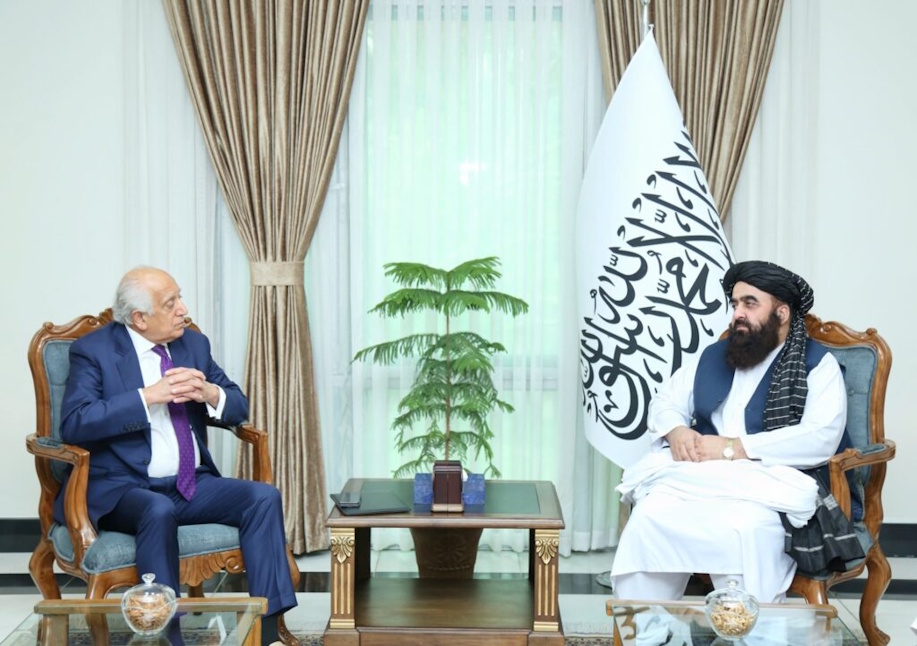
Zalmay Khalilzad’s recent visit to Kabul, the former U.S. Special Representative for Afghan Peace, should not be interpreted merely as a personal initiative or a routine ceremonial gesture. While formally characterized as unofficial, the visit carries a clearly semi-official significance, consistent with established practices of major powers that rely on backchannel diplomacy to manage complex issues rather than direct engagement or full disengagement.
From a U.S. strategic perspective, sensitive matters including the Afghan dossier are not handled exclusively through official channels. Instead, individuals possessing deep political experience, nuanced understanding of local and regional contexts, and extensive networks enabling them to operate in the gray areas between formal and informal diplomacy are utilized. Khalilzad represents a prominent example of such a figure, given his comprehensive knowledge of Afghanistan, his ability to convey messages effectively, and his capacity to assess trends without generating formal political obligations for Washington.
Accordingly, describing the visit as “unofficial” does not diminish its role as a functional political instrument, used for assessment, message transmission, pulse-taking, and gauging the degree to which the de facto authorities in Kabul adhere to internationally acceptable standards, within a framework emphasizing risk management over final decision-making.
The visit reflects the continuation of a U.S. approach that avoids full disengagement from Kabul, favoring controlled, indirect communication. Following the withdrawal, Washington relied on regional intermediaries—primarily Qatar, with its established influence, and later Saudi Arabia—to maintain minimal engagement. Khalilzad’s personal presence, however, signals an American intent to conduct a direct assessment of the Afghan situation amid evolving field and regional dynamics.
Recent security developments have been instrumental in recalibrating this assessment. Evidence indicates that Afghanistan was neither the executor nor the originator of the attack targeting Chinese workers in Tajikistan, dispelling significant regional and international concerns regarding Kabul’s security role. This finding underscores practical, rather than rhetorical, compliance with the Doha Agreement, particularly regarding the prohibition of using Afghan territory to threaten other states or undermine their interests.
This security compliance also contextualizes Khalilzad’s meeting with Amir Khan Muttaqi, the de facto Foreign Minister, as an evaluative dialogue focusing on security discipline and Afghanistan’s positioning within regional political and economic influence calculations, rather than a political prelude to recognition. Following the visit, Zaker Jalali, Deputy Head of the Political Affairs Department at the Afghan Foreign Ministry, affirmed that “the previous page has been turned” with the United States, advocating for normalization of relations and commending Washington’s positive contributions, including the construction of Kandahar Airport, the Helmand Dam, and other critical projects. This reflects growing recognition that Afghanistan’s stability remains a vital regional and international interest and that the country occupies a pivotal position in broader geopolitical calculations.
The implications of the visit extend beyond Afghanistan’s borders. The visit signals to neighboring states, Central Asia, China, Russia, and the Gulf countries that the United States, while seemingly absent, remains strategically present—monitoring, evaluating, repositioning, and working to prevent the emergence of a long-term geopolitical vacuum exploitable by rival powers.
The timing of the visit further underscores its significance, occurring on the cusp of a new year amid rapidly evolving regional and international dynamics and intensifying competition among major powers. That this was Khalilzad’s fourth visit within a short period indicates that the Afghan file remains under strategic review and that international approaches have yet to stabilize into a definitive framework.
Prospective Scenarios for Afghanistan:
1. Gradual Engagement: The United States and select international actors expand backchannel communications, provide limited economic and humanitarian assistance, and may selectively relax certain restrictions, in exchange for continued security compliance and non-export of threats to the region. While not resulting in formal recognition, this scenario aims to stabilize relative calm and prevent security or economic deterioration.
2. Consolidation of the Status Quo: The most probable near-term scenario, emphasizing crisis management rather than resolution, with continued indirect engagement, maintaining Afghanistan under strategic observation, and selectively employing political and economic leverage. This approach allows Washington to retain maneuvering space without incurring the costs of formal recognition or full engagement.
3. International Repositioning of the Afghan File: In the context of growing competition with China and Russia, Afghanistan may be leveraged as a geopolitical instrument, utilizing its strategic location or regional influence to reassert its relevance in international balance-of-power calculations.
4. Conditional and Limited Opening: The least likely, but plausible, scenario contingent on unexpected regional shifts or international agreements, involving gradual political and economic engagement beyond security commitments, without guaranteeing full international recognition.
Conclusion
In sum, Khalilzad’s visit does not signify a fundamental shift in U.S. policy but exemplifies the strategic management of American influence rather than disengagement. It conveys a dual message: to the de facto authorities in Kabul, delineating the limits of internationally acceptable behavior, and to the region, reaffirming Washington’s continued oversight of the Afghan file through backchannels, balancing non-recognition with prevention of a strategic vacuum, during a period characterized by geopolitical fluidity and rapid shifts in global power dynamics
The original article was published on the White House platform in Washington, D.C., Arabic section.
Between Tehran and the United Nations: Kabul Prioritizes National Interests Over External Agendas
Our Pashto-Dari Website

Support Dawat Media Center
If there were ever a time to join us, it is now. Every contribution, however big or small, powers our journalism and sustains our future. Support the Dawat Media Center from as little as $/€10 – it only takes a minute. If you can, please consider supporting us with a regular amount each month. Thank you
DNB Bank AC # 0530 2294668
Account for international payments: NO15 0530 2294 668
Vipps: #557320

Comments are closed.