
Afghan AI Researcher Wins Silicon Valley Gold Medal for Smart Wound-Healing Innovation

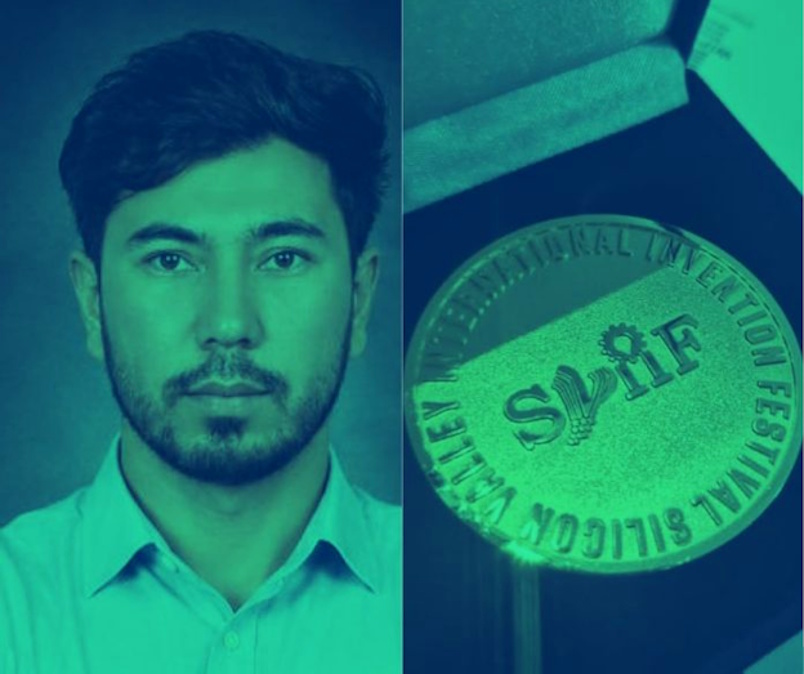
An Afghan artificial intelligence researcher has won a gold medal at the 2026 Silicon Valley International Invention Festival in California for developing an AI-powered digital platform aimed at improving wound healing and reducing permanent scarring through precision regenerative medicine.
Fereidoun Farzad, a PhD researcher specializing in artificial intelligence, received the award in Santa Clara on August 15 for his invention, “AI-Driven Digital Twin Platform for Scar-Free Precision Wound Regeneration.”
The project brings together artificial intelligence, digital twin technology and regenerative medicine to create a virtual representation of the wound-healing process. The system is designed to help researchers study how wounds heal, model different treatment scenarios and evaluate potential interventions with greater precision before they are applied in real-world clinical settings.
The recognition places an Afghan researcher among international innovators whose work is being recognized for its potential contribution to emerging medical technologies. It also highlights the growing participation of Afghan scientists in advanced fields such as artificial intelligence, biomedical engineering and digital healthcare, despite the political, financial and logistical barriers facing researchers from Afghanistan.
Using AI to understand how wounds heal
Farzad said the idea behind the project began with a fundamental scientific question: whether artificial intelligence could help make wound treatment more precise while reducing the likelihood of long-term scarring.
What began as a research concept developed over months of investigation, testing, refinement and collaboration into a digital platform capable of modeling complex biological processes involved in tissue repair and regeneration.
The central concept is the use of a digital twin a virtual representation of a physical or biological system that can be analyzed, updated and used to simulate different outcomes.
In healthcare research, digital twins are increasingly being explored as a way to model individual biological processes, predict how a patient or tissue may respond to different interventions, and support more personalized approaches to treatment.
In the case of Farzad’s project, the technology is intended to provide researchers with a digital environment in which different wound-healing scenarios can be examined and optimized.
The long-term objective is to contribute to approaches that could support faster and more effective tissue regeneration while minimizing the formation of permanent scars.
“Science has no borders, and young Afghans can compete internationally, present innovative ideas and contribute to solving complex global problems,” Farzad told Khaama Press.
He said the project is ultimately motivated by the possibility of turning advanced research into practical solutions that can improve people’s lives.
“The real value is transforming research and knowledge into a solution that can ultimately improve people’s lives,” he said.
A virtual presentation from outside the United States
Farzad and his research team were unable to travel to California to attend the competition in person because of visa restrictions and broader political and logistical circumstances affecting Afghan researchers.
Instead, the team presented its invention remotely and participated in the international competition online.
Despite the limitations, the project progressed through the competition and ultimately received the festival’s gold medal.
For Farzad, the recognition carried significance beyond the award itself. He described the achievement as evidence that Afghan researchers can participate in international scientific competitions and contribute to global innovation even when restrictions on travel and international mobility make physical participation difficult.
The experience also demonstrates how digital communication and remote participation can create opportunities for researchers who might otherwise be excluded from international scientific events.
Farzad’s second international gold medal
The Silicon Valley recognition is Farzad’s second major international innovation award.
He previously received a gold medal at the ArshMedis International Invention Festival in Russia for another research project.
Farzad attributed his latest achievement to the collective efforts of his research team, academic supervisors and mentors, emphasizing that scientific innovation is rarely the result of an individual effort alone.
The recognition, he said, reflects the work of everyone involved in developing, evaluating and refining the technology.
Why digital twins matter in regenerative medicine
Digital twin technology has emerged as an important area of research across several sectors, including healthcare.
A digital twin can represent a biological system or process in a virtual environment, allowing researchers to examine how that system might behave under different conditions.
In medicine, researchers are exploring potential applications ranging from disease modeling and treatment planning to monitoring patient responses and simulating biological processes.
For wound care and regenerative medicine, such technology could eventually help researchers better understand the complex interactions involved in tissue repair.
Wound healing is influenced by numerous biological factors, including inflammation, blood flow, cellular activity, tissue structure and the formation of new tissue. Complications can result in delayed healing, infection or excessive scar formation.
AI-based modeling could potentially help researchers identify patterns within these complex processes and explore treatment strategies tailored to specific circumstances.
Farzad’s project seeks to contribute to this broader area of research by creating a computational framework for simulating wound regeneration and exploring approaches that could lead to more precise healing outcomes.
The technology remains a research innovation rather than a substitute for clinical diagnosis or treatment, but its developers hope that continued research and validation could eventually support practical medical applications.
Afghan innovation despite significant barriers
Farzad’s achievement comes at a difficult time for Afghanistan’s academic and scientific communities.
Since the political changes of 2021, Afghan researchers and academics have faced significant challenges related to access to higher education, international travel, research funding and global academic collaboration.
These difficulties can make it harder for Afghan scientists to participate in international conferences, laboratories, competitions and research networks.
For researchers working in highly technical fields such as artificial intelligence, access to international collaboration, computing resources, laboratories, academic publications and professional networks can be particularly important.
Against this backdrop, Farzad said he hopes his achievement will encourage other Afghan students and young researchers to pursue careers in science, technology and innovation.
He believes international recognition can demonstrate that Afghan researchers have the ability to contribute to cutting-edge scientific work when given the necessary opportunities and support.
The achievement also offers a different narrative about Afghanistan one centered not on conflict and crisis, but on education, research and technological innovation.
“I want Afghanistan to be known for science and innovation”
Farzad dedicated the award to the people of Afghanistan and said he hopes scientific achievements by Afghan researchers can help change how the country is viewed internationally.
“I want Afghanistan to be known not only for war, migration and crisis, but also for science, innovation, artificial intelligence and research,” he said.
For Farzad, the broader goal extends beyond winning international awards.
He said he hopes to see more Afghan students gain access to internationally recognized universities, research laboratories and technology companies, where they can participate in the development of new knowledge and technologies.
His vision is for Afghan researchers to become contributors to global scientific progress rather than being viewed primarily as consumers of technologies developed elsewhere.
A message to young Afghan researchers
Farzad’s journey also reflects the increasingly international nature of artificial intelligence research. Scientific ideas can now be developed collaboratively across borders, tested through digital platforms and presented to international audiences without researchers necessarily being physically present at every stage.
For young Afghan scientists, however, access to these opportunities remains uneven.
Farzad hopes his experience can serve as encouragement for students who are considering careers in artificial intelligence, engineering, medicine and other scientific disciplines.
His gold medal in Silicon Valley, he said, is not simply a personal accomplishment but a reminder that Afghan researchers can participate in the global scientific community and produce ideas with potential international impact.
As artificial intelligence continues to reshape healthcare and biomedical research, projects that combine computational modeling with medicine could become increasingly important.
For Farzad and his team, the next challenge is to continue developing and validating their platform and explore how AI-driven digital twins can contribute to more precise approaches to wound healing and regenerative medicine.
The award in California has given the project international visibility but for the Afghan researcher behind it, the larger ambition is to use science and innovation to open new possibilities for both healthcare and the next generation of Afghan scientists.
Support Dawat Media Center
If there were ever a time to join us, it is now. Every contribution, however big or small, powers our journalism and sustains our future. Support the Dawat Media Center from as little as $/€10 – it only takes a minute. If you can, please consider supporting us with a regular amount each month. Thank you
DNB Bank AC # 0530 2294668
Account for international payments: NO15 0530 2294 668
Vipps: #557320

Comments are closed.