

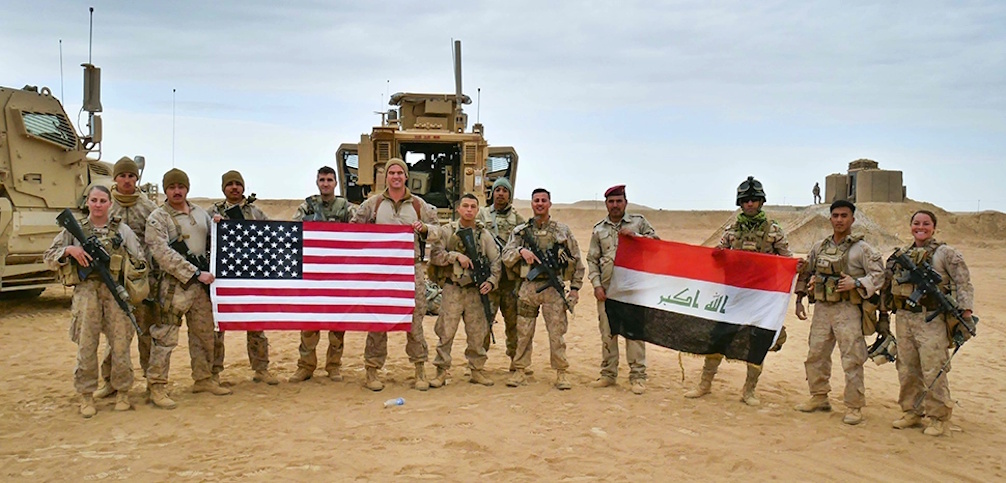
WASHINGTON — The United States announced Wednesday that it has “formally concluded” its military mission against extremist groups in Iraq, marking the end of a coalition operation that spanned more than a decade and culminated in the withdrawal of troops from Erbil Air Base in the Kurdistan region.
The US-led coalition confirmed it was ending Operation Inherent Resolve, its mission to combat the Islamic State (ISIS) in Iraq and neighboring Syria. Although ISIS was territorially defeated in Iraq in 2017 and in Syria in 2019, coalition forces had remained in the country to pursue the group’s remnants and prevent a resurgence.
“Today, the United States and our Coalition partners formally concluded Operation Inherent Resolve in Iraq, consistent with the September 2024 US-Iraq joint statement and US national interests,” Pentagon Chief Spokesman Sean Parnell said in a statement.
“The orderly departure of Coalition forces and equipment from Erbil Air Base marks the successful conclusion of the military mission that defeated ISIS in Iraq,” Parnell added.
A Gradual Drawdown
The conclusion of the mission follows a 2024 agreement between Baghdad and Washington to wind down the coalition’s presence in Iraq. Under that arrangement, coalition troops withdrew gradually from bases across the country, eventually restricting their presence to the autonomous northern Kurdistan region. The departure from Erbil Air Base — which served as the main operational hub for the Combined Joint Task Force-Operation Inherent Resolve (CJTF-OIR) and hosted most of the roughly 1,500 American and coalition personnel supporting counter-ISIS operations — represents the final phase of that drawdown.
The Iraqi government has welcomed the coalition’s withdrawal, viewing it as a means of removing the pretext that powerful Iran-backed militant factions have used to justify retaining their weapons outside of state control. Baghdad has argued that the continued presence of foreign troops provided those factions with a rationale for maintaining independent armed capacity.
Mission Shifts to Syria and Jordan
Despite the conclusion of operations in Iraq, US Central Command (CENTCOM) confirmed that CJTF-OIR remains operational and is now headquartered in Jordan. From there, US forces will continue the counter-ISIS mission in Syria alongside coalition partners and the Syrian government.
“Job well done to the tens of thousands of American service members, diplomats, and civilian personnel who answered the call in Iraq,” said Adm. Brad Cooper, CENTCOM commander. “Because of your grit, sacrifice and professionalism, ISIS no longer poses a systemic threat to Iraq’s national security, and Iraqi security forces including the Peshmerga and other Iraqi Kurdistan Region security forces now possess the capacity, leadership, and operational independence to unilaterally manage threats to their homeland.”
Cooper emphasized that the transition does not signal a broader retreat from the region.
“As we step back and hand full primary responsibility for Iraq’s security to the Government of Iraq and the brave people of Iraq, US and Coalition forces stationed across the region will remain ready to respond to any ISIS threats that arise,” he said. “Maintaining our vigilance and readiness is essential to protecting the US homeland and strengthening regional security.”
A Legacy of the Anti-ISIS Campaign
Operation Inherent Resolve was launched in 2014 after ISIS seized large swaths of territory across Iraq and Syria, declaring a so-called caliphate and committing widespread atrocities, including mass executions, enslavement, and ethnic cleansing targeting Yazidis, Christians, and other minority communities. At its peak, the group controlled an area roughly the size of Great Britain and governed millions of people.
The coalition’s air campaign and support for local ground forces including the Iraqi Security Forces, Kurdish Peshmerga, and the Syrian Democratic Forces proved decisive in rolling back ISIS’s territorial holdings. Iraq declared victory over the group in December 2017, and the territorial caliphate in Syria collapsed in March 2019 with the fall of Baghouz.
However, ISIS cells have continued to conduct insurgent attacks in both countries, and the group maintains a presence in remote areas. The coalition’s decision to end its Iraq mission reflects a calculated assessment that Iraqi forces are now capable of handling the residual threat independently.
Regional Implications
The withdrawal carries significant geopolitical implications. Iran-backed militias in Iraq, which have long demanded the departure of US troops, are likely to cite the move as a vindication of their position. However, the Iraqi government’s ability to integrate those factions into the state security apparatus or to disarm them remains an open question.
Meanwhile, the US military’s continued presence in Syria, operating out of Jordan and other regional bases, signals that Washington remains committed to preventing an ISIS resurgence in the broader region. The mission in Syria, however, faces its own complexities, including the presence of Russian and Turkish forces and the ongoing political uncertainty following the fall of the Assad regime.
For now, the Pentagon is framing the conclusion of the Iraq mission as a success story — a testament to the effectiveness of the coalition campaign and the growing capabilities of Iraqi security forces.
“Because of your grit, sacrifice and professionalism, ISIS no longer poses a systemic threat to Iraq’s national security,” Cooper said, addressing the service members who served in the mission. “Iraqi security forces now possess the capacity, leadership, and operational independence to unilaterally manage threats to their homeland.”
Our Pashto-Dari Website

Support Dawat Media Center
If there were ever a time to join us, it is now. Every contribution, however big or small, powers our journalism and sustains our future. Support the Dawat Media Center from as little as $/€10 – it only takes a minute. If you can, please consider supporting us with a regular amount each month. Thank you
DNB Bank AC # 0530 2294668
Account for international payments: NO15 0530 2294 668
Vipps: #557320

Comments are closed.