

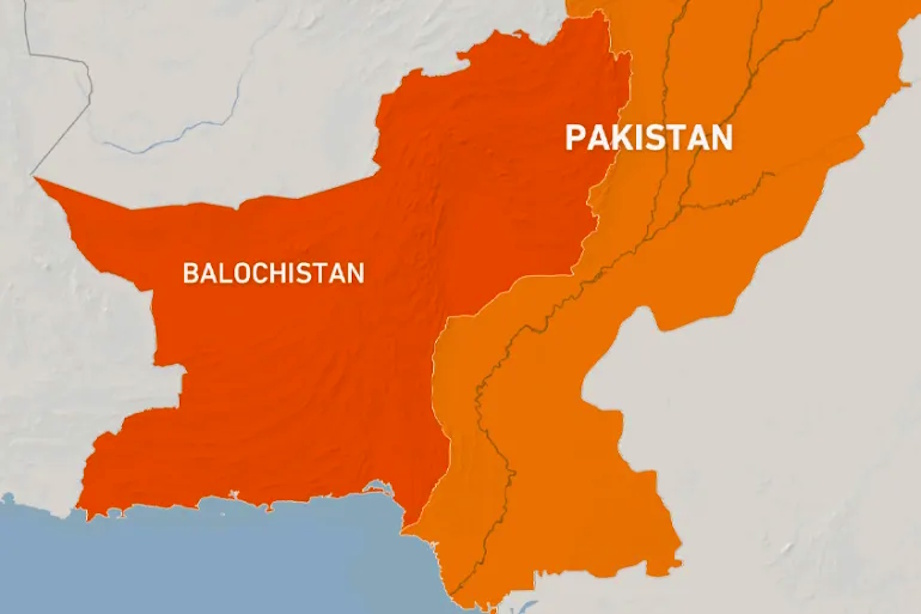
The Baloch Liberation Army (BLA) announced on Saturday that it carried out a significant wave of coordinated, simultaneous attacks on Pakistani military and government installations across at least ten cities in the vast southwestern province of Balochistan. The operation represents one of the most geographically widespread offensives claimed by the separatist group in recent memory.
The attacks targeted locations including the provincial capital Quetta, the strategic port city of Gwadar, and the districts of Pasni, Mastung, and Nushki, according to statements from both the militant group and Pakistani security officials. Initial reports from local media described assaults involving gunfire, grenades, and in some instances, suicide bombers.
A senior security official in Quetta, speaking to AFP on condition of anonymity, confirmed the coordinated nature of the strikes but asserted they had “failed due to poor planning and rapid collapse under effective security response.” The official declined to comment on potential casualties.
Government Response and Immediate Fallout
Pakistan’s interior ministry stated that security forces had “swiftly and decisively” responded to the attacks and that the situation was now under control. However, authorities have not released official casualty figures. Unconfirmed local reports and social media posts suggest there were fatalities and injuries among security personnel. Some reports also indicate that members of the security forces were abducted during the assaults.
In the aftermath, Pakistani authorities suspended mobile internet services in several affected districts and halted train services in the region as a major security clearance operation was launched.
Escalating Security Crisis
The brazen attacks underscore a sharp and continuing escalation of security tensions in Pakistan. The nation has faced a sustained resurgence of violence over the past two years, driven by both Islamist militant groups like the Tehrik-e-Taliban Pakistan (TTP) and ethno-nationalist separatist factions, primarily in Balochistan and Khyber Pakhtunkhwa provinces.
Data from the independent Pakistan Institute for Conflict and Security Studies (PICSS) highlights the deteriorating situation. According to a recent PICSS annual security report, 2025 saw a dramatic surge in violence, with 667 security force personnel killed—the highest annual death toll since 2011. Civilian fatalities also rose by 24% to 580. While state counter-operations killed over 1,000 militants, the report identified Khyber Pakhtunkhwa and Balochistan as the country’s primary conflict hotspots.
Roots of the Baloch Conflict
Balochistan, Pakistan’s largest but poorest province, has been the scene of a low-level insurgency for decades. Separatist groups, including the BLA, cite long-standing grievances over political marginalization, economic neglect, and the exploitation of the province’s substantial natural resources—including natural gas, minerals, and the strategic assets of the China-Pakistan Economic Corridor (CPEC)—by the central government and foreign entities.
In recent years, Baloch militants have increasingly targeted laborers and settlers from other Pakistani provinces working on infrastructure projects, as well as Chinese interests and other foreign energy firms, accusing them of plundering Baloch wealth without benefiting the local population. A notable escalation occurred last year when ethnic Baloch separatists attacked a passenger train carrying 450 people, leading to a two-day siege and dozens of casualties.
Analyst Warnings
Security analysts warn that the demonstrated ability of groups like the BLA to launch coordinated, multi-pronged attacks across a vast area poses a severe challenge to Pakistan’s stretched security apparatus. The simultaneous threat from multiple fronts—separatist violence in Balochistan, a TTP insurgency in the northwest, and sporadic terrorist attacks in urban centers—continues to strain the country’s internal security framework.
“The coordination and scale of this BLA operation signals a growing capability and audacity,” said one Islamabad-based security analyst. “It presents a compounding challenge for a state that is already confronting a multi-headed security crisis. The fear is that continued militant coordination could further destabilize an already volatile region.”
Our Pashto-Dari Website


Support Dawat Media Center
If there were ever a time to join us, it is now. Every contribution, however big or small, powers our journalism and sustains our future. Support the Dawat Media Center from as little as $/€10 – it only takes a minute. If you can, please consider supporting us with a regular amount each month. Thank you
DNB Bank AC # 0530 2294668
Account for international payments: NO15 0530 2294 668
Vipps: #557320

Comments are closed.