

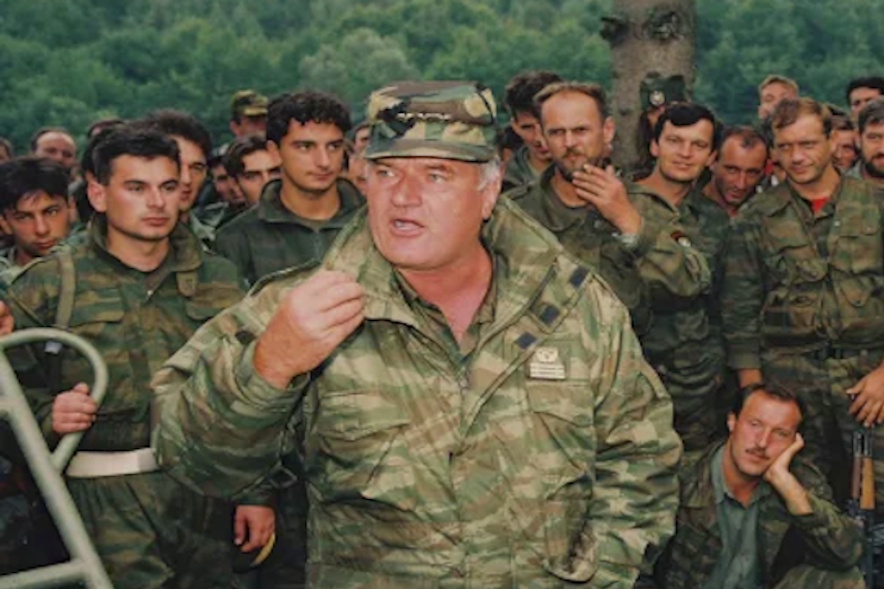
Ratko Mladic, the former Bosnian Serb military commander convicted of genocide for Europe’s worst atrocity since World War II, has died in prison at The Hague at the age of 84.
Mladic, known as the “Butcher of Bosnia,” passed away at a United Nations prison hospital in the Netherlands on Thursday, the UN tribunal confirmed. The International Residual Mechanism for Criminal Tribunals said presiding judge Graciela Gatti Santana ordered “a full inquiry into the circumstances” of his death .
His death came just days after a UN court rejected a final appeal from his defence team for early release on humanitarian grounds. On August 18, his lawyers had requested his transfer to a hospital or palliative care facility in Serbia, citing his rapidly deteriorating health and imminent death. However, Judge Gatti Santana ruled that humanitarian considerations did not justify such an exceptional measure, stating that Mladic was receiving “comprehensive and compassionate care that went far beyond minimum international standards” . Earlier this year, Serbia also requested that Mladic be allowed to receive medical treatment outside prison .
The Srebrenica Massacre
Mladic was serving a life sentence for his role in orchestrating the massacre of at least 8,000 Bosniak (Bosnian Muslim) men and boys in the UN-designated “safe area” of Srebrenica in July 1995 . His forces overran the enclave on July 11, 1995, despite its protection under UN Security Council Resolution 819, and systematically executed the victims over the following days . The bodies were bulldozed into mass graves, many later dug up and relocated to remote mountains to hide evidence of the killings .
The tribunal found that Mladic, together with late Serbian President Slobodan Milosevic and Bosnian Serb political leader Radovan Karadzic, were part of a criminal conspiracy to implement “ethnic cleansing”—the forcible expulsion of Bosniaks, Croats and other non-Serbs to create a Greater Serbia .
Beyond Srebrenica, Mladic was convicted for orchestrating a campaign of terror against Sarajevo’s civilian population during its brutal 44-month siege, which killed more than 11,500 people . His forces also took UN peacekeepers hostage and established concentration camps for detained non-Serb civilians .
From Communist Officer to Warlord
Born on March 12, 1942, in the Bosnian village of Bozinovici, Mladic rose through the ranks of the Yugoslav People’s Army before becoming commander of the Bosnian Serb army after Bosnia declared independence in 1992 . A ruthless nationalist who commanded his troops to “scorch the brains” of Bosnian Muslims and boasted of being a “Serbian god,” Mladic was one of the most notorious figures of a conflict that killed more than 100,000 people and displaced over two million .
Following the war, Mladic evaded arrest for 16 years, becoming one of Europe’s most wanted fugitives with a $10 million bounty on his head. He was finally captured in May 2011 at a relative’s home in the Serbian village of Lazarevo and transferred to The Hague . In 2017, the UN tribunal sentenced him to life in prison for crimes the court described as “amongst the most heinous known to humankind” . Former UN rights chief Zeid Ra’ad al-Hussein called him “the epitome of evil” .
Defiant to the end, Mladic shouted “This is all lies, you are all liars!” when sentenced, and had previously declared “I do not recognise this court” during his 2014 hearing .
Divided Reactions
Mladic’s death has drawn starkly contrasting reactions. For many Bosniaks who lost family members, his death in prison represents the fulfilment of justice. Kada Hotic, an 82-year-old survivor whose husband and son were killed by Serb forces in 1995, told Reuters: “I am grateful to the Tribunal because it sentenced Mladic to life and has not released him. He died in disgrace, because he killed so many people” .
Emir Suljagic, director of the Srebrenica Memorial Center, said Mladic’s death “doesn’t bring back the dead. It doesn’t clear mass graves. It does not change judgments. It does not turn a criminal into a historical figure” .
However, many Serbs continue to revere Mladic as a patriot who defended the Serbian people. Bosnian Serb separatist leader Milorad Dodik called his death “a murder” and described Mladic as “a fighter for Serbian freedom” . In Serbia’s capital Belgrade, some residents expressed admiration for the convicted war criminal, with one man telling Reuters: “I genuinely believe he protected the Serbian people, because after all, that was his duty” .
Mladic’s death closes the final chapter for the military leader of the Bosnian Serb genocide, but the wounds he inflicted on Bosnia’s society remain unhealed, and denial of the Srebrenica genocide continues to be a major obstacle to reconciliation .
Our Pashto-Dari Website

Support Dawat Media Center
If there were ever a time to join us, it is now. Every contribution, however big or small, powers our journalism and sustains our future. Support the Dawat Media Center from as little as $/€10 – it only takes a minute. If you can, please consider supporting us with a regular amount each month. Thank you
DNB Bank AC # 0530 2294668
Account for international payments: NO15 0530 2294 668
Vipps: #557320

Comments are closed.