

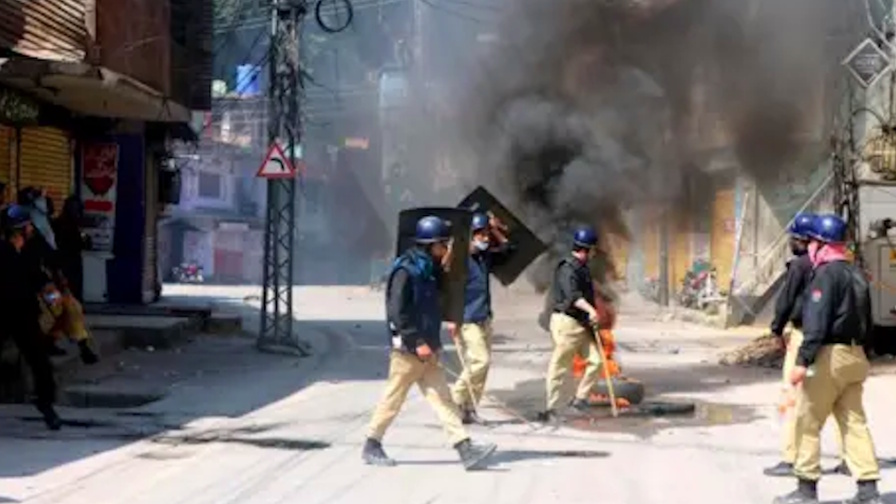
RAWALAKOT, Pakistan-administered Kashmir -A deepening political crisis in Pakistan-administered Kashmir has triggered urgent international concern over fundamental rights, as authorities move to ban a grassroots protest movement, arrest activists, deploy thousands of security personnel, and impose sweeping communication restrictions across the region. The escalating crackdown has drawn sharp criticism from human rights organizations, who warn that the government’s response threatens to erode decades of fragile civil liberties in the disputed territory.
The Roots of the Unrest
The current turmoil centers on the Joint Awami Action Committee (JAAC) , a broad coalition of traders, lawyers, students, civil society activists, and local rights groups. JAAC has emerged as a rare, unified voice challenging governance failures, economic mismanagement, and political underrepresentation in Azad Jammu and Kashmir (AJK) the name used by Pakistani authorities for the part of Kashmir they administer.
The coalition’s primary demand is the abolition of 12 reserved refugee seats in the AJK Legislative Assembly. These seats are allocated to descendants of refugees who migrated from Indian-administered Kashmir to Pakistan following partition and subsequent conflicts. Critics argue that major Pakistan-based political parties (including the Pakistan Muslim League-Nawaz and the Pakistan Peoples Party) have used these reserved seats to influence local governance, form governments, and sideline indigenous Kashmiri political voices. JAAC insists that all assembly seats should be directly elected by AJK residents, strengthening local self-governance.
Legal Confrontation and Escalation
According to the Associated Press, tensions spiked after the AJK Supreme Court upheld the constitutional validity of the reserved refugee seats. In response, JAAC called for a region-wide protest scheduled for June 9, framing the court’s decision as proof of systemic political manipulation. Protest leaders argued that the issue reflects broader public frustration over inflation, unemployment, and lack of basic services such as healthcare and clean water.
Rather than opening negotiations, authorities opted for a heavy-handed response. Dawn reported that the AJK government formally declared JAAC a banned organization under the *Azad Jammu and Kashmir Anti-Terrorism Act, 2014*. The government accused the coalition of promoting disorder, incitement, and activities prejudicial to “state security.” This designation typically reserved for armed militant groups effectively criminalized peaceful political dissent and paved the way for mass arrests.
Arrests and Communication Blackout
According to the Associated Press, dozens of JAAC activists and supporters were detained within days of the ban. Government officials defended the arrests as necessary to prevent civil unrest, while JAAC supporters described them as a blatant attempt to silence opposition ahead of planned demonstrations.
Human rights concerns deepened with reports of widespread communication restrictions. Local residents, activists, and regional media confirmed that mobile networks, internet services, and data communications were disrupted across large parts of AJK beginning June 5. Rights advocates argue that such blackouts imposed during political unrest restrict access to information, hamper emergency communications, and make independent verification of events nearly impossible.
International organizations, including Amnesty International and Human Rights Watch, have repeatedly condemned governments worldwide for using internet shutdowns to suppress dissent and evade public scrutiny. The UN Special Rapporteur on freedom of expression has called such tactics “disproportionate and often unlawful.”
A Mysterious Death and Deadly Clashes
The situation deteriorated further following the death of Shahzaib Habib, a trader and activist from the Rawalakot area. According to local activists and JAAC supporters, Habib was killed during a controversial incident involving unidentified individuals. While authorities have not publicly endorsed allegations linking security personnel to his death, his killing became a rallying cry for massive demonstrations and public outrage across the region.
Violence erupted on June 7 when clashes broke out between security forces and JAAC supporters in Rawalakot. The Associated Press reported that at least seven people, including security personnel, were killed, and dozens more injured. Protesters accused authorities of using excessive force, including live ammunition and tear gas, against unarmed demonstrators. Government officials maintained that security personnel were responding to attacks on state institutions and public property, including the torching of a government building.
Broader Implications and International Standards
The crisis has increasingly drawn attention beyond the immediate dispute over refugee seats. Rights advocates argue that the combination of a political ban, mass arrests, communication blackouts, and the weaponization of anti-terrorism laws against a civil protest movement raises grave questions about the protection of fundamental freedoms in Pakistan-administered Kashmir.
Observers acknowledge that governments have a legitimate responsibility to maintain public order. However, international human rights law requires that any restrictions on speech, assembly, and political participation be lawful, necessary, and proportionate. Critics contend that the AJK government’s response fails all three tests, risking the transformation of a political dispute into a broader human rights crisis.
What Happens Next?
As tensions remain high, calls are growing for an independent and transparent investigation into the violence, the arrests, and the communication shutdowns. The Pakistani federal government has so far remained silent, though some opposition leaders in Islamabad have expressed concern. Meanwhile, JAAC leaders have vowed to continue peaceful resistance, while authorities warn of further crackdowns.
For many residents of Pakistan-administered Kashmir, the events of recent days have become a defining test not only of political representation but also of whether peaceful dissent can be exercised without fear of state repression. With the region already caught in the crossfire of India-Pakistan rivalry, the outcome of this crisis may shape Kashmiri civil society’s relationship with the state for years to come.
Our Pashto-Dari Website
Support Dawat Media Center
If there were ever a time to join us, it is now. Every contribution, however big or small, powers our journalism and sustains our future. Support the Dawat Media Center from as little as $/€10 – it only takes a minute. If you can, please consider supporting us with a regular amount each month. Thank you
DNB Bank AC # 0530 2294668
Account for international payments: NO15 0530 2294 668
Vipps: #557320

Comments are closed.