

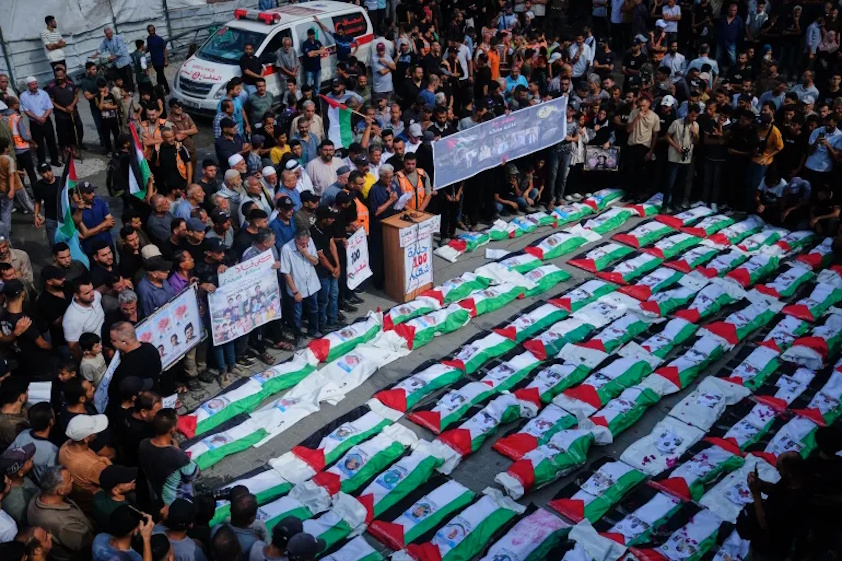
GAZA CITY – In a solemn procession that underscored the enduring horror of Israel’s military campaign in Gaza, Palestinian families on Sunday buried the recovered remains of approximately 100 people among them at least 60 children exhumed from the shattered concrete and twisted metal of the Zeitoun neighborhood in Gaza City.
The remains, many of which were little more than bone fragments and personal effects, were carried by grieving relatives from the bombed-out district to the al-Ma’madani cemetery in central Gaza City. There, beneath a pale winter sky, funeral prayers were recited over shrouded bundles that often contained no whole bodies only the material traces of lives erased in airstrikes that levelled entire residential blocks.
“These are bone remains and remnants of belongings that may have been found on the bodies, especially the children’s,” said Ghazi al-Aloul, a correspondent for Al Jazeera who witnessed the burial. “No complete bodies were recovered from this site. The Israeli occupation has prolonged this process, and continues to prolong it, preventing families from finding closure.”
A Family Decimated
Among the dead, the extended Malaka family suffered a catastrophic loss: 55 of its members were identified in the latest recovery effort. Survivors wept over shrouds marked with names scrawled in marker pen, clutching torn pieces of clothing or children’s shoes as the only remaining links to their loved ones.
For many families, this burial was a bitter mercy. Israeli forces have destroyed or bulldozed at least a dozen cemeteries across Gaza over the past 15 months, according to local authorities, making proper interment sites scarce. “The chance to bury family members in known, proper cemeteries was not available to every family,” al-Aloul noted. Some families have been forced to bury their dead in makeshift graves in schoolyards, vacant lots, or even on the edges of rubble piles.
The Unseen Dead: 8,000 Still Buried
The recovery in Zeitoun represents only a fraction of the missing. Gaza’s Civil Defense Service estimates that at least 8,000 bodies remain trapped under the debris of destroyed homes, clinics, and shelter buildings across the strip many of them in areas now under or near Israeli military control.
Raed al-Dahshan, head of the civil defense service, told Al Jazeera that his teams have drawn up detailed operational plans to retrieve these remains, but their efforts are crippled by a critical shortage of heavy machinery, protective gear, and search equipment. “We don’t have excavators, we don’t have protective equipment for our rescue workers,” he said. “With proper machinery, we could complete the recovery of an estimated 8,000 bodies in about 90 days. But if that equipment is barred from entering Gaza, this work will continue for years.”
Al-Dahshan said his agency has submitted an urgent list of required equipment—including large bulldozers, ground-penetrating radar, and personal protective suits—to international humanitarian organizations. He added that his team is willing to have all such machinery remain under international supervision, rather than in the hands of civil defense, to ease any security concerns from Israel, which has tightly controlled the entry of dual-use items into Gaza since the war began.
Identifying the Dead: A Painstaking Process
Without advanced forensic tools, identification relies on a grim combination of oral history and architectural memory. Civil defense crews work alongside survivors and neighboring families to reconstruct who was inside a building at the time of a strike. Engineers accompany the teams to sort and document findings on-site, mapping debris layers and cross-referencing with witness accounts.
“We depend on the living to tell us who is missing,” al-Dahshan explained. “But Israeli forces often failed to issue any warning before strikes, and many homes were hit multiple times. Dozens, even hundreds, of residential buildings still require excavation.”
The oldest remains recovered in the latest operation date back to November 2023 just weeks into the war indicating that many bodies have lain undiscovered for over a year, exposed to the elements and scavenging animals.
UN: “A Reminder of Brutality”
Ajith Sunghay, head of the UN human rights office in the occupied Palestinian territories, described the burials as a visceral reminder of the conflict’s toll. “Thousands of people are still languishing under this rubble,” he said. “We’re talking about areas that may be under Israeli military control 70 percent of Gaza and there is extreme difficulty accessing these zones to extract bodies.”
Sunghay stressed the importance of preserving forensic evidence for future accountability. “Accountability must happen. It is essential that we preserve the evidence we’ve been able to obtain during this sensitive period,” he said, alluding to potential war crimes investigations by the International Criminal Court and the International Court of Justice, both of which have active proceedings related to the conflict.
Mounting Death Toll and Other Mass Burials
Gaza’s Health Ministry, which has maintained meticulous records despite the collapse of much of the enclave’s health infrastructure, reports that at least 73,651 Palestinians have been killed and 174,592 wounded since October 7, 2023. The figures include both combatants and non-combatants, though women and children account for roughly two-thirds of identified fatalities.
The Zeitoun recovery is not an isolated incident. In recent weeks, similar operations have unearthed more than 100 bodies from the Abu Shariah and Hassaniya families killed in a single airstrike and over 500 remains from the Al-Taj tower complex, a multi-story residential building in central Gaza that collapsed after a series of precision strikes, according to local officials and activists.
A Crisis of Memory and Mourning
For Palestinians in Gaza, the inability to properly bury and mourn their dead has become a psychological wound as deep as the physical devastation. Islamic tradition requires prompt burial, ideally within 24 hours of death, but the war has made that impossible for thousands of families. The delayed funerals in Zeitoun offered a measure of dignity, but also reopened fresh grief.
As the sun set over al-Ma’madani cemetery, mourners placed stones on the fresh graves makeshift markers for remains that may never be fully identified. “We buried bones today,” one elderly man whispered to a reporter, his hands still caked with dust from the digging. “But we buried our hearts a long time ago.”
with Aljazeera
Our Pashto-Dari Website

Support Dawat Media Center
If there were ever a time to join us, it is now. Every contribution, however big or small, powers our journalism and sustains our future. Support the Dawat Media Center from as little as $/€10 – it only takes a minute. If you can, please consider supporting us with a regular amount each month. Thank you
DNB Bank AC # 0530 2294668
Account for international payments: NO15 0530 2294 668
Vipps: #557320

Comments are closed.