

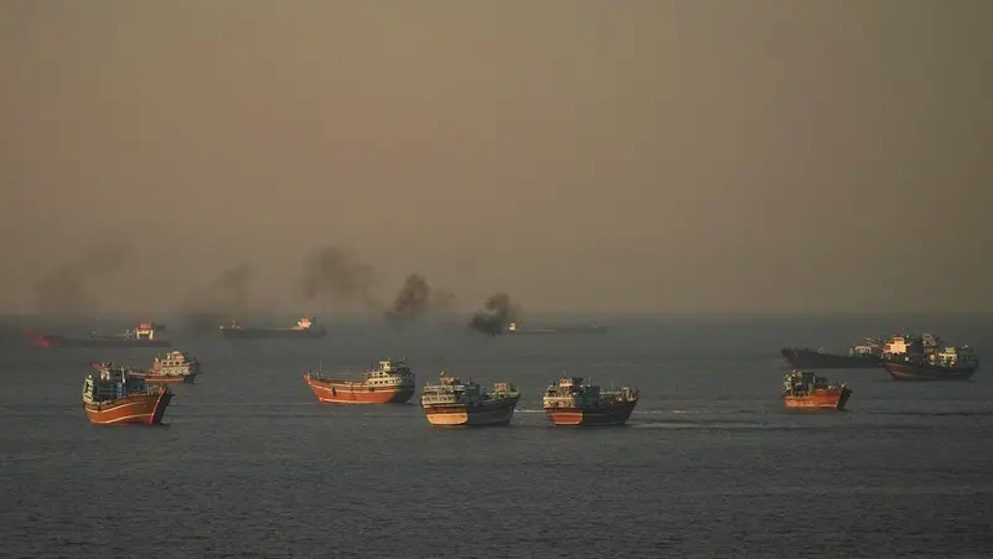
TEHRAN – In a significant development signaling a potential de-escalation of tensions in the strategic Strait of Hormuz, the first Iranian oil tankers have successfully exited a US naval blockade zone, according to maritime tracking data. The breakthrough comes just two days before high-stakes peace talks between Washington and Tehran are scheduled to commence in Switzerland.
The TankerTrackers website, which monitors global oil shipments and storage, confirmed the movement of three Iranian supertankers from the blockade perimeter on Wednesday. The vessels identified as the National Iranian Tanker Company (NITC) very large crude carriers DIONA (9569695) and HERO2 (9362073), along with a third unnamed tanker are carrying a combined total of nearly five million barrels of crude oil .
“At least two NITC VLCC supertankers have exited the US Navy blockade perimeter carrying a combined total of 3.8 million barrels of Iranian crude oil between them,” TankerTrackers reported on X, later adding that a third vessel had also cleared the zone .
The development marks Iran’s first crude exports in two months and follows the finalization of a memorandum of understanding (MoU) between the two nations on Monday. The agreement, brokered by Pakistan and Qatar, includes provisions for the immediate lifting of the US naval blockade and a broader ceasefire across all fronts .
Talks Set for Swiss Mountain Retreat
The formal signing ceremony for the agreement is scheduled for Friday at the Burgenstock mountain resort in Switzerland . The luxurious resort, perched high above Lake Lucerne, has historically hosted high-level peace negotiations, including the 2024 Ukraine peace summit and the 2002 Sudanese ceasefire talks .
According to a senior US official speaking on condition of anonymity, the framework agreement has already been signed electronically by President Donald Trump, Vice President JD Vance, Iran’s Deputy Foreign Minister Majid Takht-Ravanchi, and top negotiator Mohammad Bagher Ghalibaf .
“Iranian vessels carrying crude oil have moved out of the US blockade zone in the Strait of Hormuz ahead of planned US-Iran talks in Switzerland, as both sides prepare to begin negotiations on a final settlement to their war,” Pakistan Today reported .
Complex Negotiations Ahead
The upcoming talks, expected to begin immediately after the signing ceremony, will address the most contentious issues between the two nations: Iran’s nuclear program and the comprehensive lifting of international economic sanctions. Officials indicate that negotiators will have a 60-day window to reach a final settlement .
Iranian Foreign Minister Abbas Araghchi confirmed that a new round of negotiations is expected to begin on Friday, addressing nuclear matters and sanctions relief. “In the final agreement, decisions will be made on the nuclear issues and the lifting of sanctions,” Araghchi stated .
However, significant challenges remain. The United States and Israel are pressing to strip Iran of its stockpile of highly enriched uranium, while Iran insists on its right to uranium enrichment. A comprehensive agreement remains elusive despite weeks of indirect negotiations .
Araghchi struck a cautious note in remarks to Iranian media: “We have a history of broken commitments… we have a history of agreements being torn up. All of this is present in our minds” .
Oil Markets React
News of the Strait of Hormuz reopening has already impacted global energy markets, sending oil prices tumbling in Wednesday trading. Brent North Sea crude fell to $78.74 per barrel, while West Texas Intermediate traded at $75.85 per barrel .
The economic implications are substantial: before the war, approximately one-fifth of the world’s oil flowed through the strategic strait. The blockade had effectively stranded hundreds of ships and disrupted global energy flows, with an estimated 118 laden tankers potentially poised to exit the region within 15 days after the deal is signed .
European Support and Skepticism
Britain, France, Germany, and Italy have welcomed the preliminary peace agreement, declaring their readiness to ease some sanctions against Iran if Tehran takes “clear and verifiable steps regarding its nuclear program” . The four European nations also emphasized that Iran should not possess nuclear weapons and pledged to cooperate with the IAEA to ensure this goal is achieved .
However, some US conservatives remain skeptical about the peace deal. Senate Republicans have reportedly requested the full text of the agreement and briefings from the Trump administration. Senate Majority Leader John Thune was quoted as saying: “Let’s look at it and see what it actually is” .
Fragile Peace Underscored by Continued Violence
The diplomatic optimism was dented by fresh Israeli strikes on south Lebanon, underscoring the fragile nature of the regional ceasefire. The Israeli military confirmed it conducted a strike after identifying “a suspicious vehicle” near its troops’ operating area and intercepted rockets while carrying out an air strike against a launcher .
Lebanon’s state news agency reported that the strikes targeted two vehicles in the town of Mayfadoun and another in nearby Shukeen, killing four people. Iran’s central military command warned that Israel should “await a harsh response” to the attacks .
Analysts have warned that the parallel conflict in Lebanon between Israel and Iran-backed Hezbollah presents the biggest threat to the diplomatic thaw. Ross Harrison, a senior fellow at the Middle East Institute, described this theatre of the conflict as “the biggest ultimate spoiler” of the coming negotiations .
The maritime industry is also approaching the situation with caution. While some shipowners are beginning to reposition vessels toward Gulf ports in anticipation of a surge in demand, most remain skeptical. Insurers are holding firm on high war-risk premiums, demanding “solid evidence” that the waterway will remain safe .
“The maritime sector is treating the news with something closer to wary disbelief than celebration,” Lloyd’s List Intelligence analysts noted, describing the situation as “a fragile reprieve rather than a return to normality” .
As the international community watches closely, the Burgenstock talks represent a pivotal moment in US-Iran relations, with profound implications for regional stability and global energy security.
Our Pashto-Dari Website
Support Dawat Media Center
If there were ever a time to join us, it is now. Every contribution, however big or small, powers our journalism and sustains our future. Support the Dawat Media Center from as little as $/€10 – it only takes a minute. If you can, please consider supporting us with a regular amount each month. Thank you
DNB Bank AC # 0530 2294668
Account for international payments: NO15 0530 2294 668
Vipps: #557320

Comments are closed.