

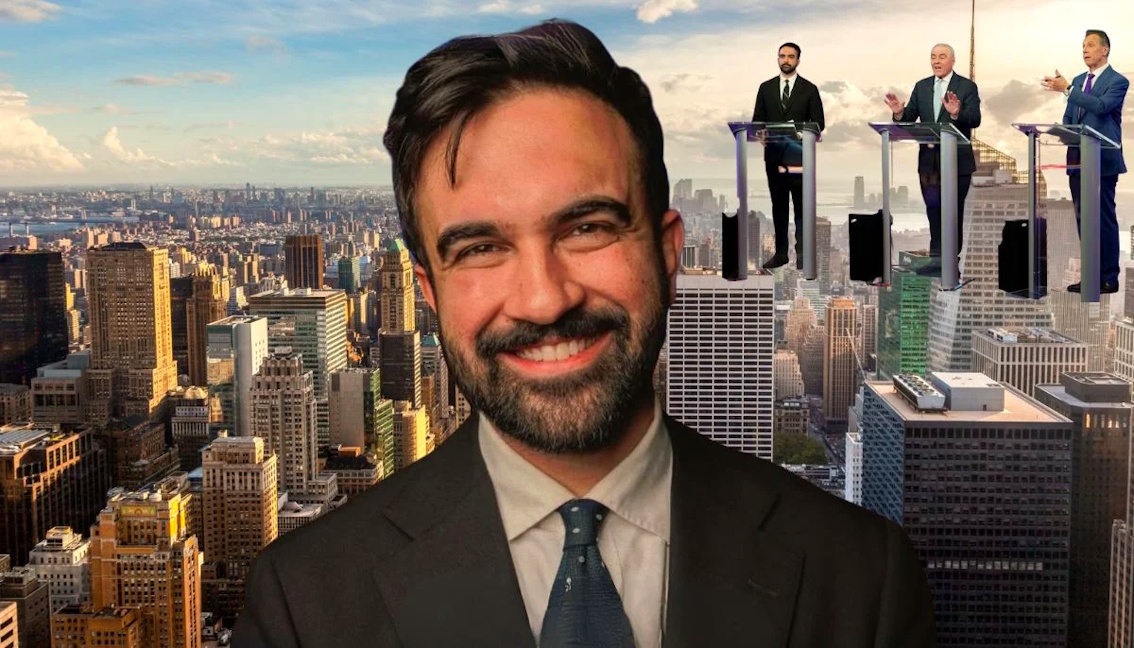
New York Mayor Zohran Mamdani has ordered the disbanding of a controversial police unit accused of using excessive force against protesters, replacing it with new teams focused on dialogue and crowd management.
Mamdani announced the decision on Monday alongside Police Commissioner Jessica Tisch, saying people exercising their constitutional right to protest should not be treated as potential terrorist threats. “The right to peaceful assembly is not a threat to public safety—it is a cornerstone of our democracy,” Mamdani said during a press conference at City Hall. “For too long, we have treated dissent as danger. Today, we begin to change that.”
The New York Police Department’s Strategic Response Group (SRG), established about a decade ago to respond to terrorist threats and other major emergencies, came under intense criticism for its handling of demonstrations, particularly during the 2020 protests against police brutality that swept the nation following the killing of George Floyd. Officers assigned to the unit faced allegations of using pepper spray, aggressive crowd-control tactics and mass arrests against demonstrators, journalists and legal observers. The unit was also subject to a 2023 legal settlement following allegations of excessive force and wrongful arrests during the 2020 demonstrations.
Under the restructuring, the city will establish a civilian-led Community Dialogue and De-escalation Division. Its members will be unarmed and will have no authority to arrest people. The division will focus on facilitating communication between police and protest organizers, training officers in de-escalation techniques, and deploying trained mediators during large gatherings. According to city officials, the new division will operate independently of the NYPD’s chain of command, reporting directly to the Mayor’s Office of Community Safety.
The NYPD will also create a new Patrol Support Division to take over some of the disbanded unit’s responsibilities, including managing public demonstrations and large gatherings. This division will draw on officers trained specifically in crowd psychology and constitutional law, with an emphasis on minimizing confrontation. Mamdani said the changes were intended to establish a different approach to public safety while protecting the right to peaceful assembly.
Tisch said the department’s approach to demonstrations and crowd control would continue, but under a revised organisational structure. “Our commitment to keeping New Yorkers safe remains unchanged,” Tisch said. “What changes is how we deploy our resources and how we engage with the communities we serve. This is about smart policing, not soft policing.”
Around 500 officers assigned to the Strategic Response Group are expected to be transferred to other NYPD divisions, including counterterrorism operations. The transfers are expected to be completed by spring 2027. Officials said no officers would lose their jobs as a result of the restructuring, and that those transferred would receive additional training in community engagement and de-escalation.
Civil rights organisations cautiously welcomed the decision but warned that the new police structure must not reproduce the practices that led to criticism of the disbanded unit. “We’ve seen rebranding before,” said Donna Lieberman, executive director of the New York Civil Liberties Union. “What matters is whether the new divisions are genuinely accountable to the public, whether their members are trained differently, and whether the culture of impunity that defined the SRG is truly dismantled. We will be watching closely.”
Police unions opposed the move, arguing that dismantling the group could undermine public safety and expose officers and residents to greater risks. Patrick Lynch, president of the Police Benevolent Association, called the decision “a dangerous experiment with public safety” and warned that the new structure would leave officers unprepared for major emergencies. “The SRG was created for a reason,” Lynch said in a statement. “Dismantling it in the name of politics puts every New Yorker at risk.”
The restructuring marks a significant change in New York’s approach to policing public demonstrations, following years of criticism over the department’s response to protests. It also reflects a broader national conversation about the role of police in managing dissent, as cities across the country reconsider the militarisation of local law enforcement. Community organisers and legal experts said they would monitor the implementation of the new divisions, particularly the civilian-led unit, to ensure that its independence and authority are preserved in practice.
The mayor’s office said the transition would begin immediately, with the Community Dialogue and De-escalation Division expected to be operational by early 2026. A public dashboard tracking the new divisions’ activities, including deployment data and complaint records, is also planned as part of the restructuring.
Our Pashto-Dari Website

Support Dawat Media Center
If there were ever a time to join us, it is now. Every contribution, however big or small, powers our journalism and sustains our future. Support the Dawat Media Center from as little as $/€10 – it only takes a minute. If you can, please consider supporting us with a regular amount each month. Thank you
DNB Bank AC # 0530 2294668
Account for international payments: NO15 0530 2294 668
Vipps: #557320

Comments are closed.