

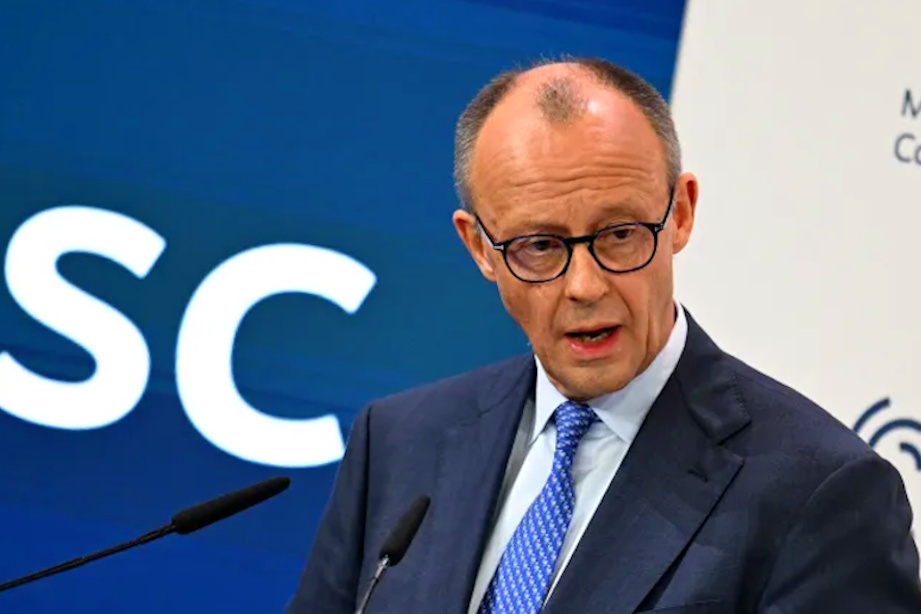
The heavy doors of the Bayerischer Hof hotel barely had time to close behind the arriving dignitaries before Friedrich Merz stepped to the podium and did something unusual for a German Chancellor at the Munich Security Conference: he told the truth, plainly, without the diplomatic gauze that usually wraps these gatherings.
“Let me begin with the uncomfortable truth,” he said, his voice carrying through the packed conference hall where presidents, generals and spies from across the globe sat in varying states of alertness. “A rift, a deep divide has opened between Europe and the United States.”
The words hung in the air like smoke. Around the room, attendees shifted in their seats. Some glanced toward the American delegation, where Secretary of State Marco Rubio sat motionless, his face revealing nothing. Others stared straight ahead, as if watching a car crash unfold in slow motion.
A year ago, it was JD Vance standing in this same spot, using his platform not to reassure allies but to lecture them about free speech, about immigration, about the very foundations of European democracy. The transatlantic relationship, built brick by brick over seventy years of shared sacrifice, had suddenly developed cracks that ran down to the bedrock.
“He was right,” Merz continued, acknowledging Vance’s diagnosis if not his prescription. “But the culture war of the MAGA movement is not ours. Freedom of speech ends here with us when that speech goes against human dignity and the constitution. We do not believe in tariffs and protectionism, but in free trade.”
The words were careful, measured the kind of language that comes from sleepless nights and urgent phone calls between European capitals. For months, leaders across the continent had been waking to headlines that felt increasingly surreal: an American president threatening to annex Greenland from Denmark, a NATO ally; tariffs aimed at European goods; questions about whether the United States would honor its Article 5 commitments if push came to shove.
And beneath all of it, the war in Ukraine grinding on, Russian forces probing for weaknesses, and a sense that the old certainties the ones that had kept the peace in Europe since 1945 were dissolving like morning frost.
Merz didn’t spare his fellow Europeans from the hard truths either. The rules-based order, that phrase diplomats have leaned on for decades like a comfortable old chair, “no longer exists,” he told them. “I fear we must put it even more bluntly: this order, however imperfect it was even at its best, no longer exists in that form.”
In the green rooms and hospitality suites where the real conversations happen, the reaction was visceral. A senior diplomat from one Baltic state, a country that still remembers Soviet tanks in its streets, leaned toward a colleague and whispered: “We’ve been saying this for years. Now they’re finally listening.”
What made the moment particularly charged was the backdrop literally. Outside the hotel’s fortified perimeter, Munich went about its business, citizens largely unaware that inside these walls, the architecture of the post-Cold War world was being quietly dismantled and redrawn. Snow fell on the city’s medieval spires. Trams clattered along Maximilianstrasse. And in the conference hall, a German chancellor was effectively declaring that the transatlantic relationship, as generations had known it, was entering an entirely new phase.
But Merz wasn’t there to deliver a eulogy. He was there to propose a resurrection.
“Let’s repair and revive transatlantic trust together,” he said, turning slightly toward the American delegation. “Being a part of NATO is not only Europe’s competitive advantage. It is also the United States’ competitive advantage. In the era of great power rivalry, even the United States will not be powerful enough to go it alone.”
It was a masterful pivot acknowledging the fracture while insisting it could be mended, appealing to American self-interest rather than sentiment. Behind the scenes, aides later confirmed, the line had been carefully calibrated after consultations with multiple European capitals. The message: we see you walking away, but here’s why you should stay.
Then came the revelation that sent ripples through the conference long after Merz left the stage. In response to a question, the chancellor confirmed that he was in “confidential talks” with French President Emmanuel Macron about creating a joint European nuclear deterrent.
The implications landed like depth charges. For decades, European security had rested on the American nuclear umbrella those bombs stored in Italian, Belgian, Dutch and German bases, ready to be deployed by allied aircraft in an emergency. For Germany, bound by its 1990 reunification treaty to renounce nuclear weapons, the very idea of discussing such matters was once unthinkable.
But these are unthinkable times.
Later that evening, Macron took the stage and doubled down. Europe, he said, must “learn to become a geopolitical power.” The continent had already begun re-arming after Russia’s 2022 invasion of Ukraine, he noted, but “we have to accelerate.” The war in Ukraine, he made clear, was not some distant conflict but Europe’s “existential challenge.” Surrender was not an option. Caving to Russian demands would only invite more aggression.
Outside the main hall, in the corridors where coffee grows cold and careers are made, the reaction was mixed. Some European officials spoke with barely concealed excitement about finally taking responsibility for their own defense. Others looked like they’d just been told the family silver was being sold. A few Americans, standing in clusters, seemed genuinely taken aback by the shift in tone.
Earlier in the day, Rubio had tried to set a more conciliatory tone than Vance’s confrontation a year ago. “The world is changing very fast right in front of us,” he told reporters before departing for Munich. “We live in a new era in geopolitics, and it’s going to require all of us to sort of re-examine what that looks like and what our role is going to be.”
But even as he spoke those words, back in Washington, Donald Trump was telling reporters outside the White House: “Greenland’s gonna want us… We get along very well with Europe. We’ll see how it works out. We’re negotiating right now for Greenland.”
The cognitive dissonance was almost too much. Here was the top American diplomat talking about partnership while his president discussed acquiring allied territory like a piece of real estate. Here were European leaders pledging to repair trust while quietly discussing nuclear deterrence without the United States.
And here, in Munich, was a moment of clarity the kind that only comes when the old certainties have crumbled and something new, still undefined, is struggling to be born.
By Friday evening, the conference had settled into its familiar rhythm of late-night meetings and early-morning briefings. But something had shifted. The questions being asked in those closed-door sessions were different now. Less about how to manage the existing relationship, more about what comes next.
As one exhausted European official put it, slipping out of a meeting that had run two hours overtime: “We spent decades building a house together. Now we’re figuring out who holds the keys, who pays the mortgage, and whether we’re still living in the same neighborhood.”
Outside, the snow continued to fall on Munich, blanketing the city in silence. Inside the Bayerischer Hof, fifty world leaders and their delegations sat with the uncomfortable knowledge that the world they’d known was gone and that the new one, whatever shape it took, was being negotiated in rooms like these, in conversations like the ones that had just begun.
Our Pashto-Dari Website


Support Dawat Media Center
If there were ever a time to join us, it is now. Every contribution, however big or small, powers our journalism and sustains our future. Support the Dawat Media Center from as little as $/€10 – it only takes a minute. If you can, please consider supporting us with a regular amount each month. Thank you
DNB Bank AC # 0530 2294668
Account for international payments: NO15 0530 2294 668
Vipps: #557320

Comments are closed.