

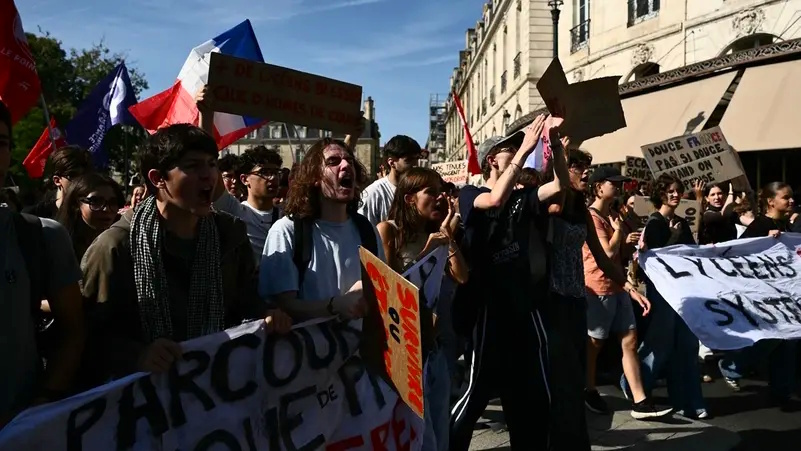
A quarter of a million demonstrators took to the streets across France on Tuesday as unions and teachers joined high school students demanding better learning conditions, in protests that later descended into sporadic clashes with security forces.
Students have blocked the entrances to hundreds of high schools for 15- to 17-year-olds since late September, complaining of missing teachers, overloaded timetables, dilapidated classrooms and buildings that cannot cope with rising temperatures.
Rights groups, unions and the students have accused authorities of using disproportionate force. A teenager lost a hand on Monday after police fired a stun grenade, while another student reportedly lost several teeth last week after being struck by a police launcher round.
A Growing Movement
At Paris’s Place de la République, protesters gathered beneath banners demanding better-funded schools. Two men in climbing gear scaled the nearby monument, where they unfurled a plastic banner reading “Neglected schools, sacrificed youth.”
“Gen Z has risen up and wants to be heard,” 19-year-old Lilia told AFP at a massive march in central Paris, adding she hoped President Emmanuel Macron would listen.
The unrest comes ahead of a 2027 election to choose Macron’s successor, with far-right candidate Marine Le Pen riding high in the polls despite a graft conviction.
An AFP reporter described the Paris march as largely peaceful, but tensions flared near its endpoint in the east of the capital as police fired tear gas and some demonstrators threw rocks at a line of officers carrying riot shields. Police officials said that “300 hostile individuals” were attempting to confront officers. Another AFP reporter saw a young man bleeding from a head wound being treated by volunteer medics.
The interior ministry said 256,000 people had joined demonstrations across the country, making it one of the largest single days of protest since the movement began.
‘At War’
Prime Minister Sébastien Lecornu condemned violence linked to the protests, telling lawmakers there was “no room for tolerance of violence.”
“Burning down a high school does not improve the state of high school buildings,” he told parliament, rejecting accusations the government had ordered “police repression” against protesters.
While many protests have been peaceful, some demonstrators have started fires, destroyed bus shelters or clashed with riot police. Police have responded with batons, tear gas and riot-control rounds.
The government says 215 students and 715 police officers have been injured since the start of the movement. A 15-year-old lost a hand to a sting-ball grenade fired by riot officers in the northern town of Lens on Monday.
In Metz, prosecutors requested a police inquiry after video footage circulated appearing to show a plainclothes officer inappropriately touching a detained female pupil younger than 15.
The government has sought to address the students’ grievances, while accusing the hard-left France Unbowed (LFI) party of encouraging the movement. Veteran LFI presidential candidate Jean-Luc Mélenchon has strongly supported the protests, while calling for non-violent methods.
Thousands of Arrests
Thomas, a 17-year-old student from the Paris suburb of Val-de-Marne, said some of the classrooms at his school were short of desks and chairs while the bathrooms lacked doors, toilet paper and soap.
“We just want better conditions for studying,” he told AFP.
Adults turned out in droves Tuesday to support the young demonstrators. In Rennes, teacher Romain Dubourg said colleagues had discussed what they viewed as police brutality and decided to stand alongside pupils. In Lyon, parents organized to support the youngsters, while teacher Rindala Younes said she wanted to help students “convey their message peacefully.”
“The high school students’ demands are legitimate,” she said.
Amnesty International on Monday said the French authorities should “put an end to the disproportionate police repression seen in recent days during student protests.” Interior Minister Laurent Nunez said police had opened 10 internal investigations into allegations of misconduct.
Since the start of the movement, 24 schools have been burned or ransacked, according to the education ministry. More than 5,000 people, 87 percent of them minors, have been arrested. The prime minister’s office said 85 teaching staff have also been injured.
Deepening Crisis in Public Education
The demonstrations reflect a broader crisis in France’s public education system, which educators say has been crippled by years of budget cuts, rising class sizes and deteriorating infrastructure. Many school buildings, constructed decades ago, lack adequate ventilation and cooling systems, making classrooms unbearable during increasingly frequent heatwaves.
Teachers’ unions have pointed to a growing shortage of qualified instructors, with some subjects particularly mathematics, sciences and languages facing acute recruitment difficulties. In some regions, classes have been cancelled for weeks at a time because no replacement could be found for absent teachers.
The movement has also drawn attention to stark inequalities between schools in wealthy urban areas and those in poorer suburbs and rural regions. Students in disadvantaged areas report crumbling facilities, outdated textbooks and limited access to extracurricular activities, widening the gap between their educational outcomes and those of their peers in more affluent communities.
Political Ramifications
The protests pose a significant challenge for Macron’s government, which has already faced widespread unrest over pension reforms and rising living costs. With the 2027 presidential election on the horizon, the handling of the education crisis could become a defining issue for candidates across the political spectrum.
Far-right leader Marine Le Pen has sought to capitalize on the discontent, framing the protests as evidence of the government’s failure to maintain basic public services. Meanwhile, left-wing parties have thrown their support behind the students, with some calling for a substantial increase in education spending.
Political analysts suggest the government’s response will be closely scrutinized, particularly given the allegations of excessive police force. The Interior Ministry’s decision to open internal investigations signals awareness of the sensitivity surrounding the issue, but critics argue that systemic reforms are needed to prevent future incidents.
What Comes Next
Union leaders have threatened further action if their demands are not met, and several schools remained blocked on Wednesday. The government has offered to open negotiations on improving school infrastructure and hiring more teachers, but protesters say the proposals fall short of what is needed.
Student organizers have vowed to continue their movement until they see concrete changes, including smaller class sizes, modernized facilities and a guarantee of adequate staffing. “We’re not asking for luxuries,” said one student leader in Paris. “We’re asking for the basics that every student in France should have.”
As the standoff continues, both sides appear to be digging in, raising the prospect of prolonged disruption to the school year and further tests of the government’s ability to manage social unrest.
Our Pashto-Dari Website

Support Dawat Media Center
If there were ever a time to join us, it is now. Every contribution, however big or small, powers our journalism and sustains our future. Support the Dawat Media Center from as little as $/€10 – it only takes a minute. If you can, please consider supporting us with a regular amount each month. Thank you
DNB Bank AC # 0530 2294668
Account for international payments: NO15 0530 2294 668
Vipps: #557320

Comments are closed.