

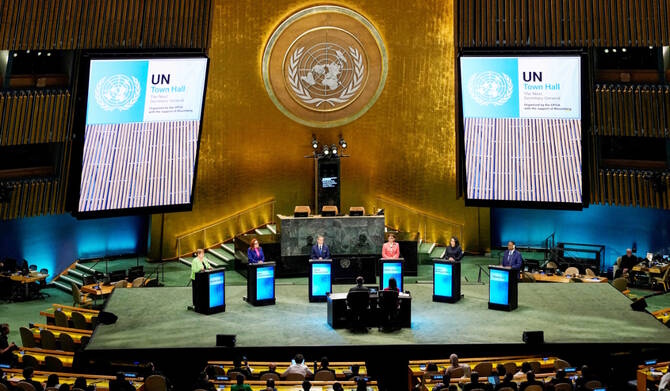
GENEVA – The race to succeed António Guterres as the 10th United Nations Secretary-General is officially underway, with the winner set to begin a five-year term on January 1, 2027. The selection process, traditionally marked by informal straw polls and intense behind-the-scenes lobbying, took its latest turn on Friday. According to sources close to the proceedings, a second informal ballot showed Guyana’s Carolyn Rodrigues Birkett narrowly edging ahead of a crowded field though no formal decision is expected for months.
To secure the position, a candidate must not only win the informal approval of the 15-member Security Council but also avoid a veto from any of its five permanent members (P5): the United States, Russia, China, the United Kingdom, and France. With the campaign intensifying, here is a closer look at the declared candidates vying to lead the global body through an era of deepening geopolitical fractures.
RAFAEL GROSSI (Argentina)
At 65, Grossi is a veteran Argentine diplomat who has spent the last six years as Director General of the International Atomic Energy Agency (IAEA) a role that has placed him at the center of some of the world’s most volatile nuclear standoffs. His tenure has been defined by high-stakes shuttle diplomacy: he led efforts to salvage parts of the 2015 Iran nuclear deal after the U.S. withdrawal in 2018, though critics accuse him of being overly accommodating toward Tehran.
Grossi’s most tangible achievement came in Ukraine, where he successfully negotiated the deployment of an IAEA monitoring team to the Russian-occupied Zaporizhzhia nuclear power plant, preventing a potential radiological disaster. A polyglot father of eight, he is widely seen as a frontrunner due to his deft handling of the Security Council’s permanent members a critical asset for any candidate. However, Moscow has already signaled reservations about his bid, and his ability to navigate Russian opposition will be a decisive test of his candidacy.
REBECA GRYNSPAN (Costa Rica)
A 70-year-old economist and former Vice President of Costa Rica, Grynspan currently leads the UN Conference on Trade and Development (UNCTAD). She has framed her campaign around reform-minded multilateralism, positioning herself as a barrier-breaker who has spent her career challenging gender norms. To avoid conflicts of interest during the race, she has stepped back from her UNCTAD duties until September.
If elected, Grynspan would make history as the first woman to lead the UN. She has spoken candidly about the trade-offs between family and public service, and how being UNCTAD’s first female chief shaped her collaborative leadership style. “I am not waiting for special treatment. I want equal treatment,” she told Reuters. She pitches herself as a “mature leader” who would modernize the UN’s agility while fiercely defending its founding values.
MICHELLE BACHELET (Chile)
A two-time President of Chile and former UN High Commissioner for Human Rights, Bachelet, 74, brings one of the most distinguished résumés in the race. She also served as the first Executive Director of UN Women, cementing her credentials on gender equality.
Despite early backing from Brazil and Mexico, her domestic support crumbled in March when Chile’s new right-leaning government withdrew its endorsement. Her candidacy faces further headwinds from Washington: in April, U.S. UN Envoy Mike Waltz echoed Republican Senator Pete Ricketts’ criticism that Bachelet failed to label China’s actions against Uyghur Muslims as “genocide” during her tenure as human rights chief. Beijing has remained conspicuously silent on her bid, leaving her campaign in a diplomatic no-man’s-land between U.S. skepticism and Chinese ambiguity.
MACKY SALL (Senegal)
A geologist by training, Sall, 64, served as Senegal’s president for 12 years until stepping down in 2024. His campaign is rooted in the Global South’s agenda: he advocates for debt relief for developing nations and a sweeping overhaul of the Security Council to grant permanent seats to African and other underrepresented states.
“More than ever, a reinvented multilateralism remains the best way to respond to the challenges of a world in full transformation,” he wrote on X. Nominated by Burundi, Sall would become only the third African Secretary-General after Boutros Boutros-Ghali and Kofi Annan if he prevails. His regional support is strong, but he will need to convince the P5 that his reformist zeal won’t alienate the established order.
MARIA FERNANDA ESPINOSA (Ecuador)
Espinosa, 61, is a former foreign and defense minister of Ecuador under President Rafael Correa. Nominated by Antigua and Barbuda, she brings deep institutional knowledge of the UN system, having served as Ecuador’s ambassador to the UN and as President of the General Assembly.
Her campaign emphasizes climate action, biodiversity, and Indigenous rights issues she has championed as an advisor to the UN and NGOs. In her vision statement, she struck a pragmatic tone: “I offer a candidacy grounded in a simple conviction: the UN must recover the courage to prioritize, the discipline to deliver, and the political confidence to act with purpose.” Her challenge will be to differentiate herself in a field crowded with Latin American and female candidates.
CAROLYN ALLISON FARIDA RODRIGUES BIRKETT (Guyana)
A career diplomat and former foreign minister of Guyana, Rodrigues Birkett, 58, has served as her country’s Permanent Representative to the UN since 2020. She holds several historic firsts: she was the first woman and the highest-ranking Indigenous person to hold Guyana’s top diplomatic post.
Her campaign pledges to strengthen conflict prevention, accelerate climate action, and make the UN more effective and responsive. If elected, she would break two glass ceilings simultaneously becoming both the first woman and the first Caribbean national to lead the world body. Her narrow lead in the latest straw poll suggests she is a serious contender, though she will need to translate early momentum into broader P5 consensus.
OLARA OTUNNU (Uganda)
At 75, Otunnu is the oldest candidate in the race. A veteran UN diplomat and former Under-Secretary-General, he was nominated by Uganda and has framed his campaign around restoring the organization’s eroded moral authority.
In his vision statement, Otunnu pledged to prioritize resolving major international conflicts, continue internal institutional reforms, and establish a new oversight body for artificial intelligence governance. He also stressed that climate action must not come at the expense of economic development in poorer nations. His extensive UN experience is an asset, but his age and the desire for generational change could work against him.
IVONNE BAKI (Ecuador)
Born to Lebanese immigrant parents, Baki, 75, is the second-oldest candidate and was nominated by Tonga in August. Her life story is deeply shaped by conflict—she lived through Lebanon’s 15-year civil war, and her campaign is built on the imperative of conflict prevention.
“I will be on the ground, not just at the desk in New York… in war zones, in areas of tension, engaging every party directly to stop conflicts before they erupt,” she has said. Baki has publicly claimed that her candidacy enjoys U.S. support, citing friendships with both President Donald Trump and former President Bill Clinton. However, Washington has not officially confirmed this, and her ability to rally broader international backing remains unproven.
What’s Next?
The Security Council will continue holding informal polls in the coming months to gauge support, with official voting likely to take place in late 2026. While gender, geographic rotation, and diplomatic experience are all critical factors, the ultimate decision will hinge on the often-opaque calculus of the P5 veto. As the field narrows, one thing is certain: the next Secretary-General will inherit a UN under immense strain navigating great-power rivalry, climate emergencies, and a crisis of public trust in global governance.
Our Pashto-Dari Website

Support Dawat Media Center
If there were ever a time to join us, it is now. Every contribution, however big or small, powers our journalism and sustains our future. Support the Dawat Media Center from as little as $/€10 – it only takes a minute. If you can, please consider supporting us with a regular amount each month. Thank you
DNB Bank AC # 0530 2294668
Account for international payments: NO15 0530 2294 668
Vipps: #557320

Comments are closed.