

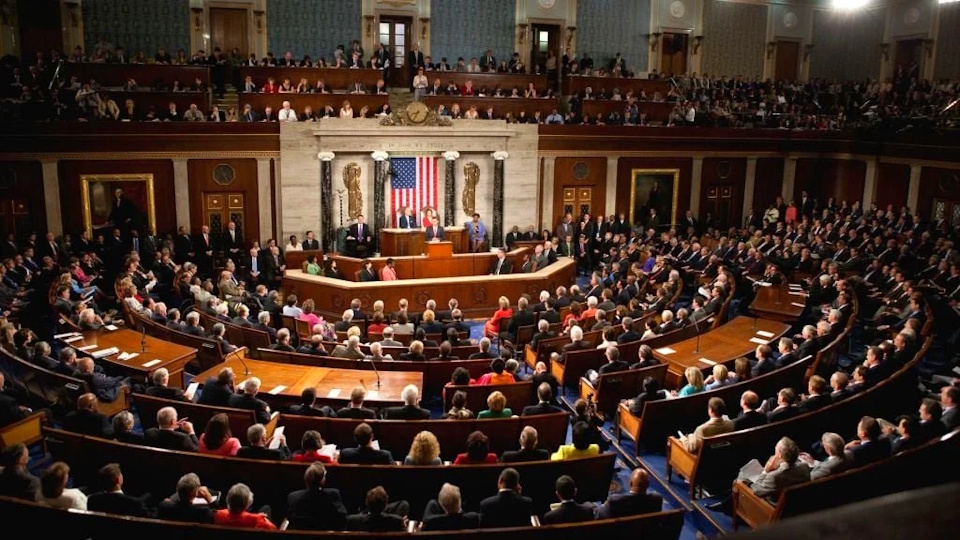
Measure seeks to reassert Congress’s constitutional authority over war, but faces likely presidential veto
WASHINGTON, D.C. -In a significant challenge to President Donald Trump’s military policy toward Iran, the United States Senate has approved a bipartisan war powers resolution requiring the president to either end ongoing military operations against Iran or obtain explicit congressional authorization before launching further military action.
The Senate voted 50–48 in favor of the measure on Tuesday, marking one of the most notable congressional efforts in recent decades to reclaim authority over decisions of war and peace. The resolution had already passed the House of Representatives earlier this month, making it the first Iran-related war powers measure to clear both chambers of Congress.
Despite its passage, the resolution is unlikely to become law. The White House has indicated that President Trump would veto the measure, and supporters are not expected to have the two-thirds majority required to override a presidential veto.
Bipartisan Defections Signal Growing Unease
Republicans control the Senate, but four GOP senators broke with their party to support the resolution: Bill Cassidy of Louisiana, Lisa Murkowski of Alaska, Susan Collins of Maine, and Rand Paul of Kentucky.
Two Republican senators Mitch McConnell of Kentucky and Dave McCormick of Pennsylvania did not vote.
Among Democrats, only Senator John Fetterman of Pennsylvania voted against the measure.
The bipartisan nature of the vote reflects growing concern among lawmakers about the expansion of presidential war-making powers and the lack of congressional oversight over military engagements.
Senate Democratic Leader Chuck Schumer characterized the vote as a constitutional necessity rather than a partisan exercise.
“For years, Trump promised maximum pressure on Iran,” Schumer said during debate. “Instead, he delivered maximum confusion, maximum chaos, and maximum cost to the American people.”
Schumer accused Republicans of repeatedly enabling the administration’s military actions while failing to demand accountability or a clear strategy.
Origins of the Conflict
The resolution comes amid continuing tensions following a major escalation in the U.S.-Iran conflict.
On February 28, Trump authorized military operations against Iranian targets in coordination with Israel, dramatically expanding hostilities across the Middle East. The campaign followed earlier U.S. military strikes against Iran’s nuclear infrastructure during the 2025 conflict commonly referred to as the “Twelve-Day War.”
The administration has consistently argued that military action was necessary to prevent Iran from developing a nuclear weapon and to counter what it describes as Iranian threats to regional stability.
Iran, however, has repeatedly denied seeking nuclear weapons and has condemned the attacks as violations of international law and state sovereignty.
Critics within Congress argue that the president initiated military action without adequate consultation with lawmakers and without a formal authorization for the use of military force.
What the Resolution Would Do
The resolution directs the president to remove U.S. armed forces from hostilities involving Iran unless Congress formally authorizes military action through:
- A declaration of war;
- A specific Authorization for Use of Military Force (AUMF); or
- A response to an imminent attack against the United States or its armed forces.
Supporters emphasize that the measure does not prohibit the United States from defending itself. Rather, they argue that it restores the constitutional balance intended by the Founding Fathers.
Under Article I of the U.S. Constitution, Congress not the president holds the authority to declare war.
Debate Over Ongoing Diplomacy
Opponents of the resolution argued that congressional intervention could undermine delicate diplomatic efforts currently underway between Washington and Tehran.
Negotiators from both countries have been meeting in Switzerland to discuss the implementation of a ceasefire framework established earlier this year. While talks continue, regional tensions remain high, and questions persist regarding the durability of any agreement.
Republican Senator James Risch of Idaho, one of the resolution’s strongest critics, warned that congressional action could weaken America’s negotiating position.
“If this passes, the Iranians are going to simply stand up and walk away from negotiations,” Risch argued on the Senate floor.
He also dismissed the practical significance of the vote, noting that any measure lacking presidential approval would have little immediate effect on military operations.
“The president isn’t going to pay any attention to it,” Risch said.
Public Opinion Turns Against the War
The Senate vote comes amid increasing public skepticism about the conflict.
Recent polling has shown declining support for continued military engagement with Iran. Rising energy prices, concerns over broader regional instability, and fears of a prolonged conflict have all contributed to public unease.
Economic consequences have also become a growing political issue. Disruptions to shipping routes in the Persian Gulf and instability surrounding the Strait of Hormuz a critical artery for global oil supplies have contributed to fluctuations in energy markets and increased costs for consumers.
These concerns have become particularly important as lawmakers prepare for fiercely contested midterm elections later this year.
A Long-Running Constitutional Struggle
The debate over the Iran conflict reflects a broader constitutional struggle that has persisted for decades.
Although the Constitution grants Congress the power to declare war, successive presidents from both parties have increasingly relied on executive authority to deploy military forces overseas without formal declarations of war.
The last official declaration of war by Congress occurred during World War II. Since then, military operations in Korea, Vietnam, Iraq, Afghanistan, Libya, Syria, and elsewhere have largely been conducted under broad congressional authorizations or executive action.
Trump has repeatedly defended expansive presidential authority in matters of national security.
In a recent interview, he rejected suggestions that the Iran conflict demonstrated the need for greater congressional oversight, insisting that presidents must retain flexibility to respond to threats without waiting for legislative approval.
Constitutional scholars note that this tension between Congress and the White House has intensified in recent years as lawmakers increasingly question the legal basis for long-running military engagements.
Kaine Leads Congressional Pushback
The resolution’s chief sponsor, Democratic Senator Tim Kaine of Virginia, has spent years advocating for stronger congressional oversight of military actions involving Iran.
Following Tuesday’s vote, Kaine argued that Congress was fulfilling one of its most fundamental constitutional responsibilities.
“The most solemn power that Congress possesses is the power to declare war,” he said.
Kaine emphasized that America’s founders intentionally vested that authority in the legislative branch because of the enormous consequences associated with military conflict.
“The stakes of war are too great to place in the hands of a single individual,” he said.
Symbolic Vote, Lasting Implications
Even if the resolution never becomes law, analysts say its passage represents a significant political development.
The bipartisan vote highlights growing frustration among lawmakers regarding presidential military authority and signals increasing congressional willingness to challenge executive power in matters of war.
It also underscores a broader debate over whether the United States should continue relying on expansive presidential interpretations of military authority or return to a model in which Congress plays a more decisive role in authorizing armed conflict.
For now, President Trump retains the ability to veto the measure and continue current military operations. Yet Tuesday’s vote demonstrated that concerns over executive war powers are no longer confined to one political party.
As tensions with Iran continue and diplomatic negotiations remain uncertain, the struggle between Congress and the White House over who controls the nation’s war-making authority appears far from over.
Our Pashto-Dari Website

Support Dawat Media Center
If there were ever a time to join us, it is now. Every contribution, however big or small, powers our journalism and sustains our future. Support the Dawat Media Center from as little as $/€10 – it only takes a minute. If you can, please consider supporting us with a regular amount each month. Thank you
DNB Bank AC # 0530 2294668
Account for international payments: NO15 0530 2294 668
Vipps: #557320

Comments are closed.