
Iran-Israel Tensions Drive Surge in Voluntary Return of Afghan Migrants

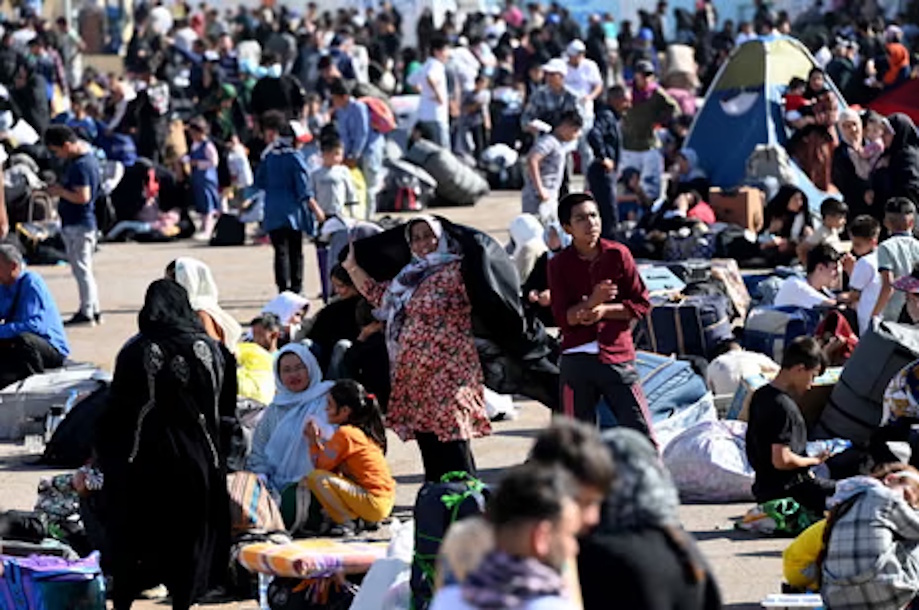
(DawatMedia24)-Hundreds of Afghan migrants holding legal documents are voluntarily returning home from Iran each day through the Islam Qala crossing in western Herat province. Returnees and border officials report that this wave of returns is a direct consequence of escalating tensions between Iran and Israel, which have created a climate of fear and insecurity.
While the daily number of Afghans forcibly deported from Iran remains steady, officials at the border crossing have noted a significant increase in those choosing to leave of their own accord. These individuals, who possess passports or valid residency permits, cite worsening security conditions and the loss of work opportunities as their primary motivations for leaving.
According to border officials, between 2,500 and 3,000 Afghan migrants are still forcibly returned through Islam Qala each day—a figure largely unchanged from before the regional escalation. However, the number of Afghans returning voluntarily with proper documentation has risen sharply to between 1,300 and 1,500 per day, an increase of roughly 200-300 from previous weeks.
“Security Concerns Forced Us to Leave”: Returnees Share Their Stories
Many returnees describe a difficult decision to abandon their livelihoods in Iran in favor of safety in Afghanistan, a country grappling with its own deep humanitarian and economic crises.
Hafizullah, a 20-year-old from eastern Kunar province, had travelled to Iran for work after his father passed away, becoming the sole provider for his 11-member family. Despite holding legal documents, the recent hostilities made him fear for his life.
“I worked in Iran for more than a year, but after the Israeli attacks intensified, the lives of migrants were at risk. I had to leave Iran to save my life,” he explained, adding that he was forced to return to Afghanistan empty-handed, leaving his job and income behind.
Ali Mousavi, a returnee originally from Herat province, shared a similar story. He had been working at a restaurant in Tehran for about a year and held a valid passport. However, the escalating conflict made him rethink his future.
“I had to return to my homeland to protect my life,” Mousavi said. He noted that while his monthly income ranged between 15 and 20 million tomans, soaring living costs in Iran made it increasingly difficult to cover even basic expenses, further compounding his decision to leave.
Returnee Complains of Mistreatment in Iran
Beyond the fear of regional conflict, some returnees also cited long-standing issues with how Afghan migrants are treated by Iranian authorities.
Naqibullah, who travelled to Iran from southeastern Khost province to escape poverty and unemployment, is responsible for supporting a 13-member family. He recounted harsh treatment at the hands of Iranian police.
He alleged that officers demanded extra payments from migrants and subjected them to violence while in detention camps. His account highlights the precarious situation many Afghans face, even those who entered Iran through unofficial channels or overstayed their visas.
Border Officials Prepared for Potential Influx
Afghan border officials at Islam Qala say they are prepared for the situation, even as the numbers of voluntary returnees climb.
Jan Mohammad Noor, head of border affairs at the crossing, confirmed that forcible deportations remain consistent at 2,500 to 3,000 per day. However, he added that port officials are on high alert and ready to assist all returnees. “If necessary, we have the capacity to manage up to 50,000 arrivals daily in an emergency,” Noor stated, indicating a preparedness for a potential mass exodus should the conflict widen.
Abdul Wahab Kamran, deputy commissioner at Islam Qala, provided the specific data on the voluntary returns, confirming the uptick from 1,300 to 1,500 per day and attributing it directly to the heightened tensions in the region.
UNICEF Warns of Rising Risks for Returning Afghan Children
The humanitarian impact of the returns is a growing concern, particularly for the most vulnerable. UNICEF in Afghanistan has issued a stark warning about the dangers facing children arriving from Iran amid the ongoing conflict.
Tajudeen Oyewale, UNICEF’s representative in Afghanistan, stated on Tuesday that the hostilities in the region are creating immediate and serious dangers for children crossing the border. “The fighting in Iran has created immediate dangers for children crossing the border,” he said in a statement.
According to the agency, many families are returning to Afghanistan unexpectedly, arriving with no clear plans or financial resources. They face a deeply uncertain future in a country where basic services are already stretched to their limits.
Oyewale described the harrowing journeys of many returnees, noting that families often arrive “confused and urgently seeking basic information and support.” He warned that as the number of returnees grows, so too will the risks for children, particularly those in dire need of healthcare and humanitarian assistance.
In 2025 alone, nearly three million Afghan migrants were returned from neighboring countries, with an estimated 60 percent being families with children. During the peak of returns last year, UNICEF supported more than 8,000 unaccompanied or separated children arriving from Iran and Pakistan.
The organization stressed that the challenges do not end at the border. Returning families often settle in communities where healthcare, education, and shelter are already under severe pressure, potentially exacerbating Afghanistan’s ongoing humanitarian crisis.
Our Pashto-Dari Website


Support Dawat Media Center
If there were ever a time to join us, it is now. Every contribution, however big or small, powers our journalism and sustains our future. Support the Dawat Media Center from as little as $/€10 – it only takes a minute. If you can, please consider supporting us with a regular amount each month. Thank you
DNB Bank AC # 0530 2294668
Account for international payments: NO15 0530 2294 668
Vipps: #557320

Comments are closed.