

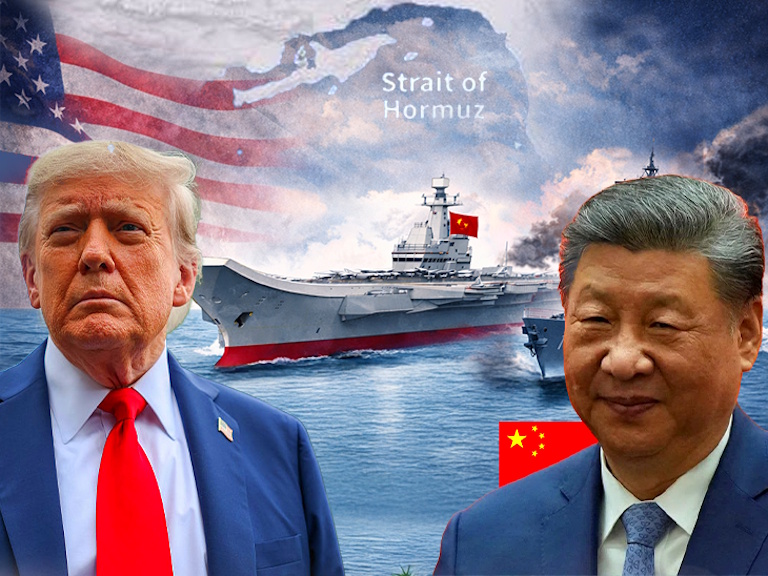
A growing body of analysis, across policy circles, energy economists, and strategic commentators, points to a conclusion many still resist: if the United States successfully concludes the Iran war and consolidates control over the Strait of Hormuz, it does not just win a regional conflict,it scores a decisive victory in great-power competition with China.
This is not incidental. It is structural.
- The Strait of Hormuz Is the Center of Gravity of China’s Vulnerability
The modern Chinese economy runs on imported energy, and that dependency is geographically concentrated in one chokepoint.
- Roughly half of China’s oil imports are tied to flows through the Strait of Hormuz or Iran/Venezuela supply chains
- More than 80% of oil and LNG passing through Hormuz goes to Asian markets, disproportionately affecting China and its peers
- The strait itself carries about one-fifth of global oil trade
This is not just an economic statistic, it is a strategic dependency. China’s industrial base, military logistics, and export system all rely on uninterrupted Gulf energy flows.
The Iran war has exposed the fragility of that system. With shipping disrupted and prices spiking, China faces immediate systemic pressure when Hormuz is contested .
- The U.S. Strategy Is Not About Iran, It Is About Controlling China’s Energy Lifeline
Several analyses converge on a key insight: the operational target may be Iran, but the strategic target is China.
- U.S. actions aim at “controlling energy exports through the Strait of Hormuz” and limiting cheap Iranian oil to China
- The blockade directly threatens China’s access to discounted Iranian crude and regional influence
This reframes the entire conflict. Iran is not the endpoint, it is the lever.
If Washington can:
- Degrade Iran’s military capacity
- Enforce maritime control over Hormuz
- Reshape post-war energy flows
Then it gains coercive leverage over the world’s largest energy importer—China.
- Energy Warfare Is the New Containment Strategy
Unlike Cold War containment, this is not about territorial alliances, it is about supply chain dominance.
The emerging strategy has three pillars:
(a) Chokepoint Control
The Hormuz blockade demonstrates that the U.S. Navy can interrupt or regulate global energy transit at will.
(b) Energy Substitution
The U.S. is simultaneously rising as a more secure and dominant energy supplier, reducing global reliance on unstable regions
(c) Strategic Coupling
Washington is tying Middle East stability directly to U.S.-China relations, forcing Beijing to engage on American terms
This is classic grand strategy: not direct confrontation, but manipulation of the opponent’s structural dependencies.
- China’s Strategic Dilemma: Power Without Access
China’s response has been cautious, and revealing.
- Beijing has called for stability and protection of shipping, not confrontation
- It is being forced to balance energy dependence against its doctrine of non-interference
This exposes a fundamental weakness:
China is a global power that cannot secure its own energy routes without risking escalation with the United States.
Even increased naval presence or diplomatic pressure cannot solve this. The geography is fixed. The U.S. Navy dominates blue-water control.
- If the U.S. Wins in Iran, It Reshapes the Global Order
A successful conclusion to the war, defined not just by ceasefire, but by sustained control over Hormuz and Iranian capacity, would produce cascading effects:
Strategic Outcomes
- China’s energy vulnerability becomes permanent leverage
- U.S. dominance shifts from military primacy to systemic control
- Allies in Asia (Japan, India, South Korea) move closer to U.S. security guarantees
Economic Outcomes
- Global capital shifts toward U.S.-controlled or protected energy systems
- China’s growth model faces structural constraints due to energy insecurity
Geopolitical Outcomes
- The Middle East becomes less a battlefield and more a strategic platform in U.S.-China rivalry
- Beijing is forced into a reactive posture globally
- The Critical Caveat: Success Requires Completion
This strategy only works if the U.S. finishes the war decisively.
Analysts warn that failure would come not from battlefield defeat, but from premature termination under economic pressure .
If the U.S.:
- Lifts pressure too early
- Allows Iran to reconstitute capacity
- Fails to institutionalize control of energy flows
Then the strategic advantage evaporates.
Conclusion: A Regional War with Global Consequences
What appears to be a Middle Eastern conflict is, in reality, a pivot point in 21st-century geopolitics.
- Iran is the battlefield
- Hormuz is the mechanism
- China is the real strategic target
If the United States successfully concludes the war and locks in control over the energy architecture of the Gulf, it achieves something far more significant than regime deterrence:
It gains enduring leverage over the single greatest rival to its global primacy.
That is not a tactical win.
That is grand strategy realized.
Our Pashto-Dari Website

Support Dawat Media Center
If there were ever a time to join us, it is now. Every contribution, however big or small, powers our journalism and sustains our future. Support the Dawat Media Center from as little as $/€10 – it only takes a minute. If you can, please consider supporting us with a regular amount each month. Thank you
DNB Bank AC # 0530 2294668
Account for international payments: NO15 0530 2294 668
Vipps: #557320

Comments are closed.