

A growing diplomatic dispute has erupted between Italy and the United States after US President Donald Trump launched a series of public attacks against Italian Prime Minister Giorgia Meloni, prompting sharp rebukes from Rome and the cancellation of a planned high-level diplomatic visit to Washington.
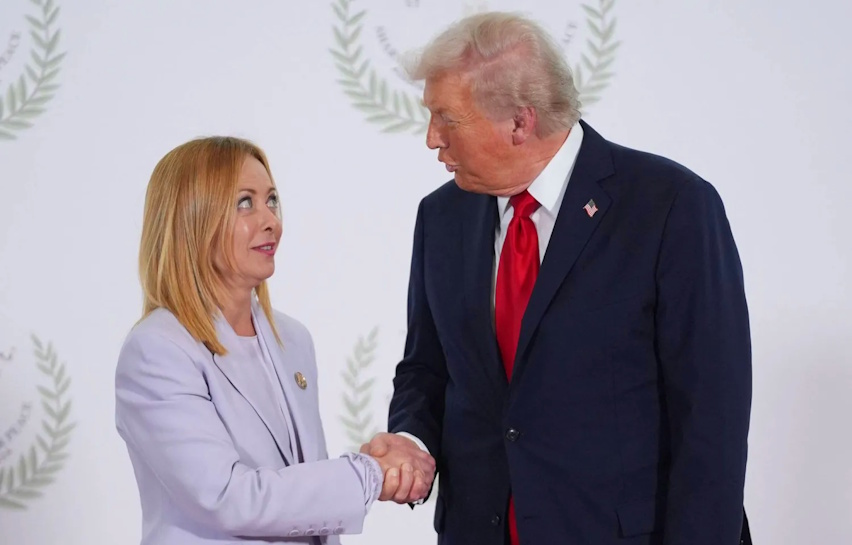
The controversy began following the recent G7 Summit in France, where Trump claimed that Meloni had repeatedly requested a photograph with him and suggested that her political standing in Italy was declining.
Writing on his Truth Social platform while spending the weekend at Camp David, Trump alleged that Meloni had asked “over and over” for a picture during the summit and claimed that she was “doing poorly in Italy with her level of popularity.”
Trump also criticized Meloni for refusing to support American efforts aimed at preventing Iran from obtaining or developing a nuclear weapon. He further accused her government of creating “a great logistical inconvenience” by denying the United States access to Italian military facilities for operations related to Iran.
In response, Meloni strongly rejected the allegations, describing Trump’s remarks as “constant, unprovoked attacks” and calling them “senseless.”
“These constant, unprovoked attacks are senseless,” Meloni wrote on Instagram. “As for my popularity, being your friend has certainly not helped it, nor does it depend on my relationship with you. My popularity is none of your concern. I suggest you focus on yours.”
The Italian prime minister also defended her government’s position regarding military bases, emphasizing that Italy’s agreements concerning the use of its facilities are governed by established international arrangements.
“The use of Italian bases is governed by agreements that we have always respected and that cannot be violated as long as I am prime minister,” she said.
Dispute Over G7 Photo Claim
The tensions escalated after Trump reportedly told Italian television channel La7 that Meloni had “begged” him for a photograph during the G7 summit.
According to the interview, Trump said:
“She’s probably happy that I spoke to her. I didn’t have to speak to her. She begged me for a picture. She wanted a picture with me so badly that, if I hadn’t felt sorry for her, I wouldn’t have done it.”
Meloni responded in a video message posted on Instagram under the title “Italy and I Never Beg.” She dismissed the claims as entirely false and expressed shock at the manner in which the US president was treating one of Washington’s closest European allies.
“I am frankly stunned,” she said. “I do not know why the President of the United States behaves this way toward allies. But there is one thing he must remember: neither I nor Italy ever beg.”
Photographs from the G7 summit showed Trump and Meloni engaged in what appeared to be cordial discussions, and Meloni initially told reporters that there had been “no recriminations” and that their relationship remained unchanged. However, Trump’s subsequent comments reignited tensions and transformed a private disagreement into a public diplomatic confrontation.
Italy Cancels US Visit
The dispute soon spilled into official diplomatic channels.
Italian Foreign Minister Antonio Tajani announced the cancellation of his scheduled visit to the United States, which had been planned for June 21–22.
In a statement posted on X, Tajani condemned Trump’s remarks, saying:
“President Trump’s serious and offensive remarks towards Prime Minister Giorgia Meloni are an insult to all of Italy. For this reason, I have decided to cancel my visit to the United States.”
The cancellation marks a significant escalation in the dispute and reflects growing frustration within the Italian government over Trump’s repeated public criticisms.
Wider Political Fallout
Meloni has received support from across Italy’s political spectrum, with both government allies and opposition figures criticizing Trump’s comments as disrespectful and unnecessary.
The latest clash also highlights a widening rift between Rome and Washington over foreign policy issues, particularly following Trump’s military actions involving Iran earlier this year.
Although Meloni and Trump have often been viewed as ideological allies and maintained a close political relationship in the past, recent months have exposed growing differences between the two leaders.
Meloni was notably the only European leader to attend Trump’s inauguration in January 2025, a gesture widely interpreted as evidence of their strong ties. However, the current dispute has raised questions about the future of that relationship.
The confrontation follows another disagreement earlier this year when Trump criticized Pope Leo XIV, describing him as “weak on crime” and “terrible for foreign policy.” Meloni responded at the time by calling the remarks “unacceptable.”
As the exchange of accusations continues, analysts warn that the dispute risks damaging relations between two long-standing NATO allies at a time of heightened international tensions and ongoing instability in the Middle East.
For now, neither side appears willing to back down, leaving one of the most important transatlantic relationships facing an unexpected and highly public test.
Our Pashto-Dari Website

Support Dawat Media Center
If there were ever a time to join us, it is now. Every contribution, however big or small, powers our journalism and sustains our future. Support the Dawat Media Center from as little as $/€10 – it only takes a minute. If you can, please consider supporting us with a regular amount each month. Thank you
DNB Bank AC # 0530 2294668
Account for international payments: NO15 0530 2294 668
Vipps: #557320

Comments are closed.