
The Earth Splits: Venezuela Reels from Devastating Twin Quakes, Declares State of Emergency

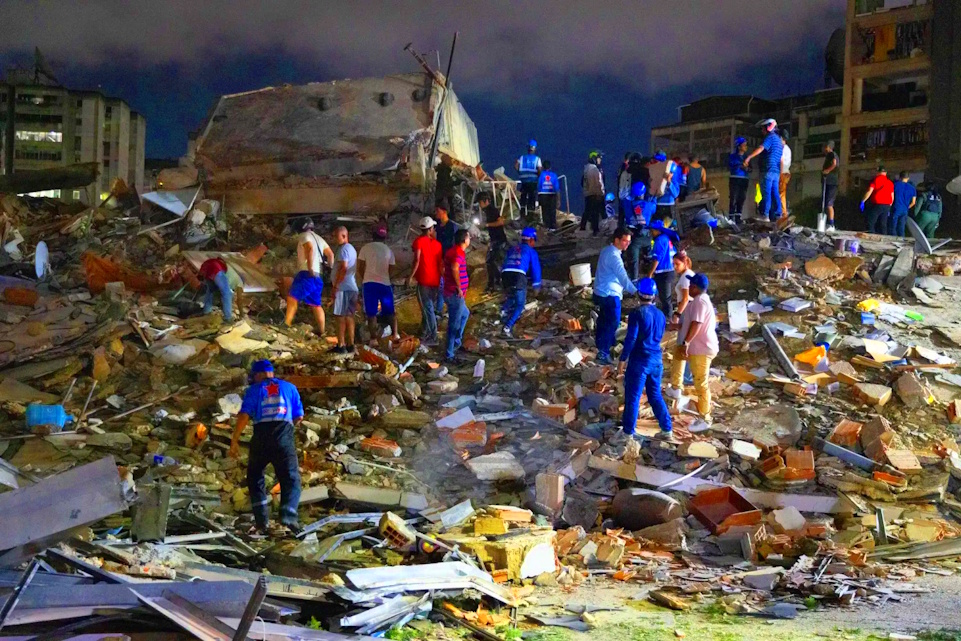
Caracas, Venezuela – Venezuela declared a nationwide state of emergency on Wednesday night after two colossal earthquakes, occurring within just 39 seconds of each other, turned the capital into a landscape of dust and rubble, forced the closure of the country’s primary international airport, and plunged a nation already burdened by crisis into a desperate fight for survival.
Interim leader Delcy Rodriguez confirmed the closure of Maiquetia International Airport near Caracas due to “serious damage” to its infrastructure, grounding flights and cutting a vital link to the outside world. As rescue teams scrambled to reach trapped survivors, the death toll was confirmed at 32, though authorities and international geologists warned that the number was almost certain to skyrocket. The United States Geological Survey (USGS) estimated a 44% probability that the final death toll could exceed 10,000, painting a grim picture of the hours and days ahead.
The “Doublet” That Shook a Nation
According to the USGS, the first violent tremor a magnitude 7.2 struck at 22:04 GMT, its epicenter located 21 kilometers (13 miles) west of the coastal town of Moron. Before the shaking from the initial blast had even subsided, a more powerful magnitude 7.5 earthquake hit roughly 45 kilometers away. The USGS described the event as a “doublet,” a rare and particularly devastating phenomenon where a major foreshock is immediately followed by an even larger mainshock.
The tremors, which struck at depths of 22 kilometers and 10 kilometers respectively, violently awakened the capital. In the upscale Altamira neighborhood, an AFP journalist witnessed the complete destruction of a 22-story building, reduced to a pile of twisted steel and concrete. Volunteers scrambled over the unstable debris, crying out for flashlights as they dug with their bare hands, while anguished relatives screamed the names of the missing into the night.
“It was unbelievable. The stairs came away, the whole wall cracked. Things fell from the ceiling. It was horrible,” recounted 54-year-old bank employee Odalis Escalona, who fled her home in terror.
“We Hugged Each Other and Ran”: Human Stories from the Rubble
For 38-year-old engineer Jesus Alejandro Pina, the quake was a terrifying lesson in structural physics. He was on the top floor of a seven-story building when the shaking began. “Glasses were breaking, pictures were falling, the television too. Everything was falling. Even the columns and beams were making noise,” he told Al Jazeera. “As an engineer, I know the movement helps absorb energy. But if it lasts too long, it reaches a breaking point. That’s when collapses happen.”
Across the city in El Paraiso, 25-year-old Luis Alejandro Ruiz Garcia’s phone buzzed with a Google earthquake alert just moments before the violent shaking threw his apartment into chaos. “My mother and my sister got up from their beds in fear,” he said. “We hugged each other and, as soon as we could, managed to get out of my building as quickly as possible.” Outside, the air was thick with orange dust. A residential building three blocks away had pancaked into the ground. “It looked like one of those images from a country at war,” he added, describing streets filled with people screaming for help.
A City in Shock and a Government on Edge
Interior Minister Diosdado Cabello confirmed that while the full extent of fatalities was still unknown, injuries were widespread and several buildings had collapsed. As a precaution, gas supplies were cut to several damaged structures to prevent secondary explosions. “We have some damaged structures and we don’t want any kind of accident involving gas to occur,” he said.
The psychological toll was immense. Thousands of residents remained huddled in parks and plazas well past midnight, too terrified to return to their homes amid a relentless series of 20 aftershocks that rattled the region. Carmen Guedez, 69, was trapped on an upper floor with her bedridden sister when the jolt hit. “It kept getting stronger,” she said. “We couldn’t get out. The neighbors are still out on the street.” In shopping centers, screams of panic erupted as shoppers fled through emergency stairwells.
The hardest-hit states included Trujillo, Carabobo, Miranda, and La Guaira, where communication lines were severed, leaving families in a torturous limbo, unable to contact loved ones.
A Global Response and Regional Fears
The shockwaves were felt far beyond Venezuela’s borders, triggering alarm sirens in the Colombian capital of Bogota and prompting evacuations. Freddy Tovar, coordinator of Colombia’s National Seismological Network, warned that “some aftershocks may occur, which could also be widely felt across Colombian territory.” However, both Colombian authorities and the US National Tsunami Warning Center were quick to rule out any threat of a tsunami.
Shortly after the Venezuelan catastrophe, a separate magnitude 7.2 tremor hit northern Japan, though no casualties or material damage were immediately reported there.
U.S. Offers Aid Amid Devastating Reports
Late Wednesday, U.S. President Donald Trump offered immediate support, posting on his Truth Social platform: “The two major earthquakes that just hit the great people of Venezuela are both massive in scale and have left a devastating number of deaths.” Despite his initial phrasing regarding the death toll which was later clarified as an expression of concern rather than a confirmed figure the President stated, “The U.S.A. stands ready, willing, and able to help! I have instructed all agencies of our government to get ready to move quickly.”
While the international community began to mobilize, on the ground in Caracas, the night was filled with the sounds of sirens and the low hum of generators. For the survivors, the trauma is far from over. The USGS has warned of a high likelihood of significant aftershocks, and for a country already grappling with economic collapse and mass emigration, this seismic disaster represents a humanitarian tragedy of unimaginable proportions. Rescue workers continue to dig through the ruins, racing against time to save those still trapped beneath the debris of a city that, in just 39 seconds, was forever changed.
Our Pashto-Dari Website

Support Dawat Media Center
If there were ever a time to join us, it is now. Every contribution, however big or small, powers our journalism and sustains our future. Support the Dawat Media Center from as little as $/€10 – it only takes a minute. If you can, please consider supporting us with a regular amount each month. Thank you
DNB Bank AC # 0530 2294668
Account for international payments: NO15 0530 2294 668
Vipps: #557320

Comments are closed.